
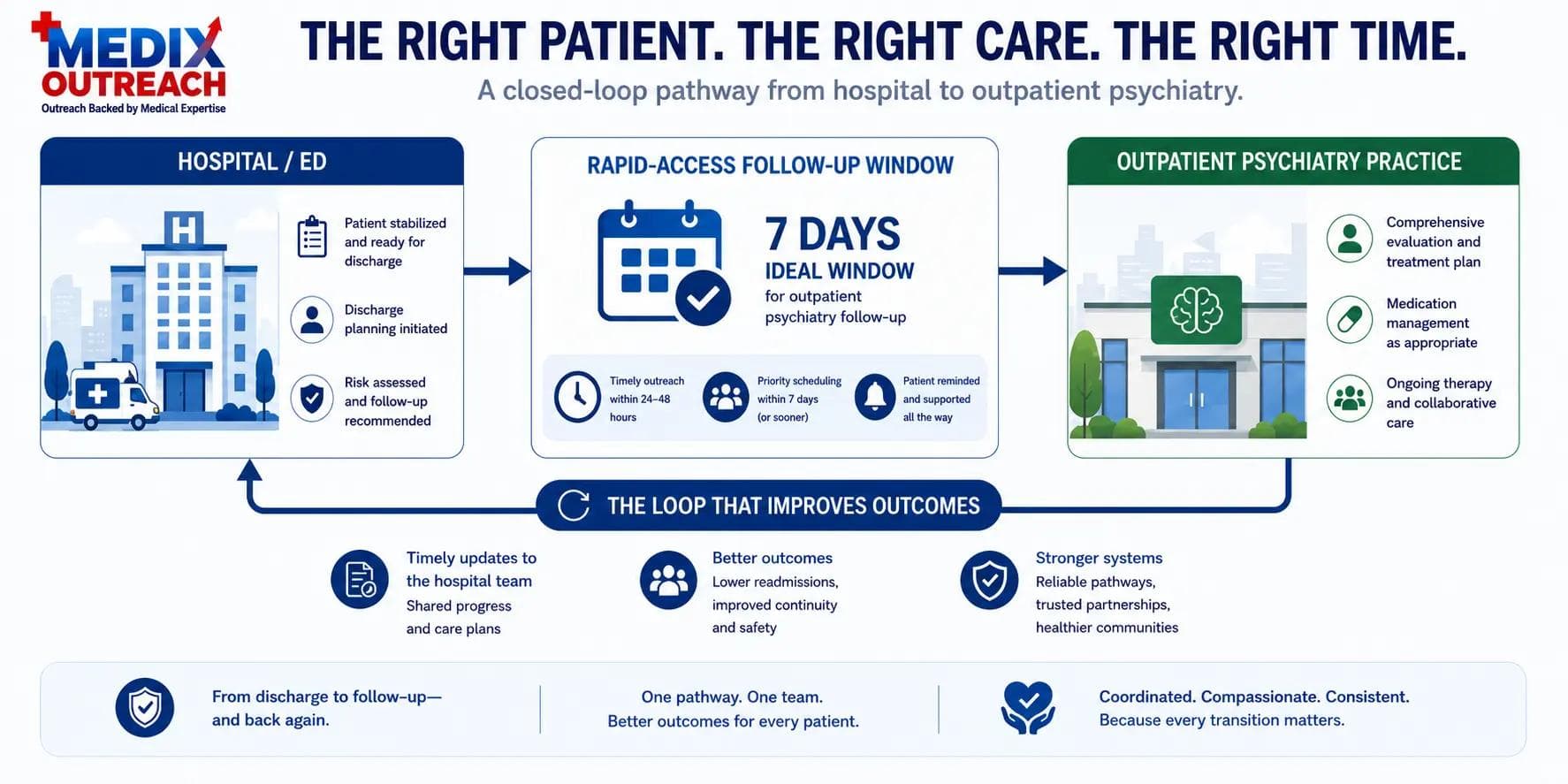
A hospital discharge or ED-to-psychiatry referral is a care-transition referral: a patient who has been in the emergency department or an inpatient setting for a behavioral health reason needs timely outpatient psychiatric follow-up, and the discharging team needs a reliable place to send them. This is the highest-stakes referral relationship a psychiatry practice can hold, because the post-discharge window is when patients are most vulnerable and most likely to fall out of care. It is also the relationship where operational readiness matters most — because a hospital partnership without the capacity to absorb its referrals is not a growth strategy, it is a liability.
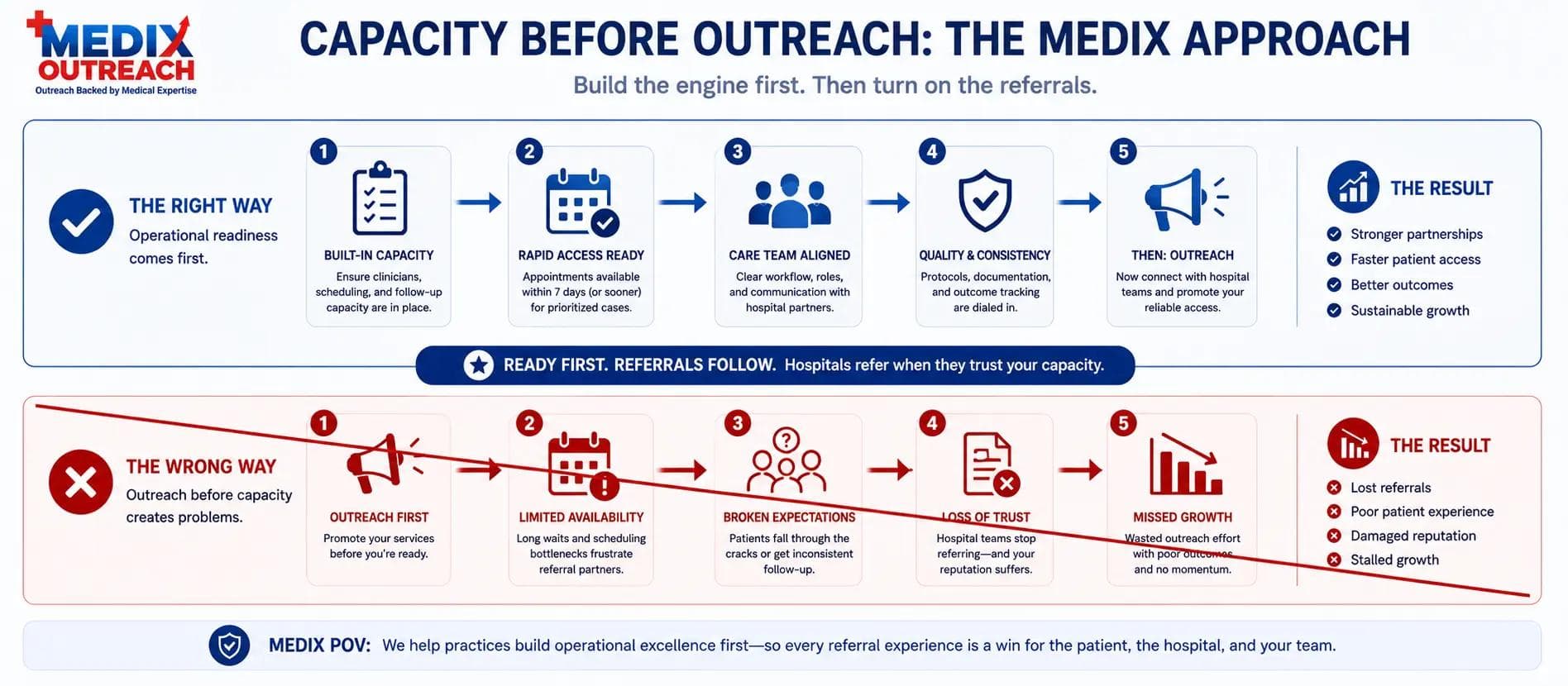
The Medix point of view here is a sequencing rule: operational readiness comes before outreach. Before a psychiatry practice courts discharge planners and ED case managers, it needs the rapid-access slots, the triage boundaries, and the loop-closure workflow to actually serve those referrals. Marketing a fast-access pathway you cannot staff damages the exact relationship you were trying to build.
Who owns hospital and ED behavioral-health referrals?
Discharge referrals do not come from a physician the way a PCP referral does. They come from a transition team:
- Discharge planners - A dependable follow-up slot inside the discharge timeline
- Case managers - Confirmation the patient was scheduled — and flagged if not
- Social workers - A low-barrier path the patient can actually complete
- ED / inpatient teams - Assurance the handoff will not fail during the vulnerable window
Because the referral involves a transition of care, it lives squarely in the interoperability and care-coordination space. ONC's standards for supporting a transition of care or referral describe how discharge summaries and referral information should move to the receiving provider — the technical backbone of a discharge follow-up pathway.
Why is rapid access the whole game here?
Post-discharge follow-up is time-sensitive in a way routine referrals are not. The value of the pathway is measured in how quickly the patient is seen after leaving the hospital, because the risk of disengagement and readmission concentrates in that early window. That makes patient access, capacity, and eligibility the load-bearing elements:
- Patient access — a rapid-access slot reserved for discharge referrals, not the back of the routine queue.
- Capacity — enough of those slots to actually meet the volume you accept.
- Eligibility — a fast way to confirm coverage so it does not become the bottleneck.
Rapid-access pathways and their honest limits
A rapid-access pathway is a defined, faster route for discharge referrals: reserved slots, a named contact for the hospital team, and expedited eligibility. But here is the compliance-adjacent honesty this topic requires — do not promise a same-day or same-week standard, or any specific follow-up timeframe, unless the practice can actually deliver it. A promised standard the practice misses is worse than an honest one it keeps. Define the pathway around real, sustainable capacity, and let outreach describe only what operations can support.
Mid-article CTA
Need help building your healthcare growth engine?
Medix helps healthcare startups, clinics, pharma companies, and provider-focused platforms build scalable commercial pipelines.
Book a Strategy CallClinical triage boundaries
Discharge referrals can arrive at a range of acuities, so the same discipline from clinical triage for psychiatry referrals applies: a clinician decides whether the patient is appropriate for routine outpatient follow-up, needs an urgent pathway, or requires a higher level of care than the practice offers. Outpatient psychiatry is one level in a continuum that includes intensive outpatient and partial hospitalization; a discharge patient who needs a step-down level should be routed accordingly, not simply booked because a slot exists. Triage stays clinician-owned; intake staff escalate, they do not assess.
Closing the loop with the discharging team
The discharge relationship lives or dies on loop closure. The hospital team needs to know the patient was contacted and scheduled — or was unreachable, so they can intervene before the patient is lost. This is closed-loop referral communication at its most consequential: an unclosed loop after a discharge is not just a lost referral, it is a patient who left the hospital and may have disappeared from care. Communicating back to the discharging team is the entire point of the pathway.
How to build the relationship — in the right order
- Build capacity first. Reserve rapid-access slots and staff them before any outreach.
- Define triage boundaries and the escalation path for higher-acuity discharge referrals.
- Stand up loop closure to the discharging team as a default, not an exception.
- Then approach the transition teams — discharge planners, case managers, social workers — with a pathway you can prove works.
- Measure time-to-follow-up and loop-closure rate, and report reliability back to the hospital.
Done in that order, a discharge pathway becomes one of the most valuable and durable relationships in a psychiatry referral network. Done in the wrong order — outreach before capacity — it burns the relationship on the first missed handoff.
Frequently asked questions
What is a hospital discharge psychiatry referral?
A care-transition referral in which a patient discharged from an ED or inpatient setting for a behavioral health reason is referred to an outpatient psychiatry practice for timely follow-up, coordinated with the discharging team.
Why does rapid access matter for discharge referrals?
The post-discharge window is when patients are most vulnerable to disengaging from care and being readmitted, so the pathway's value depends on how quickly the patient is seen after leaving the hospital.
Should a practice promise same-day or same-week follow-up?
Only if it can actually deliver it. Promising a follow-up standard the practice cannot sustain damages the hospital relationship — define the pathway around real capacity.