
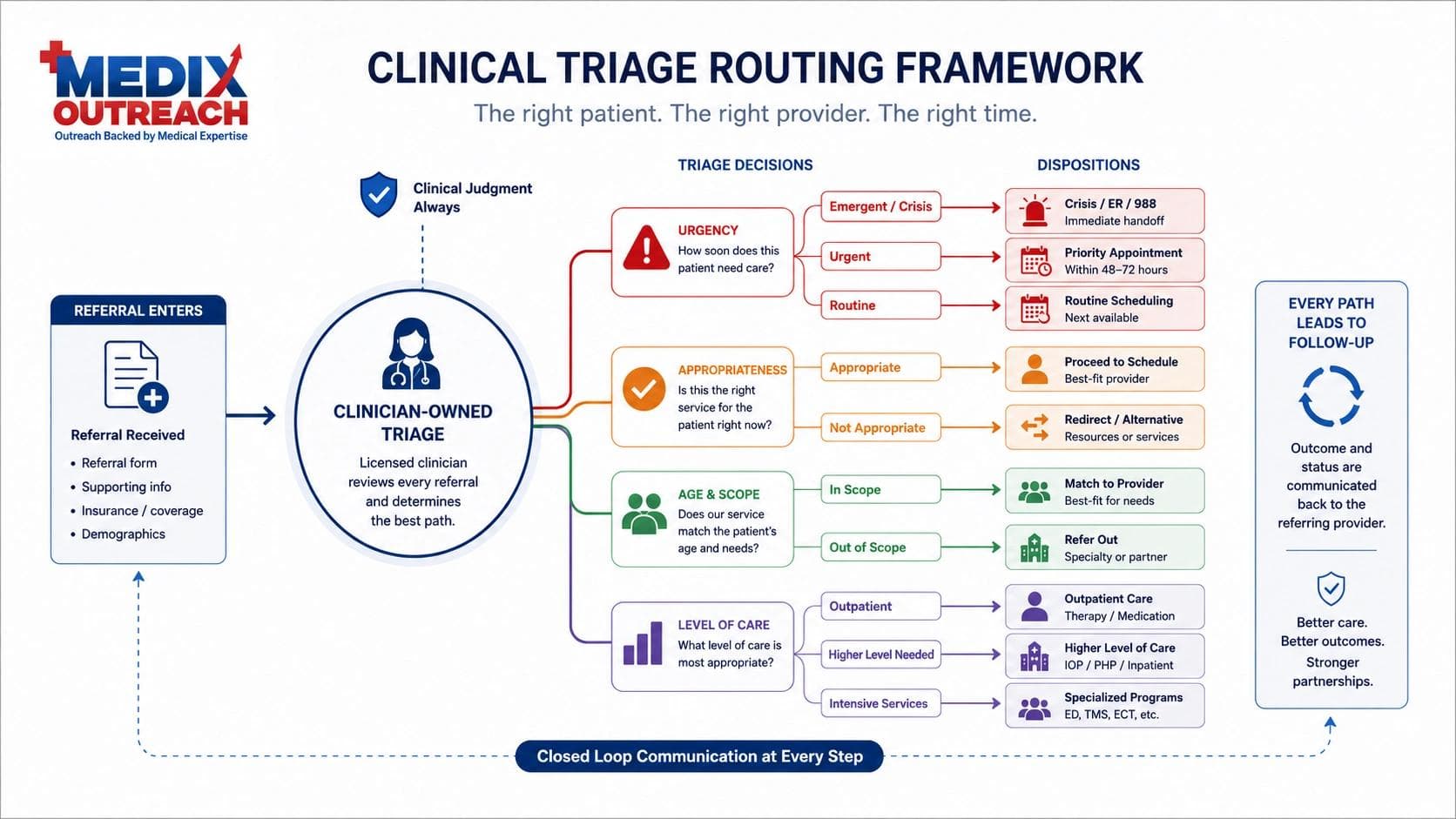
Clinical triage for psychiatry referrals is the clinician-owned process of reviewing each incoming referral and routing the patient by urgency, clinical appropriateness, and the level of care they need. It is distinct from administrative intake — the scheduling and eligibility work that gets a patient into the system. Administrative staff move the referral; a clinician decides what happens to the patient. Keeping that line bright is not optional. It is the difference between a safe, defensible referral operation and one that quietly lets non-clinicians make clinical calls.
This article is operational, not clinical: it describes how a psychiatry practice can structure triage so referrals are routed correctly, referrers get a clear disposition back, and no patient is mis-sorted. It does not provide diagnosis, treatment, or crisis-management instructions — those are clinical decisions made by licensed clinicians at the point of care.
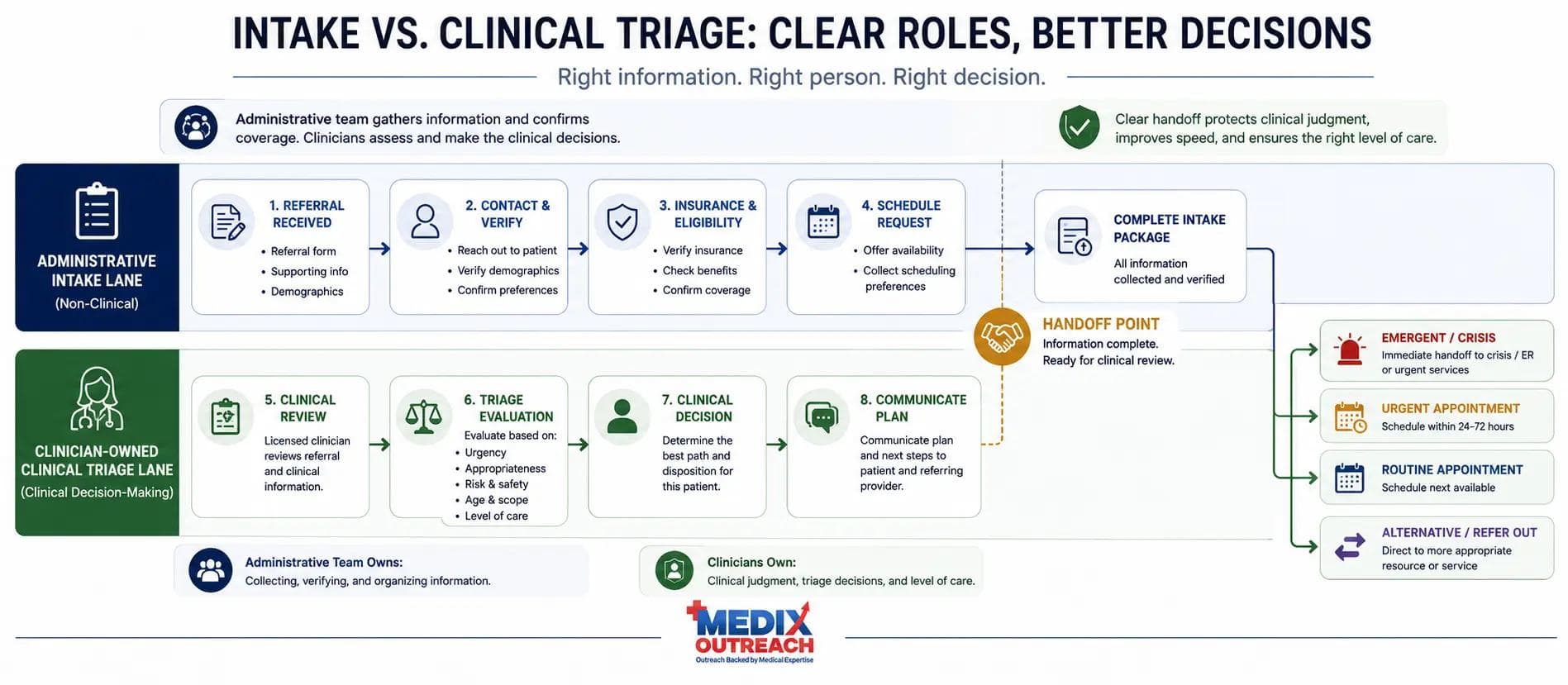
Administrative intake vs clinical triage: who owns what?
The two functions run in sequence and must never be blurred:
- Owned by intake/administrative staff - Owned by a licensed clinician
- Captures demographics, insurance, referral source - Reviews the clinical reason, urgency, and safety flags
- Verifies eligibility, confirms receipt - Decides appropriateness, level of care, and routing
- Schedules per the clinical disposition - Sets the disposition the schedule follows
The Medix rule is unambiguous: clinical triage is clinician-owned. Administrative and business-development staff never make clinical triage decisions — they surface the referral, capture the inputs, and execute the schedule the clinician sets. A marketing or intake team that "decides" a case is routine or urgent has crossed a line that no referral-growth strategy is worth crossing.
What does clinical triage actually evaluate?
A clinician triaging a psychiatry referral is answering a short set of questions:
- Urgency — routine vs urgent, based on the referral's safety flags and clinical reason.
- Appropriateness — is this a referral the practice can clinically serve?
- Age eligibility — does the patient fall within the practice's scope (for example, adult-only vs child/adolescent)?
- Practice scope — is the presenting need within what the practice treats?
- Level of care — does the patient need routine outpatient psychiatry, or a higher level of care the practice does not provide?
The referral form feeds this, which is why the reason-for-referral field on the psychiatry referral form matters so much — it is the primary input to a clinician's triage decision.
Mid-article CTA
Need help building your healthcare growth engine?
Medix helps healthcare startups, clinics, pharma companies, and provider-focused platforms build scalable commercial pipelines.
Book a Strategy CallRouting: routine, urgent, and out-of-scope referrals
Triage produces one of a small number of dispositions, each with an owner and a next action:
- Routine outpatient - Schedule into a standard new-patient slot
- Urgent (clinician-flagged) - Route to a rapid-access slot per the practice's urgent pathway
- Out of scope (age/condition/level of care) - Redirect appropriately and tell the referrer where the patient was routed
- Needs higher level of care - Escalate per clinical governance; do not hold in outpatient
Medicare's outpatient mental health framework recognizes that outpatient psychiatry is one level in a continuum — alongside intensive outpatient and partial hospitalization programs — which is why a triage clinician needs "needs a higher level of care" as a real, routable disposition rather than an afterthought.
Escalation governance
Every triage operation needs a written escalation path: what an intake staffer does the moment a referral surfaces an acute safety concern, and how fast a clinician is brought in. The point of governance is speed and clarity — the non-clinician's job is to escalate immediately to a clinician, not to assess. This is an operational safeguard, not clinical advice; the clinical response itself is always the clinician's to make.
Communicating the disposition back to referring providers
Triage is not complete until the referring provider knows what happened. A referring clinician who sent an urgent case needs to know it was received and routed; one whose referral was out of scope needs to know where the patient went, so they can act. Reporting the disposition back is part of the closed-loop referral workflow and, for hospital and ED sources, the foundation of the fast-access follow-up pathway. Silence after a triage decision is as damaging as silence after a visit.
Operational triage metrics
Triage quality is measurable without touching clinical outcomes:
- Time-to-triage — how fast a referral gets a clinician's disposition.
- Urgent-pathway response time — how fast flagged cases are routed.
- Out-of-scope rate — a high rate signals unclear scope communicated to referrers.
- Disposition-communicated rate — share of referrals where the referrer was told the outcome.
These metrics tell you whether triage is fast, appropriately scoped, and closing the loop — the operational health of one of the core components of a psychiatry referral network.
Frequently asked questions
What is clinical triage for psychiatry referrals?
It is the clinician-owned review of each incoming referral to route the patient by urgency, clinical appropriateness, age eligibility, practice scope, and level of care — distinct from administrative intake, which handles scheduling and eligibility.
Who should own clinical triage?
A licensed clinician. Administrative and business-development staff capture inputs and execute the schedule, but they never make the clinical triage decision.
How is triage different from administrative intake?
Administrative intake captures demographics, insurance, and referral source and confirms receipt. Clinical triage evaluates the clinical reason, urgency, and safety and decides appropriateness, level of care, and routing.