

Ambulatory surgery centers are the fastest-growing site of care in the United States - and one of the hardest B2B accounts to win. An ASC is not a small hospital. It is a lean, physician-influenced business that gets paid a single bundled facility fee per case, which means every dollar of supply, implant, or staffing cost comes straight out of its margin. Sell to an ASC the way you sell to a health system and you will lose on day one.
This playbook covers what an ASC actually is, who makes the buying decision, what surgery centers want from a vendor, where deals stall, the sales motion that works, and how to grow ASC business inside federal referral rules.
What an ASC is - and why it buys differently
An ambulatory surgery center is a Medicare-certified facility that performs same-day surgical and diagnostic procedures and sends the patient home the same day. Under Medicare, ASCs are reimbursed through a dedicated, largely bundled payment - see the CMS Ambulatory Surgical Center payment system. The facility is paid one rate for the case; most supplies and devices are packaged into that rate rather than billed separately.
That single economic fact drives everything about how an ASC buys. A hospital can often pass costs through; an ASC cannot. Many ASCs are also partly or wholly owned by the surgeons who operate in them, so the people choosing your product are frequently the same people whose distributions depend on the center's profitability. The practical implication: your pitch has to lead with case-cost impact and throughput, not features.
Who actually makes the buying decision
ASC buying committees are smaller and flatter than a hospital's, but they are specific. Map these roles before your first meeting:
- Administrator / center director - the economic buyer, accountable for case cost, margin, and throughput.
- Director of nursing / clinical director - owns clinical workflow, safety, and staff adoption.
- Materials or supply-chain manager - owns contracts, stock levels, and the group purchasing organization (GPO) relationship.
- Medical director and physician-owners - clinical decision-makers whose preference items (implants, instruments) carry real weight.
- Governing board - approves larger capital and contract commitments.
Unlike a hospital value-analysis committee that can take quarters to convene, an ASC can decide fast once the administrator and a physician champion agree - if you have given both what they need.
What surgery centers actually want from a vendor
Winning ASC pitches answer four questions directly:
- Will this lower my case cost or protect my margin? Quantify the per-case economics, including any reduction in reprocessing, waste, or opened-but-unused inventory.
- Will it speed up or slow down the room? OR turnover time is money in an ASC; anything that improves throughput is a growth lever, anything that slows it is a non-starter.
- Is it reliable? A single stockout that cancels a case is a reputational and financial event. Prove supply continuity and service responsiveness.
- Does it hold up clinically? Physician-owners will not trade outcomes for price. Bring evidence and peer references, not just a price list.
Where ASC sales cycles stall
Most ASC deals die for predictable reasons. GPO contracts can lock pricing and tiers, so a product that is not on-contract or price-competitive with the center's GPO faces an uphill battle - the same contracting dynamics covered in the guide to hospital procurement, GPOs, and IDNs. Evaluation and trial burden is another blocker: ASCs have little slack to pilot, so your eval has to be low-friction. Physician preference items create split decisions when owners disagree. And vendor-access and credentialing rules increasingly gate who can even enter the clinical area. Name and plan for each of these before they surface.
Mid-article CTA
Need help building your healthcare growth engine?
Medix helps healthcare startups, clinics, pharma companies, and provider-focused platforms build scalable commercial pipelines.
Book a Strategy CallA sales motion that wins ASC accounts
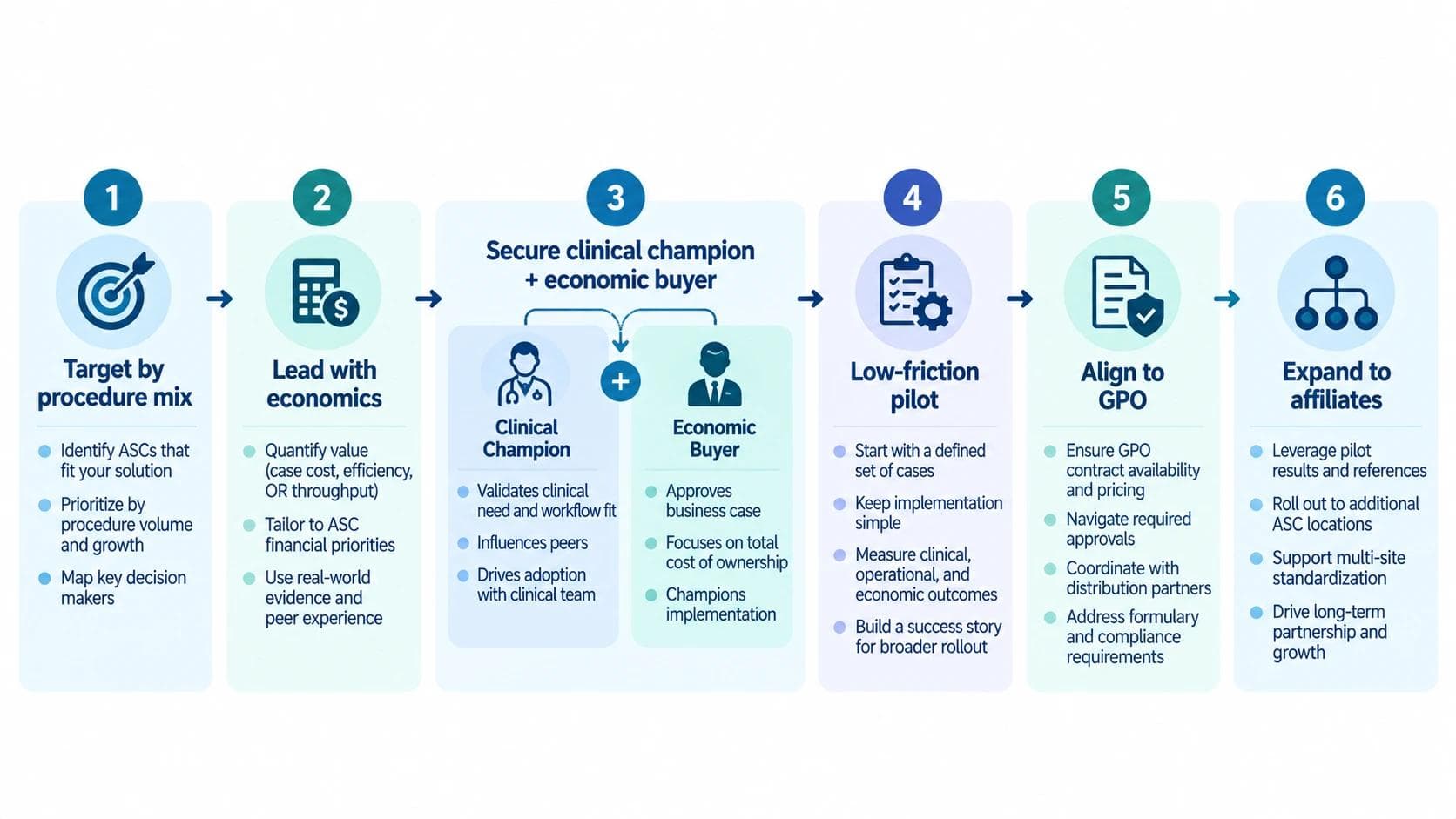
Sustainable ASC sales is a repeatable motion, not a cold-pitch lottery - the same discipline Medix applies to selling to hospitals and selling to clinics and private practices:
- Target by procedure mix. Identify ASCs whose specialty and case volume match where your product has the strongest case-cost or throughput story (orthopedics, GI/endoscopy, ophthalmology, pain, ENT).
- Lead with economics. Open with a per-case cost-and-throughput model specific to their procedures, not a capabilities deck.
- Secure two allies. You need a clinical champion (often a physician-owner) and the economic buyer (the administrator). One without the other stalls.
- Make the pilot trivial. Design a low-burden evaluation with clear success criteria the administrator pre-agrees to.
- Align to the GPO. Get on-contract or demonstrate price parity so procurement has no reason to say no.
- Expand deliberately. Use a win at one center to reach affiliated centers, management companies, and the surgeons' other sites.
Grow ASC business within Anti-Kickback and Stark rules
Because many ASCs are physician-owned and most procedures are federally reimbursed, ASC selling sits squarely inside federal fraud-and-abuse law. The Anti-Kickback Statute prohibits offering anything of value to induce referrals or purchases of federally reimbursed items - see the OIG summary of the fraud and abuse laws. The Physician Self-Referral Law (Stark) restricts referrals where a financial relationship exists - see CMS on physician self-referral. Structure pricing, consulting, and co-marketing to withstand scrutiny, compete on genuine value rather than inducements, and have counsel review any arrangement that touches physician-owners.
Measure what moves ASC revenue
- Win rate and sales-cycle length by specialty and center type (independent vs. management-company-affiliated).
- Case-cost savings delivered per account - your most portable proof point.
- GPO-contract coverage across your target ASC list.
- Expansion rate from first center to affiliated sites and surgeon networks.
Frequently asked questions
How do you sell to an ambulatory surgery center? Lead with case-cost and OR-throughput economics, map the small buying committee (administrator, clinical director, materials manager, physician-owners), secure both a clinical champion and the economic buyer, align to the center's GPO contract, and keep any physician-owner arrangements compliant with Anti-Kickback and Stark rules.
Who is the decision-maker at an ASC? Usually the administrator or center director as the economic buyer, working with a physician champion or medical director for clinical approval. Materials management owns the GPO contract, and the governing board approves larger commitments.
How is selling to an ASC different from selling to a hospital? ASCs are paid a bundled facility fee, so supply and device costs reduce margin directly; committees are leaner and faster; and physician-owners carry more influence. Economics and throughput matter more, and pure feature selling matters less.
Why do ASC deals stall? GPO contract lock or price mismatch, high evaluation burden, split physician-preference decisions, and vendor-access or credentialing requirements. Plan for each before it blocks the deal.
Becoming the vendor ASCs rely on
Ambulatory surgery centers reward sellers who respect their economics: prove case-cost and throughput impact, earn both the administrator and a physician champion, stay on-contract, and operate compliantly. Do that and a single center becomes a repeatable, expandable channel across its affiliates and surgeons.
Medix Outreach builds and runs the commercial motion that wins surgical-facility accounts for device, supply, and software companies. To open ASC accounts faster, book a free strategy call or explore our Healthcare Commercial Growth & Go-to-Market service.