

Many promising health system deals die in the same place. The clinicians love the product. The pilot goes well. Everyone nods in the room. And then the deal disappears into procurement and never comes back. The seller assumes the buyer went cold. In reality, the deal ran into the actual purchasing machinery of a hospital, which almost no outside seller understands until it has stalled a few of their deals.
Understanding the hospital procurement process is what separates companies that sell into health systems from companies that endlessly pilot inside them. Hospitals do not buy the way clinics or businesses buy. They buy through group purchasing organizations, integrated delivery network standardization, value analysis committees, and supply chain teams whose job is to control cost and risk. Each of these adds a gate, and each gate has its own logic.
This guide explains how hospitals actually buy. It covers the players, how group purchasing organizations and integrated delivery networks work, what value analysis committees want to see, how capital and operating budgets shape decisions, and how a product moves from clinical interest to a purchase order.
Clinical Approval Is Not a Purchase Order
The single most expensive misunderstanding in health system sales is believing that clinical enthusiasm equals a purchase. It does not. A physician who wants your product has influence, not authority. In a modern health system, the decision to spend money is deliberately separated from the people who use the product, precisely so that clinical preference does not drive uncontrolled spending.
This is why so many sellers get stuck. They run a great clinical process, win a champion, and assume the rest is paperwork. Then supply chain asks whether the product is on a group purchasing agreement, the value analysis committee asks for evidence the champion never mentioned, and finance asks which budget it comes from. The sale was never almost done. It had only cleared the first gate.
The fix is to run the clinical process and the procurement process in parallel, not in sequence. Our guides on how to sell to hospitals and selling to hospitals without wasting months on cold outreach cover the sales approach. This article covers the machine behind the purchase.
The Players in Hospital Procurement
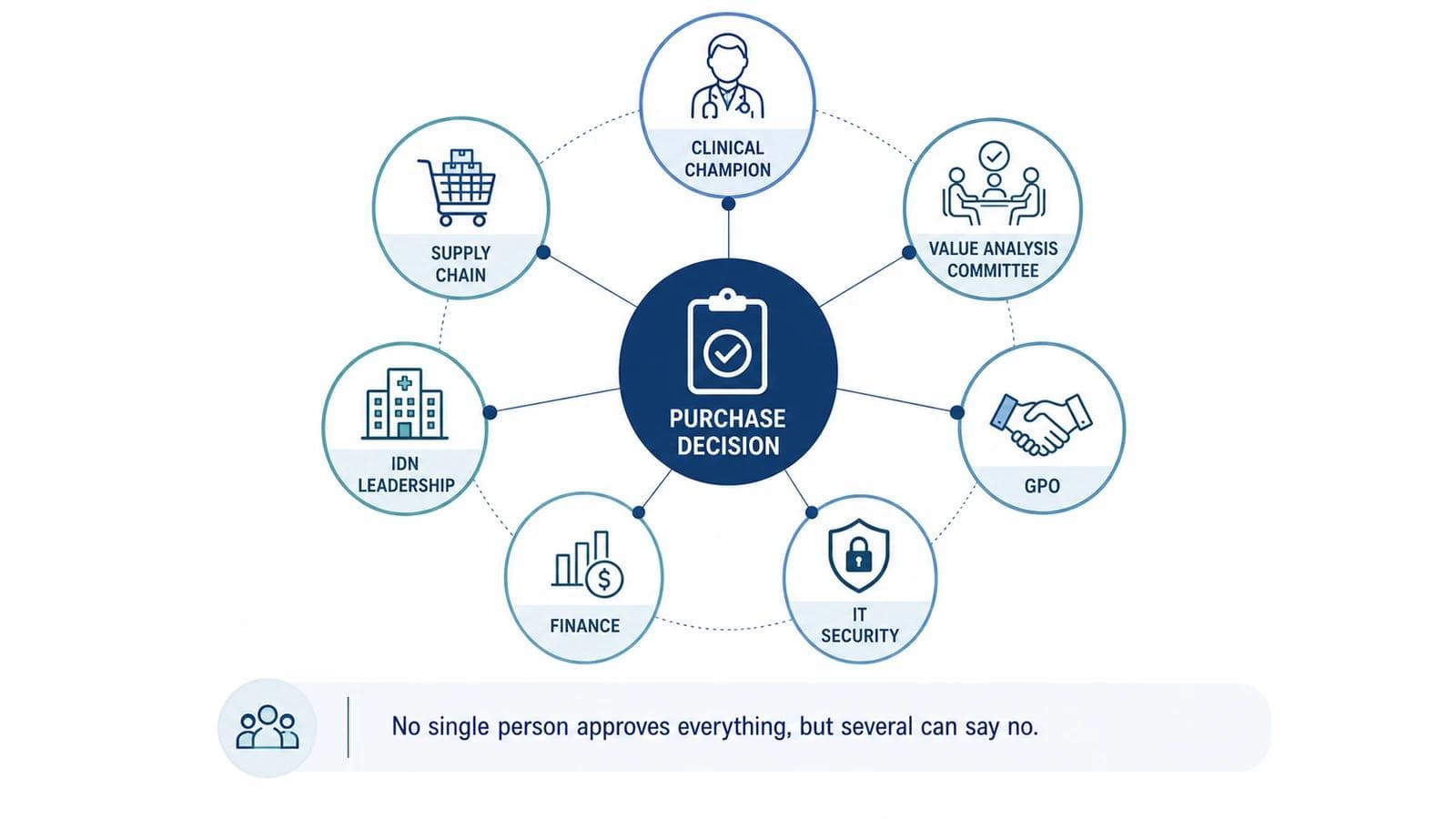
A health system purchase involves more people than any single conversation reveals. Map them early.
- The clinical champion and end users. The physicians, nurses, or staff who want the product. They create demand but rarely control budget.
- Supply chain and materials management. The team responsible for sourcing, contracts, and cost control. They ask whether a product is on contract, what it costs against alternatives, and whether it is worth adding.
- The value analysis committee. A cross functional group that reviews new products for clinical value, financial impact, and operational fit before they are approved for purchase.
- Group purchasing organization. The external contracting body that negotiates pricing on behalf of many hospitals. Much of what a hospital buys flows through GPO agreements.
- Integrated delivery network leadership. At the system level, corporate supply chain and standardization decisions increasingly override individual hospital choices.
- Finance and the C-suite. For larger purchases, especially capital, senior finance leaders control approval and timing.
- Information security and IT. For anything digital, security and integration review is its own gate.
No single person can say yes to everything, but several can say no. Your job is to understand which gate you are at and who controls the next one.
Group Purchasing Organizations: How They Work
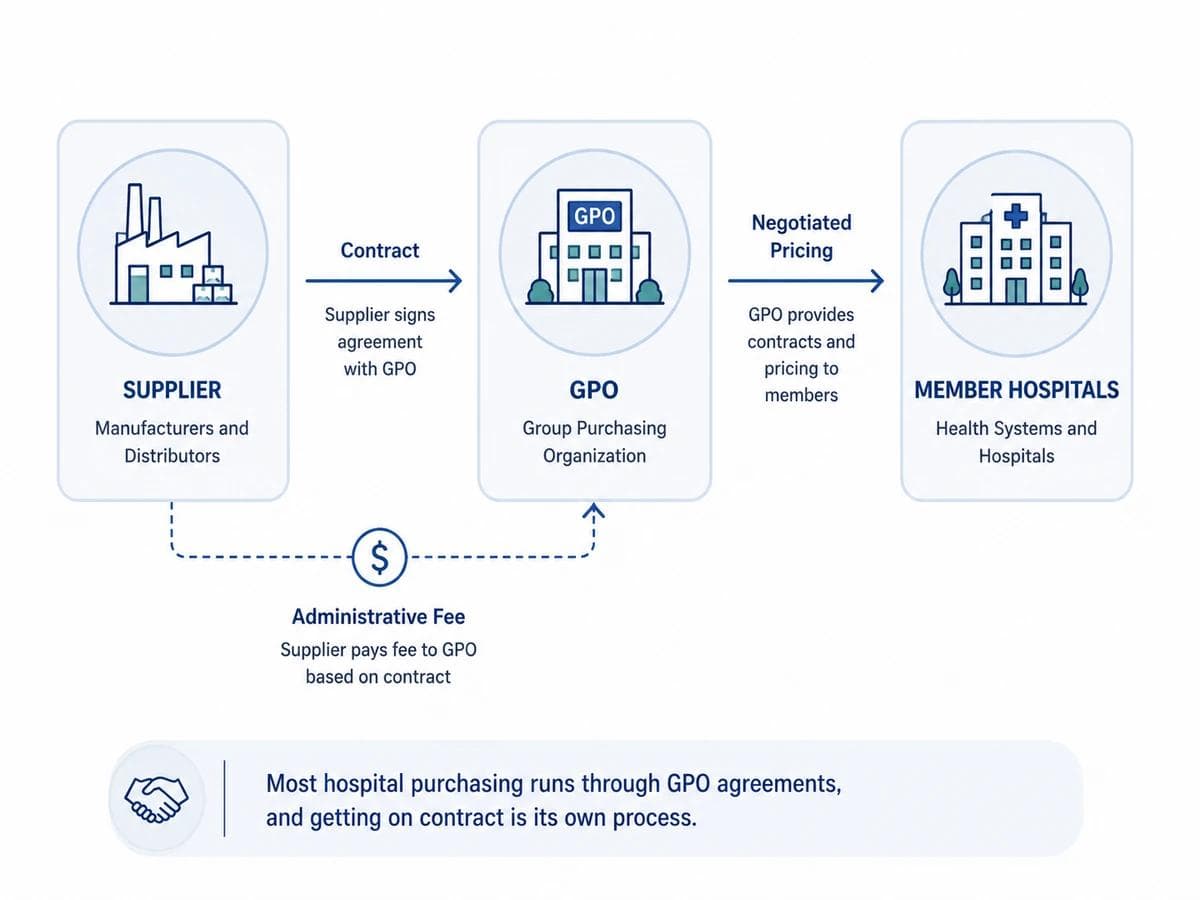
Group purchasing organizations, or GPOs, are one of the most misunderstood parts of hospital buying. A GPO aggregates the purchasing power of many hospitals to negotiate pricing and contracts with suppliers. Most hospitals belong to at least one GPO, and a large share of hospital purchasing runs through GPO agreements.
The basic structure works like this. Suppliers contract with the GPO. Member hospitals buy under those contracts at negotiated pricing. The GPO is typically funded through administrative fees paid by suppliers based on purchasing volume, an arrangement recognized under a specific safe harbor in federal law. The Department of Health and Human Services Office of Inspector General addresses these fees in its safe harbor regulations, which is why compliant GPO contracts are structured the way they are.
For a seller, the practical implications are significant:
- If your category is one hospitals buy through a GPO, being off contract can be a hard barrier. Supply chain may not be able to buy from you easily even when clinicians want to.
- Getting onto a GPO agreement is its own sales process, with its own timelines and requirements, separate from selling to any individual hospital.
- GPO contracting affects pricing expectations. Hospitals often expect the negotiated rate, which shapes how you price from the start.
If GPOs are relevant to your category, build a GPO strategy early. Discovering the requirement after a hospital wants to buy is a common and avoidable delay.
Integrated Delivery Networks and System-Level Buying
The era of the standalone hospital making independent purchasing decisions is fading. Most hospitals now belong to integrated delivery networks, or IDNs, which are systems of hospitals, clinics, and other facilities under shared ownership. As these systems consolidate, purchasing power moves upward.
That shift changes your strategy. A decision that a single hospital could once make locally is increasingly made at the system level through corporate supply chain and standardization committees. A yes from one facility may mean little if the system has standardized on a competitor, and a system-level agreement can open many facilities at once.
The lesson is to understand the ownership and standardization structure of any hospital you target. Selling one facility inside a large system without understanding the system's contracting posture often leads to a local yes that procurement cannot honor.
What the Value Analysis Committee Wants
The value analysis committee, often called the VAC, is where new products are evaluated before purchase. It exists to make sure the system spends money on things that deliver real clinical, financial, and operational value, not just on whatever clinicians request. For many product categories, especially devices and clinical technology, clearing the VAC is the decisive step.
Value analysis committees generally want three kinds of evidence:
- Clinical value. Evidence that the product improves outcomes, safety, or quality compared with current practice.
- Financial impact. A clear picture of total cost, including the effect on downstream costs like complications, length of stay, or readmissions, not just the unit price.
- Operational fit. How the product fits existing workflows, what it requires from staff, and what it takes to implement.
The teams that clear value analysis committees prepare a complete evidence package before they are asked. For devices in particular, this connects to the broader launch process covered in our medical device go-to-market strategy guide. Bring the financial and operational case with the clinical one, because a committee that has to go find the missing pieces usually tables the decision instead.
Capital Versus Operating Budgets
Where the money comes from inside a hospital determines how and when you get bought. Hospitals separate capital budgets, used for larger, longer lived purchases, from operating budgets, used for ongoing supplies and services. This distinction is not bureaucratic trivia. It controls timing and approval.
If your product is a capital purchase, it may compete against everything else the system wants to fund that cycle, from imaging equipment to facility upgrades, and it may be tied to an annual budgeting calendar. Miss the cycle and you can wait a year. If your product fits an operating budget, the path can be faster but the scrutiny on recurring cost is high.
Understand which budget your product comes from, who controls it, and what the cycle looks like. Framing your offer to fit the buyer's budget reality, rather than forcing it into the wrong category, removes a common source of delay. It also shapes how you price and package the offer, since a capital purchase and a recurring operating expense are evaluated very differently.
Mid-article CTA
Need help building your healthcare growth engine?
Medix helps healthcare startups, clinics, pharma companies, and provider-focused platforms build scalable commercial pipelines.
Book a Strategy CallHow a Product Actually Gets Purchased
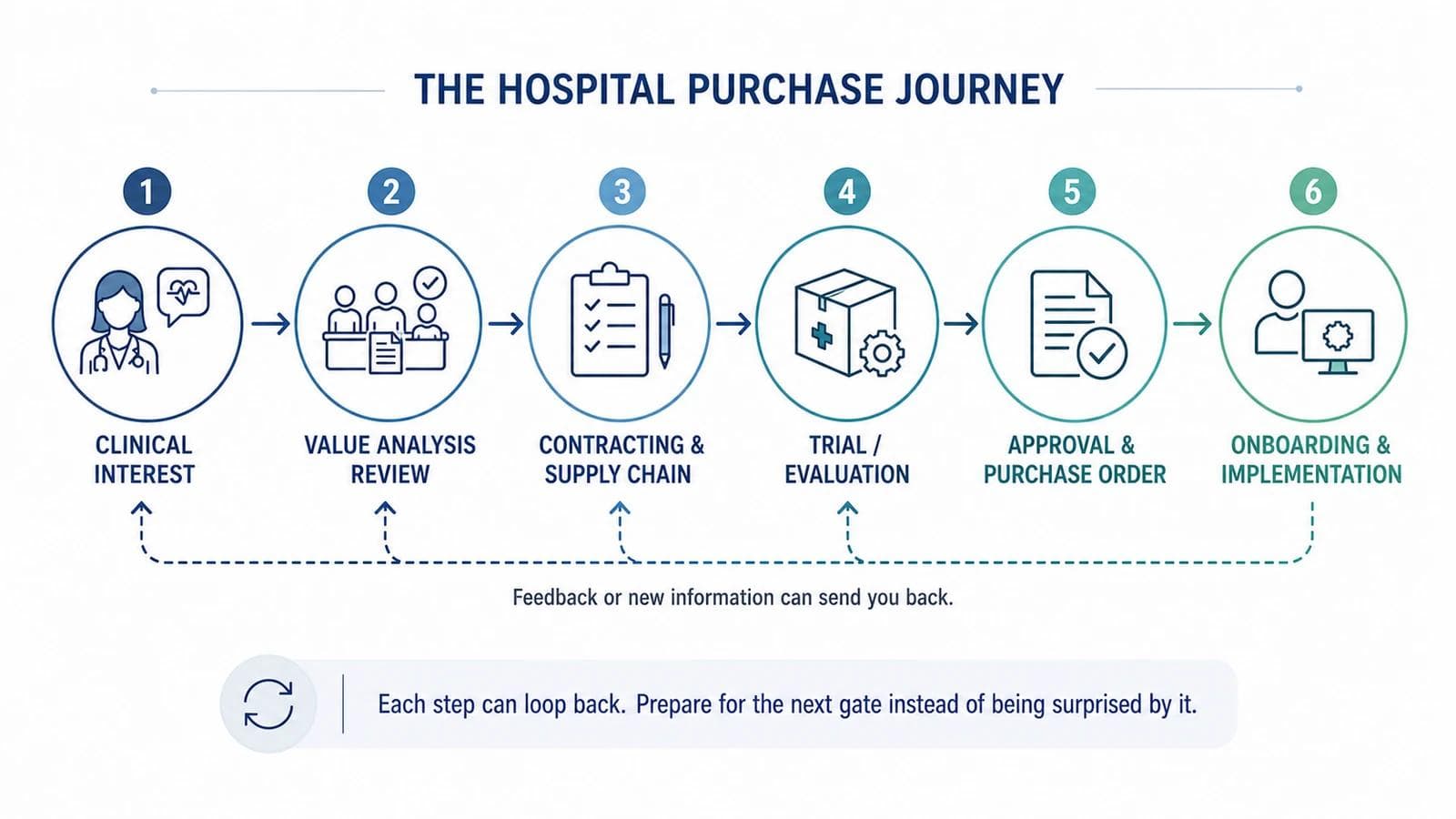
Putting the pieces together, a typical health system purchase moves through a sequence like this:
- Clinical interest. A champion or department identifies a need and wants the product.
- Value analysis review. The value analysis committee evaluates clinical, financial, and operational value.
- Contracting and supply chain. Supply chain checks GPO status, negotiates or confirms pricing, and handles the contract.
- Trial or evaluation. Many systems require a limited trial with defined criteria before full adoption.
- Approval and purchase order. Finance approves, and a purchase order is issued.
- Onboarding and implementation. The product is integrated into workflows, and adoption begins.
Each step can loop back. A committee can send you back for more evidence. Supply chain can send you back to the GPO. Understanding the whole path lets you prepare for the next gate instead of being surprised by it, which is also why hospital deals take so long, a reality we examine in why healthcare sales cycles keep stretching.
How to Navigate Procurement as a Seller
You cannot remove the gates, but you can stop being surprised by them. The teams that sell into health systems consistently do a few things well.
- Build a GPO and contract strategy early, before a hospital asks, so being off contract never blocks a willing buyer.
- Prepare a complete evidence package with clinical, financial, and operational proof ready for the value analysis committee.
- Recruit two allies, not one. A clinical champion creates demand. A supply chain or value analysis ally helps the purchase clear procurement.
- Understand the budget and its cycle, and frame your offer to fit the right budget category and timing.
- Connect procurement to reimbursement where relevant. For many products, how the hospital gets paid affects whether it will buy, which ties back to market access and reimbursement strategy.
- Be patient and organized. Procurement rewards sellers who make the buyer's internal case easy to advance.
Where Technology and Service Purchases Differ
Not everything a hospital buys moves through the same path. Traditional supplies and devices flow through supply chain and group purchasing agreements. Technology and services often follow a different route, and knowing which one you are on saves months.
Software and digital tools usually add gates that physical products do not. Information security review, data privacy assessment, and integration analysis can all sit between clinical interest and purchase, and each can be lengthy. A solution that touches patient data or connects to the electronic health record faces scrutiny that a disposable device never sees. Build your security documentation and integration answers before you need them.
Service agreements bring their own questions about scope, staffing, and performance that supply chain evaluates differently from a product. And newer categories may not have an established GPO contract at all, which can mean more flexibility on pricing but also more work to create a buying pathway where none yet exists.
The practical takeaway is to ask early how your specific category gets bought inside the target system. The path for a technology platform, a service, and a physical product can look very different, and preparing for the wrong one wastes time.
Common Procurement Mistakes
- Treating clinical approval as a done deal and neglecting the procurement path entirely.
- Discovering GPO or contract requirements only after a hospital wants to buy.
- Bringing the value analysis committee a clinical story with no financial or operational evidence.
- Selling one facility without understanding the parent system's standardization and contracting posture.
- Ignoring which budget the purchase comes from and missing the capital cycle.
- Pricing without accounting for negotiated GPO rates and total cost expectations.
Frequently Asked Questions
What is the difference between a GPO and an IDN?
A group purchasing organization is an external body that negotiates pricing and contracts on behalf of many hospitals. An integrated delivery network is a system of hospitals and facilities under shared ownership that makes purchasing decisions internally. A hospital can belong to both, using its IDN for system decisions and its GPO for contract pricing.
Do I have to be on a GPO contract to sell to hospitals?
It depends on your category. For many supplies and devices, being off contract is a real barrier because supply chain buys through GPO agreements. For newer categories, especially some technology and services, there may be more flexibility. Determine early whether a GPO agreement is required for your product.
What is a value analysis committee looking for?
Clinical value, financial impact, and operational fit. The committee wants evidence that the product improves care, understands its full cost including downstream effects, and knows what implementation will require. Bring all three before you are asked, not just the clinical story.
Why do hospital deals stall after the clinical team says yes?
Because clinical approval is not a purchase. After the champion says yes, the deal still has to clear value analysis, supply chain and GPO contracting, budget approval, and sometimes security review. Sellers who prepare only for the clinical conversation get surprised by every later gate.
How long does hospital procurement take?
It varies widely, but health system purchases commonly take many months and sometimes over a year, especially for capital purchases tied to annual budget cycles or products that require GPO contracting and value analysis review. Plan for a long, gated process.
Sell to the Machine, Not Just the Room
Hospitals are not hard to sell to because clinicians are hard to convince. They are hard to sell to because the purchase is deliberately separated from the preference. Group purchasing organizations, integrated delivery network standardization, value analysis committees, and supply chain teams all exist to control cost and risk, and each one can hold up a deal the clinicians already want.
The companies that win in health systems treat procurement as part of the sale from day one. They build contract strategy early, prepare the evidence procurement needs, recruit allies inside supply chain as well as inside the clinical team, and respect the budget cycle. That work is unglamorous, and it is exactly what turns a great pilot into a purchase order.
Navigate Health System Procurement With Medix
Selling into hospitals rewards companies that understand the purchasing machinery as well as the clinical story. That combination of clinical credibility and commercial execution is the core of Medix Outreach's commercial growth and go-to-market work.
Our pharmacist-led team helps healthcare companies build the evidence, contract strategy, and relationships that move health system deals from clinical interest to purchase order. If procurement keeps stalling your deals, book a strategy call and we will map your path through it.