

For a medical device company, the channel decision is often the commercialization decision. Build the wrong US sales channel - or recruit distributors and reps who carry your product as an afterthought - and even a strong device stalls. Build the right one, with partners who already have the surgeon or specialty relationships you need, and distribution compounds. This is especially true for emerging and foreign manufacturers, for whom the US channel is both the biggest opportunity and the easiest thing to get wrong.
This guide covers the channel models and their tradeoffs, where device makers go wrong, how to recruit the right distributors and reps, what foreign manufacturers must do to enter the US, and how to stay compliant while you build.
Direct, distributor, or independent rep: choose the model first
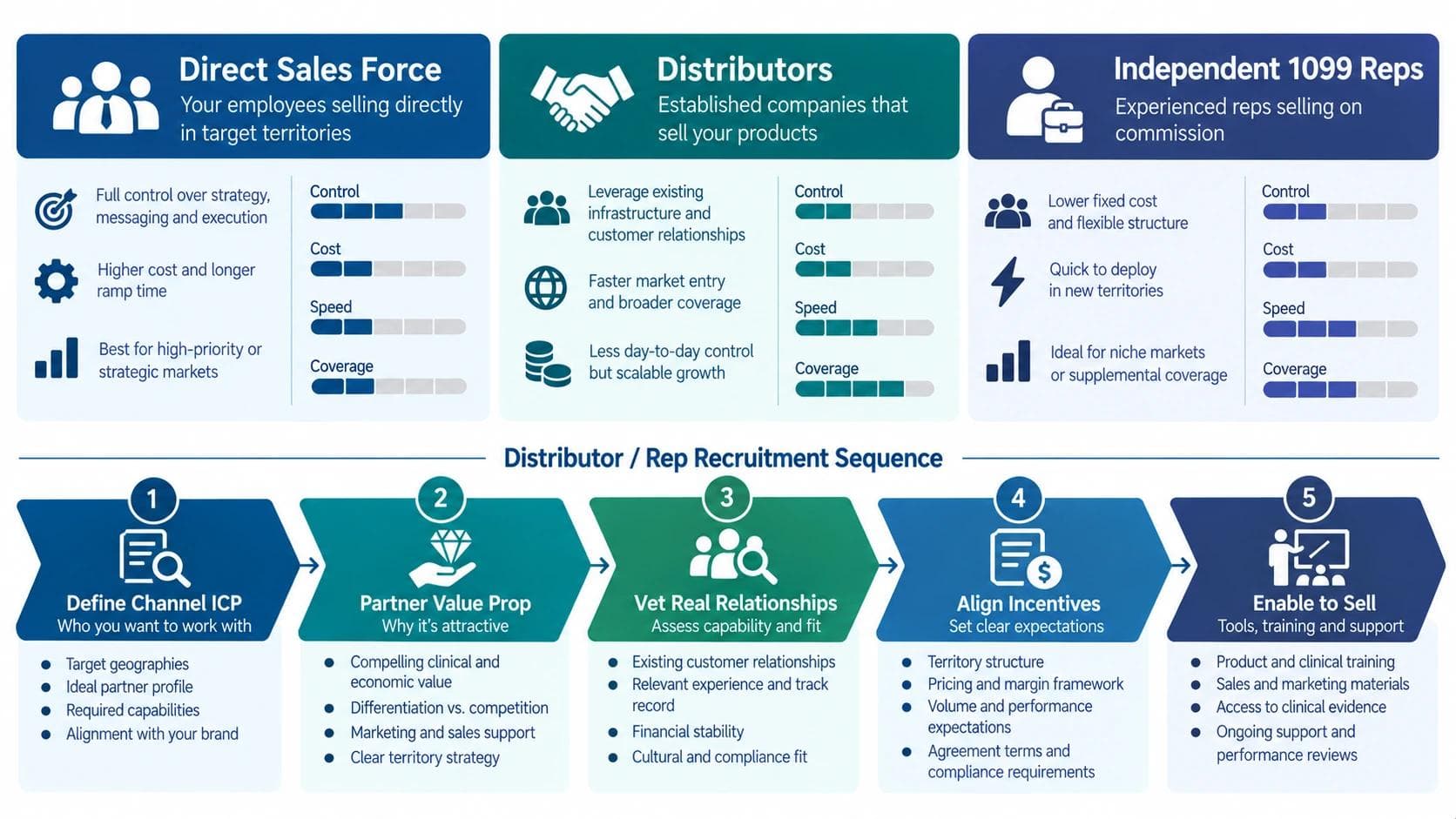
Three channel models dominate US medical device sales, and most companies use a blend:
- Direct sales force. W-2 reps you employ. Maximum control, brand consistency, and data - but the slowest and most expensive to scale, especially across geographies.
- Independent distributors. Companies that buy and resell, often holding inventory and owning regional relationships. Fast coverage and lower fixed cost, but less control and shared economics.
- Independent (1099) sales reps and rep agencies. Commission-based reps or agencies that carry complementary lines into specialties where they already have relationships. Fast access to the right doctors, but your product competes for their attention against their other lines.
The right answer depends on your device's clinical complexity, price point, call point (surgeon, materials manager, administrator), and capital. Decide the model before you recruit - it determines who you are even looking for. This sits alongside the broader medical device go-to-market strategy.
Where device makers go wrong
Most failed channels fail for predictable reasons: recruiting distributors or reps who lack existing relationships in your call point; signing partners on promises rather than territory and specialty fit; providing no training, clinical enablement, or marketing support so the product dies in the bag; misaligning incentives so reps favor higher-commission lines; and treating recruitment as a one-time event rather than ongoing channel management. Each is avoidable with a disciplined recruitment and enablement process - the same distribution-partnership discipline that governs any healthcare channel.
How to recruit the right distributors and reps
- Define the channel ICP. Specify the territories, specialties, and call points you need, and the lines a good partner should already carry.
- Build the partner value proposition. Reps and distributors choose you; articulate the margin, the demand, the enablement, and the support that make your line worth carrying.
- Vet real relationships, not resumes. Qualify candidates on the specialty relationships, active accounts, and complementary (non-competing) lines they genuinely hold.
- Structure incentives for attention. Align commissions, exclusivity, and territory so partners prioritize your product rather than parking it.
- Enable before you expect sales. Provide clinical training, sales tools, and marketing support so partners can actually sell - not just list - your device.
Mid-article CTA
Need help building your healthcare growth engine?
Medix helps healthcare startups, clinics, pharma companies, and provider-focused platforms build scalable commercial pipelines.
Book a Strategy CallUS market entry for foreign manufacturers
For a non-US manufacturer, the channel comes after the regulatory foundation. Before selling, device establishments generally must register and list their devices with the FDA - see FDA device registration and listing - and most devices must carry a unique device identifier under the FDA UDI system, alongside the appropriate premarket pathway and a US agent where required. Only once the regulatory prerequisites are in place does channel recruitment make sense. This is exactly the market-entry sequence behind Medix's cross-border market-expansion work and its international licensing case study.
Build the channel within Anti-Kickback and industry rules
Device sales arrangements touch federal fraud-and-abuse law, particularly where physicians have a financial stake. The Anti-Kickback Statute prohibits inducements tied to referrals or purchases of federally reimbursed items - see the OIG fraud and abuse laws - and physician-owned distributorships in particular draw heightened scrutiny. Interactions with healthcare professionals should also follow the AdvaMed Code of Ethics. Structure distributor and rep agreements, discounts, and consulting to withstand review, and have counsel vet any physician-ownership arrangement.
Manage the channel, don't just launch it
- Coverage: territories and specialties with active, producing partners vs. gaps.
- Productivity: revenue per rep/distributor and ramp time to first sales.
- Mindshare: your share of each partner's selling effort relative to their other lines.
- Compliance: current agreements, training, and documentation across the channel.
Frequently asked questions
How do you recruit medical device distributors? Define the territories, specialties, and call points you need; build a compelling partner value proposition; vet candidates on the real relationships and complementary lines they already hold; align incentives so they prioritize your product; and enable them with training and marketing support.
Should a device company use direct reps, distributors, or independent reps? It depends on clinical complexity, price point, call point, and capital. Direct gives control at higher cost; distributors give fast regional coverage; independent 1099 reps give quick access to existing specialty relationships. Many companies blend models by territory.
How does a foreign manufacturer enter the US device market? First meet regulatory prerequisites - FDA establishment registration and device listing, UDI, the correct premarket pathway, and a US agent where required - then recruit and build the US distributor or rep channel.
What compliance rules apply to device distributor arrangements? The Anti-Kickback Statute governs inducements tied to referrals or federally reimbursed purchases (with heightened scrutiny on physician-owned distributorships), and HCP interactions should follow the AdvaMed Code of Ethics. Have counsel review agreements and any physician ownership.
Building a channel that actually sells
Medical device distributor recruitment is a strategic build, not a hiring post: choose the model, recruit partners for real relationships and fit, align incentives, enable them to sell, and manage the channel continuously - all on a compliant regulatory foundation. Do that and distribution becomes a durable growth engine instead of a graveyard of signed-but-silent partners.
Medix Outreach recruits and builds US distributor and sales-rep networks for device and life-sciences companies, including foreign manufacturers entering the market. To build your channel, book a free strategy call or explore our Strategic Partnerships, Licensing & Market Expansion service.