

Most U.S. healthcare companies treat international expansion as a someday problem. The MENA region is the exception worth moving on sooner, because it is one of the few places where governments are actively pulling foreign healthcare capacity in rather than protecting incumbents. Saudi Arabia's Vision 2030 and the Gulf states' broader diversification programs have turned healthcare into a priority sector with public money behind it.
That pull is real, but it does not make entry easy. Companies that expand into the Gulf on enthusiasm alone usually lose the first year to two avoidable mistakes: choosing the wrong regulatory path, and signing with the wrong local partner. This playbook is about avoiding both.
Short version: expanding a U.S. healthcare company into MENA means picking one or two Gulf markets first, registering your product with the right national regulator through a compliant local authorization holder, deciding deliberately between a distributor and your own entity, and building enough clinical credibility to win public and private contracts. The sequence matters more than the speed.
Why U.S. Healthcare Companies Are Looking at the Gulf
The interest is not hype. Gulf governments are building hospitals, standing up new health systems, and mandating insurance coverage that expands private demand. Saudi Arabia and the UAE in particular have made attracting foreign healthcare, pharmaceutical, and medical technology companies an explicit policy goal, and they have paired that goal with procurement budgets and localization incentives.
For a U.S. company, three things make the region commercially attractive:
- Demand is government-backed, not just market-driven. Public health systems are large buyers, and national programs create predictable demand for categories like diagnostics, medical devices, digital health, and specialty pharmaceuticals.
- Competition is thinner than in the U.S. Many categories that are crowded at home have far fewer credible players in the Gulf, so a differentiated product can win share faster.
- Reimbursement expansion is pulling in private demand. Mandatory health insurance in markets like the UAE and Saudi Arabia grows the privately funded side of the market alongside public procurement.
None of that removes the work. It changes the question from "is there demand" to "can we reach it compliantly and through the right partner." For the U.S. Commercial Service's country-by-country read on healthcare demand and regulation, the International Trade Administration's country commercial guides are a credible, free starting point.
MENA Is Not One Market: Sequence the GCC First
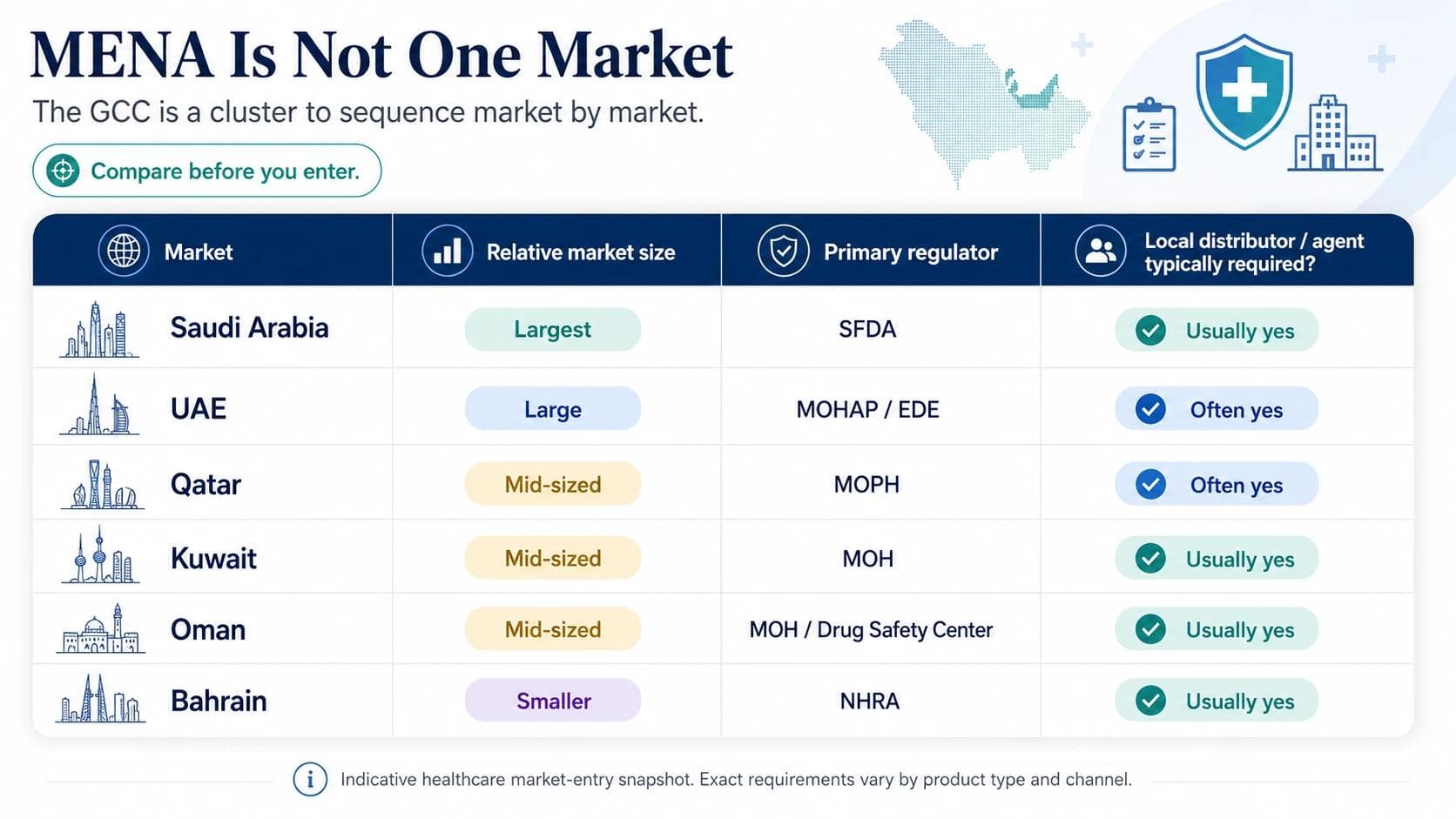
The single most expensive misconception is treating "MENA" as a market. It is roughly twenty countries with different regulators, reimbursement systems, languages of business, and procurement rules. For most U.S. healthcare companies, the practical entry region is the Gulf Cooperation Council: Saudi Arabia, the United Arab Emirates, Qatar, Kuwait, Oman, and Bahrain.
Even inside the GCC, the markets are not interchangeable:
- Saudi Arabia is the largest and most strategically important, with the deepest public procurement and the most aggressive localization agenda. It is also the most demanding on registration and local presence.
- The UAE is often the softest landing: two influential emirate-level health authorities in Dubai and Abu Dhabi, a large private sector, and a business environment built to host foreign companies.
- Qatar, Kuwait, Oman, and Bahrain are smaller and frequently entered after Saudi and the UAE are established, often through the same regional distributor.
A disciplined entry picks one lead market, usually Saudi Arabia or the UAE, proves the model there, and then extends across the GCC. Trying to launch all six at once is how companies spread a small team across six regulatory processes and win none of them. If you have not yet done the equivalent groundwork for your home market, our guide to healthcare market entry strategy covers the demand-validation work that should precede any geographic expansion.
The Regulatory Reality: Registration and the Authorization Holder
In every GCC market, your product has to be registered before it can be sold, and in almost every case a locally licensed entity must hold or sponsor that registration. This is the detail that surprises U.S. teams used to clearing one national regulator and selling nationwide.
The regulators you will actually deal with include:
- Saudi Arabia: the Saudi Food and Drug Authority (SFDA) regulates drugs, medical devices, and food, and runs the registration pathways you must clear to sell.
- United Arab Emirates: the federal Ministry of Health and Prevention (MOHAP) registers pharmaceuticals and devices nationally, while the Dubai Health Authority (DHA) and the Department of Health - Abu Dhabi (DoH) govern their emirates. A UAE launch often means satisfying more than one authority.
- Other GCC states maintain their own ministries of health, and there is a Gulf-level centralized drug registration track intended to streamline approvals across member states.
Two practical implications follow. First, your regulatory timeline is a gating factor for the entire commercial plan, so it belongs at the front of the schedule, not the middle. Second, whoever holds your registration has real leverage over your business, because in many cases the marketing authorization is tied to the local entity rather than to you. That makes partner selection and regulatory strategy the same decision, not two separate ones.
The Distributor Question: Partner or Build
Almost every U.S. healthcare company entering the Gulf faces the same fork: appoint a local distributor or agent, or establish your own entity. Most start with a distributor, and for good reason. A capable distributor already holds licenses, understands the tender calendar, has relationships inside the hospitals and health authorities, and can hold your product registration. Building all of that from scratch can take a year or more.
The tradeoff is control. An exclusive distributor who underperforms can quietly cap your entire market, and because the registration may sit with them, switching is painful. The distributor decision in the Gulf has the same economics and the same failure modes as building a distribution channel anywhere, which we cover in depth in our guide to distribution partnerships in healthcare. The regional specifics change the stakes, not the logic.
A few principles hold up across GCC markets:
- Match the distributor to the buying process, not just the geography. Selling implantable devices into public hospitals is a different capability than selling wellness products into private clinics. The best pharma distributor in Riyadh may be the wrong partner for a diagnostics platform.
- Structure exclusivity around performance. Tie exclusive rights to registration milestones, sales minimums, and defined territories so an underperforming partner does not freeze the market.
- Keep a hand on the registration. Where the regulatory framework allows, retain rights or a clear transfer mechanism so the marketing authorization does not become a hostage.
Choosing and vetting a Gulf partner is close cousin to choosing a licensing partner, and the diligence discipline is the same one we lay out in how to find and approach a pharma licensing partner.
Mid-article CTA
Need help building your healthcare growth engine?
Medix helps healthcare startups, clinics, pharma companies, and provider-focused platforms build scalable commercial pipelines.
Book a Strategy CallHow Public Procurement Actually Works
A large share of Gulf healthcare demand flows through public procurement, and it does not behave like U.S. commercial selling. Government health systems buy through structured tenders and centralized purchasing bodies, and your product usually has to be registered and often locally represented before it can even be listed.
In Saudi Arabia, for example, a substantial volume of public healthcare purchasing is consolidated through a national procurement company, which means getting onto the right formularies and framework agreements matters more than any single sales conversation. The practical consequence is that the sales cycle has two clocks: the registration clock and the tender clock. You can be commercially ready and still wait months for the next purchasing window, so mapping the tender calendar early is part of the entry plan, not an afterthought.
Private-sector demand, driven by hospital groups and insured patients, moves faster and rewards clinical differentiation and provider relationships more directly. Many successful entrants run both motions in parallel: public tenders for scale and predictability, private providers for early traction and reference accounts.
A Phased Entry Sequence
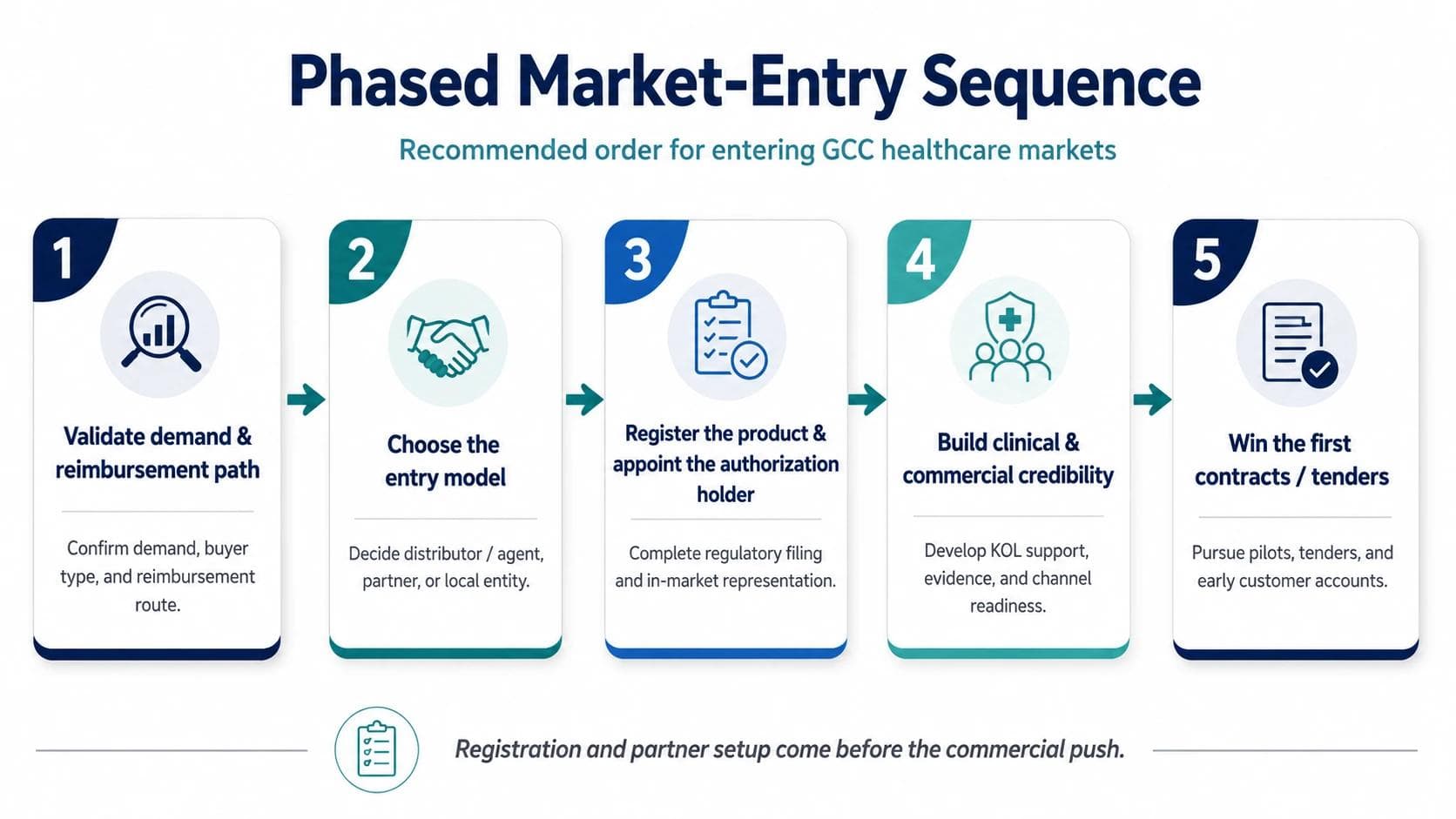
The companies that expand into the Gulf successfully tend to follow a recognizable order. Skipping steps is what creates the expensive year.
- Validate demand and the payment path. Confirm that a real, funded buyer exists for your specific product in your lead market, whether that is public procurement, mandatory-insurance-driven private demand, or both. Enthusiasm from a conference is not validation.
- Choose the entry model. Decide between a distributor, a direct entity, or a hybrid, based on your category, margin, and appetite for control. This decision drives everything downstream.
- Register the product and settle the authorization holder. Start the regulatory process early and lock down who holds the registration and under what terms. Treat this as a commercial negotiation, not a formality.
- Build clinical and commercial credibility. Gulf buyers, like U.S. buyers, adopt on trust. Reference sites, key opinion leaders, local clinical evidence, and a credible local presence do more than any pitch. This is the same clinical-credibility work that wins deals at home, applied to a new set of decision-makers.
- Win the first contracts and reference accounts. Target a small number of winnable tenders and marquee private accounts, deliver, and use those references to open the rest of the GCC.
This is the international application of the same commercial discipline in our healthcare business development strategy guide: understand the buyer, sequence the work, and build proof before you scale.
Common Failure Modes
The mistakes repeat across companies and categories:
- Treating registration as paperwork. It is the critical path. A late or wrong regulatory submission delays the entire commercial launch.
- Signing a broad exclusive with the first eager distributor. Enthusiasm is not capability. An exclusive with the wrong partner can lock up a market for years.
- Launching in all six GCC states at once. A small team cannot run six regulatory and procurement processes well. Lead with one, prove it, expand.
- Porting U.S. messaging directly. Buyers care about local clinical relevance, service and support presence, and fit with national health priorities, not your U.S. logo wall.
- Underestimating the relationship layer. Business in the Gulf runs on trust and presence. Companies that fly in for a week and expect a signed deal misread the market.
Where Medix Fits
Medix Outreach is a pharmacist-led healthcare growth partner with roots on both sides of the U.S. to MENA corridor, and Gulf market expansion is a core part of our strategic partnerships, licensing, and market expansion work. We help U.S. healthcare and pharma companies pressure-test demand in a target market, decide between a distributor and a direct presence, identify and vet local partners, and open the regulatory and commercial doors that make the first contracts possible. Our work on international pharma licensing and expansion is one example of moving a product across borders through the right partnerships. You can read more about the team's pharmacist-led approach to healthcare commercialization.
Frequently Asked Questions
Which MENA market should a U.S. healthcare company enter first?
For most U.S. healthcare, pharma, and device companies, the practical first markets are Saudi Arabia or the United Arab Emirates. Saudi Arabia offers the largest public procurement and the strongest government backing but is more demanding on registration and localization. The UAE is often an easier operational base thanks to its large private sector and business-friendly environment. Pick one as the lead market, prove the model, then extend across the GCC.
Do you need a local partner to sell healthcare products in the Gulf?
In most GCC markets, yes. A locally licensed entity typically must hold or sponsor your product registration, and a distributor or agent usually manages import, tenders, and relationships with hospitals and health authorities. Some companies eventually establish their own entity, but nearly all begin with a local partner because building licenses and relationships from scratch is slow.
How long does MENA market entry take for a healthcare company?
It varies by product class and market, but the regulatory registration is almost always the critical path and should be assumed to take several months to over a year depending on the category. Because public procurement also runs on tender cycles, a realistic first-revenue horizon is measured in quarters, not weeks. Starting registration and partner selection early is the single biggest lever on the timeline.
Is the GCC drug and device registration process centralized?
Partly. Each country has its own regulator, such as the SFDA in Saudi Arabia and MOHAP in the UAE, and there is a Gulf-level centralized drug registration initiative intended to streamline approvals across member states. In practice most companies still plan for country-level registration in their lead markets and use the centralized track where it genuinely accelerates approval.
What kinds of U.S. healthcare companies are the best fit for Gulf expansion?
Companies with a differentiated, registrable product and a category the Gulf is actively investing in tend to do best: medical devices, diagnostics, specialty and branded pharmaceuticals, digital health, and healthcare services and training. If your advantage depends entirely on U.S.-specific reimbursement or infrastructure, the model needs rethinking before it will travel.