
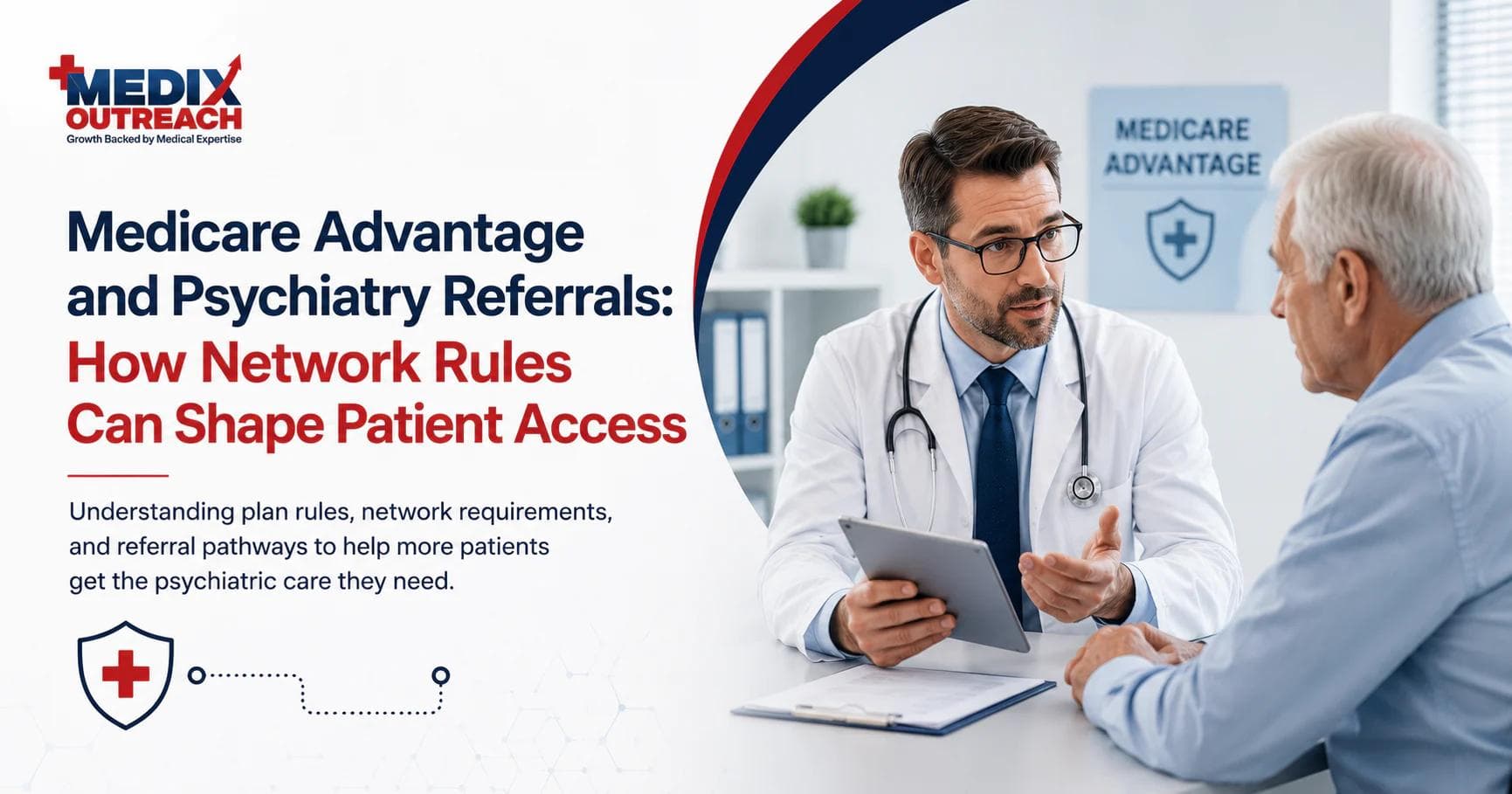
Medicare Advantage has become an important part of the U.S. healthcare landscape, and its network structure can directly influence how patients access behavioral health providers.
For psychiatry practices, understanding this environment is important for both patient access and referral growth.
The key is to avoid treating "Medicare" as one uniform system.
Original Medicare and Medicare Advantage can operate differently, and Medicare Advantage plans can have their own networks, cost-sharing structures, and referral requirements.
Medicare Advantage Is Not the Same as Original Medicare
Under Original Medicare, beneficiaries can generally see any doctor or provider who accepts Medicare.
Medicare Advantage plans, however, are offered by private insurers and can use different network structures and plan rules.
Depending on the plan, patients may need to use network providers or follow specific referral or authorization processes.
For psychiatry practices, this means that a patient's Medicare status alone does not tell you everything you need to know about access.
The specific Medicare Advantage plan matters.
Why Network Participation Matters
A psychiatrist can be clinically appropriate but inaccessible to a patient if the provider is outside the patient's network or if the plan requires a particular referral pathway.
That creates a practical issue for PCPs.
A primary care provider may want to refer a patient to a particular psychiatrist, but the referral needs to work within the patient's coverage.
CMS has continued to emphasize behavioral health access within Medicare Advantage, including network adequacy requirements for outpatient behavioral health.
This makes accurate network information increasingly important.
The Role of the Medicare Advantage Referral Specialist
For practices dealing with significant Medicare Advantage volume, understanding payer-specific referral requirements can become an operational advantage.
The relevant questions include:
- Which Medicare Advantage plans does the practice participate with?
- Is the psychiatrist listed correctly in the plan's network?
- Does the patient's plan require a referral?
- Is prior authorization required?
- Are there plan-specific scheduling requirements?
- What documentation must accompany the referral?
The answers vary.
That is why practices should verify requirements with the patient's specific plan rather than relying on assumptions.
Medicare Mental Health Referrals Require More Than Payer Knowledge
Insurance is only one part of the referral pathway.
The practice also needs to be accessible.
A PCP may identify a psychiatrist who accepts the patient's plan, but if the first available appointment is far away, the patient may still struggle to access care.
This makes payer participation and operational capacity closely connected.
A strong Medicare mental health referrals strategy should therefore consider:
Coverage + availability + clinical fit + referral process.
Network Adequacy Creates a Broader Commercial Context
CMS has been strengthening behavioral health network adequacy requirements within Medicare Advantage.
The 2025 Medicare Advantage final rule established an outpatient behavioral health facility-specialty category that includes multiple behavioral health provider types and introduced standards intended to support access.
The broader policy direction matters to psychiatry practices.
Health plans need behavioral health capacity.
Providers need relationships with referring organizations.
Patients need accessible care.
That creates an ecosystem in which psychiatry practices can become valuable referral destinations.
Mid-article CTA
Need help building your healthcare growth engine?
Medix helps healthcare startups, clinics, pharma companies, and provider-focused platforms build scalable commercial pipelines.
Book a Strategy CallPCP Relationships Still Matter
Payer networks do not replace provider relationships.
A PCP may know which psychiatrist is clinically appropriate for a patient.
The payer determines whether the patient can access that provider under the plan.
The strongest referral pathway connects both.
This is why psychiatry practices should make it easy for PCPs to understand:
- Insurance participation
- Clinical scope
- Availability
- Referral process
- Communication process
When these details are clear, referral friction decreases.
Don't Treat Every Medicare Advantage Plan the Same
One of the biggest mistakes practices can make is creating broad statements such as:
"Medicare Advantage patients need referrals."
That is too general.
Requirements vary by plan.
The correct approach is to verify the patient's coverage and applicable plan requirements before scheduling or providing services.
This is particularly important because Medicare Advantage includes different plan types and network arrangements.
What Practices Should Monitor
A psychiatry practice can track Medicare-related referral performance through:
- Referrals by Medicare Advantage plan
- Referral acceptance
- Time to appointment
- Completed appointments
- Authorization delays
- Network-related referral losses
- PCP referral sources
This can reveal whether a practice has a payer problem, an access problem, or a referral workflow problem.
Medicare Psychiatry and the Broader Access Challenge
CMS has continued to make behavioral health access a policy priority.
Its behavioral health initiatives have included efforts to improve access, payment, and integration across Medicare.
The 2026 Medicare Physician Fee Schedule also includes policies supporting behavioral health integration and psychiatric Collaborative Care Model services in primary care settings.
For psychiatry practices, the broader message is clear:
Behavioral health is becoming increasingly connected to primary care and payer infrastructure.
The Medix Outreach Perspective
Medix Outreach helps psychiatry practices understand referral growth as a combination of provider relationships, payer access, operational readiness, and patient pathways.
A strong Medicare Advantage strategy isn't simply about joining more networks.
It is about identifying which networks matter, making access clear to referral partners, and building the operational infrastructure to convert appropriate referrals into completed care.
Conclusion
Medicare Advantage can significantly influence psychiatry referral pathways.
Network participation, plan rules, availability, and referral requirements all affect whether a patient can move from a PCP recommendation to a completed psychiatric appointment.
Practices that understand these dynamics can become more useful referral partners to primary care and other healthcare organizations.
The opportunity isn't simply to accept more Medicare Advantage patients.
It is to make Medicare mental health referrals easier to complete.