

Orthopedic practice growth is fundamentally a referral game - most patients arrive through primary care, urgent care, emergency departments, physical therapy, and workers' compensation, not advertising. The practices that grow build and manage those referral relationships deliberately, while competitors wait for referrals to arrive by habit. This guide maps the orthopedic referral landscape, the levers that actually move referral behavior, and how to build a referral engine that compounds.
Demand is not the constraint - musculoskeletal conditions are highly prevalent and the population is aging. The constraint is whether referring providers and patients choose your practice. That is a solvable, systems problem, and it starts from the same base as any provider referral engine.
The musculoskeletal referral map
Orthopedic referrals come from more sources than most practices actively work. Map all of them and you will usually find neglected, high-potential relationships.
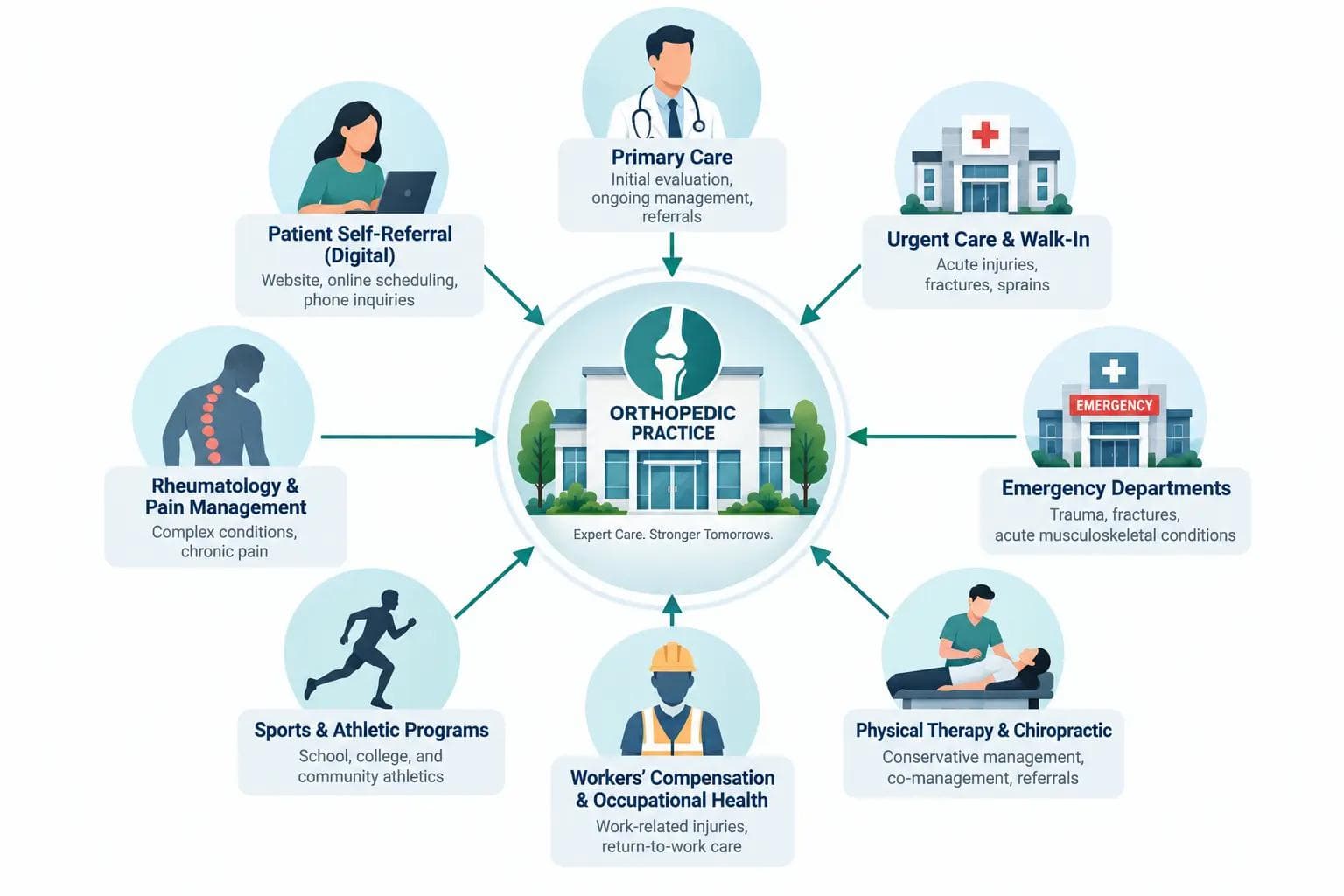
- Primary care - the largest source for most practices; PCPs triage musculoskeletal complaints daily and need a trusted specialist.
- Urgent care and walk-in clinics - a fast-growing source of acute injuries that need orthopedic follow-up.
- Emergency departments - fractures and injuries needing specialist follow-up after discharge.
- Physical therapy and chiropractic - reciprocal relationships; PTs both receive and send referrals.
- Workers' compensation and occupational health - employer and occupational-medicine referrals with distinct reporting needs.
- Sports and athletic programs - schools, teams, and clubs that need reliable orthopedic partners.
- Rheumatology and pain management - adjacent specialists managing overlapping patients.
- Patient self-referral - a growing digital channel as patients research and book directly.
The levers that win orthopedic referrals
Referring providers choose specialists based on a short list of things that make their own lives and their patients' outcomes better:
Access and speed
For acute musculoskeletal injuries, the practice that sees the patient soonest usually wins the referral. Protect same-day and next-day slots for referred acute cases, and make sure referring offices know you can accommodate them. Access is the single most controllable referral lever in orthopedics.
Communication back to the referrer
PCPs stop referring to specialists who go silent. A prompt, clear note after each referred visit - what you found, what you did, and the plan - is what keeps referrals coming. Closed-loop communication is worth more than any marketing spend.
Clinical reputation and outcomes
Referring providers stake their own credibility on where they send patients. Subspecialty depth, strong outcomes, and adherence to recognized orthopaedic clinical resources standards build the confidence that drives referrals. This is clinical credibility wins referrals in action.
Ease of referring
Every point of friction - a fax that fails, an unclear process, a hard-to-reach office - sends the next referral elsewhere. Make referring to you the path of least resistance.
Mid-article CTA
Need help building your healthcare growth engine?
Medix helps healthcare startups, clinics, pharma companies, and provider-focused platforms build scalable commercial pipelines.
Book a Strategy CallBuilding the referral engine
- Baseline your referrals by source. Know who refers to you now and how much, before you try to grow.
- Tier and prioritize. Focus energy on high-potential PCP, urgent-care, and PT relationships rather than spreading thin.
- Assign ownership. As volume grows, a physician liaison program gives referral relationships a dedicated owner and cadence.
- Fix access and communication first. These operational levers move referrals faster than any campaign.
- Add the digital front door. Capture self-referring patients with easy online scheduling and credible clinical content - the core of Patient Acquisition & Practice Growth.
- Track and reallocate monthly. Treat referral growth as a managed system, on the same foundations as broader provider network development.
Orthopedic referral KPIs
- Referrals by source, tiered by volume and trend.
- Referral-to-appointment conversion and time-to-appointment for referred patients.
- New vs. reactivated referring providers per quarter.
- Payer mix by source, including workers' comp.
- Self-referral / online booking volume as a growing channel.
Subspecialty positioning: turning depth into referrals
Referring providers do not just choose a practice; they choose the right expert for a specific problem. Making your subspecialty depth visible and easy to use is a direct referral lever:
- Map your subspecialties clearly - spine, sports medicine, joint replacement, hand, foot and ankle - so referrers know exactly who to send where.
- Give referrers a routing shortcut - a simple guide or contact for matching a patient to the right surgeon reduces friction.
- Publish credible clinical content by subspecialty to support both provider confidence and patient self-referral.
- Protect fast access by subspecialty, not just practice-wide - an urgent fracture and an elective joint consult are different promises.
- Feed subspecialty demand back into recruiting - referral patterns reveal where added capacity would capture more volume.
Orthopedic demand is large and durable; the practices that win are the ones that build referral relationships as deliberately as they build clinical skill. Medix's Provider Network Development and Patient Acquisition & Practice Growth teams help orthopedic practices do exactly that.
Frequently Asked Questions
Where do orthopedic referrals come from?
Primarily from primary care, urgent care, emergency departments, physical therapy and chiropractic, workers' compensation and occupational health, sports and athletic programs, and increasingly from patients self-referring online. Most established practices are heavily dependent on a handful of PCP and urgent-care relationships.
How can an orthopedic practice get more PCP referrals?
By making referral easy and fast: quick access for referred patients, clear communication back to the PCP after each visit, and a reliable point of contact. Access and closed-loop communication move PCP referral behavior far more than advertising.
Should an orthopedic practice hire a physician liaison?
Once referral volume justifies it, yes. A physician liaison who systematically manages PCP, urgent-care, and PT relationships typically pays for themselves through incremental referrals. Smaller practices can start with a part-time or outsourced liaison function.
How important is same-day or next-day access for orthopedics?
Very. For acute injuries, the practice that can see the patient soonest often gets the referral. Fast access is one of the strongest and most controllable levers on orthopedic referral growth.