
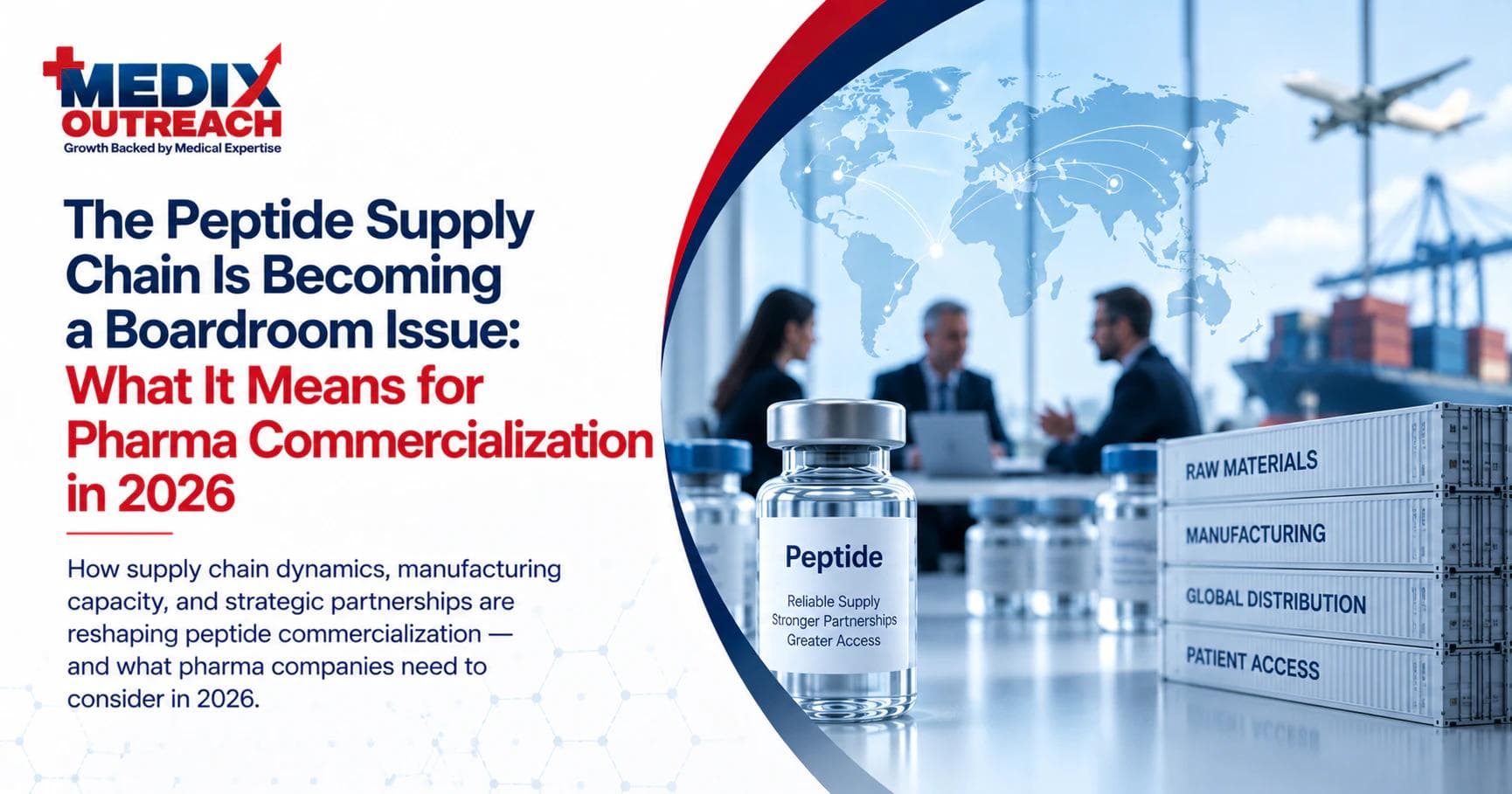
For years, manufacturing could appear to be primarily an operational consideration. In the peptide market, that is changing. Growing demand, capacity investment, CDMO consolidation, and increasingly complex development programs are making manufacturing strategy a commercial issue.
For pharma companies, the question is no longer simply whether a supplier can produce a peptide. It is whether the entire supply strategy can support commercialization.
From manufacturing vendor to strategic partner
Peptide manufacturing is becoming integrated with development and commercialization planning. Peptide developers are involving CDMOs earlier in development, while CDMOs expand capabilities and capacity in response to demand. The relationship increasingly looks less like supplier-to-product and more like a continuum from development to manufacturing to scale to supply to commercialization - a shift reflected in current pharma partnership strategy.
Why this changes business development
A peptide company offering manufacturing services may compete against organizations with larger capacity, multiple manufacturing locations, integrated development services, specialized peptide expertise, strong regulatory infrastructure, and existing pharmaceutical relationships. Competing on price alone becomes difficult. The stronger commercial strategy is to demonstrate where the organization reduces complexity or creates strategic value.
What buyers may want to understand
Pharmaceutical decision-makers may evaluate questions such as:
- Can the partner scale with the program?
- How quickly can capacity become available?
- What development support exists?
- How resilient is the supply model?
- Can the company support technology transfer?
- What happens when commercial demand increases?
- Can the relationship continue across development stages?
These questions create opportunities for a more sophisticated pharma partnership strategy and a clearer peptide market-entry plan.
Mid-article CTA
Need help building your healthcare growth engine?
Medix helps healthcare startups, clinics, pharma companies, and provider-focused platforms build scalable commercial pipelines.
Book a Strategy CallSupply-chain resilience as a commercial differentiator
A manufacturer that can clearly communicate its capabilities, development experience, capacity strategy, quality infrastructure, and geographic footprint has a stronger commercial story. This is increasingly relevant as pharmaceutical companies weigh supply-chain resilience and manufacturing location. Industry reporting through 2026 shows peptide CDMO capacity expanding rapidly, including in North America, even as large-scale capacity lead times remain a near-term bottleneck.
What peptide marketing outreach should communicate
This is where peptide marketing outreach needs to move beyond generic capability statements. Instead of “here is what we manufacture,” outreach can focus on “here is how our capabilities could support your development and commercialization pathway.” That difference can significantly change the quality of B2B conversations.
A stronger commercial messaging framework
Peptide companies can organize outreach around four questions:
- What problem does the pharmaceutical company face?
- Where does our technical capability intersect with that problem?
- What evidence demonstrates our ability to execute?
- What commercial relationship could develop from the initial conversation?
This creates a more useful bridge between marketing and peptide B2B sales.
Why timing matters
The earlier a company identifies a relevant pharmaceutical program, the more opportunity it has to build a relationship before a formal supplier-selection process begins. That does not mean aggressively selling too early. It means becoming relevant early - through thought leadership, technical conversations, market intelligence, and targeted outreach.
Final takeaway
Peptide manufacturing is increasingly connected to commercialization. As demand grows and manufacturing strategies evolve, pharmaceutical companies will evaluate partners on their ability to support the entire development-to-commercial pathway. For peptide companies, that creates a clear business development opportunity - and the ones that translate technical capability into commercial relevance, as part of a broader healthcare commercialization strategy, will build more durable pharmaceutical relationships.