

Healthcare commercialization is the process of turning an approved or market-ready healthcare product into predictable revenue. It covers everything between having something worth buying and having customers who actually buy, use, and renew it: positioning, market access, pricing, go-to-market design, provider outreach, business development, and revenue execution. A strong clinical result or a working product is the starting line, not the finish. Commercialization is the discipline that closes the gap between the two.
What is healthcare commercialization?
Healthcare commercialization is the set of connected decisions and activities that move a healthcare product from regulatory clearance or product-market fit to durable commercial adoption. It is broader than marketing and broader than sales. Commercialization decides who the product is for, why a clinical or economic buyer should care, how it gets paid for, how it reaches the people who prescribe or purchase it, and how a company turns early interest into repeatable revenue.
In practice, commercialization spans several disciplines that most teams run as separate projects: positioning, market access, pricing, go-to-market, demand generation, provider and payer outreach, partnerships, and the selling motion. Run as isolated efforts, these produce activity without traction. Run as one system, they produce revenue you can forecast.
The distinction matters because healthcare punishes teams that treat go-to-market as an afterthought. A drug, device, diagnostic, or software product can be clinically excellent and still fail commercially if no one can bill for it, if the wrong stakeholder is targeted, or if the value story does not survive a skeptical clinical buyer. Commercialization is where that risk is managed on purpose rather than discovered by accident.
Who needs a healthcare commercialization strategy?
Any company selling into the U.S. healthcare system needs a commercialization strategy, but the shape of that strategy changes with the product and the buyer. The common thread is that the buyer is rarely one person and almost never decides on features alone. Clinical value, economic value, workflow fit, and payment all have to line up before money moves.
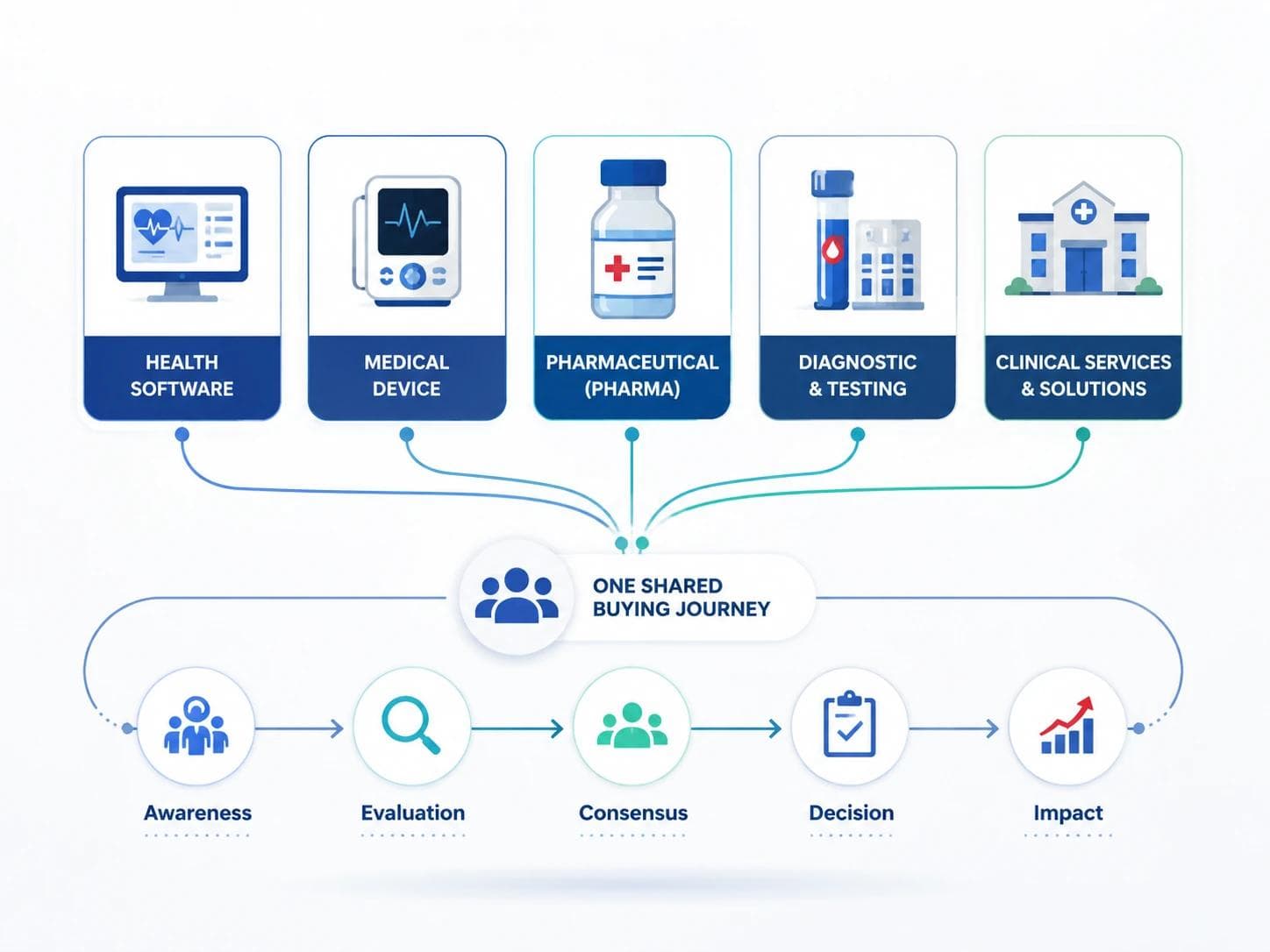
- Healthtech and healthcare SaaS: the product has to satisfy a clinical champion, an IT and security review, and a procurement process that all evaluate different things. A demo rarely closes a deal on its own.
- Medtech and medical devices: FDA clearance is table stakes, not a sales argument. Adoption depends on clinical evidence, procurement committees, and purchasing structures such as group purchasing organizations and integrated delivery networks.
- Biotech and pharma: revenue depends on coverage, coding, and access as much as efficacy. Licensing and partnership deals are often the fastest route to a new market or geography.
- Diagnostics and laboratory services: without a coding and coverage pathway, even a superior test struggles to convert clinical interest into billable volume.
- Healthcare services and specialty pharmacy: growth runs on provider referrals and local demand, which behave more like relationship networks than transactions.
Companies entering the United States from abroad face the steepest version of this curve, because the buying process, reimbursement rules, and stakeholder map differ from almost every other market. A clear healthcare market entry strategy is often the difference between a slow, expensive launch and a controlled one; the mechanics of that first move are worth planning before the first sales hire. See our guide to entering the U.S. market with less waste for how that sequencing works.
Why do strong healthcare products still stall commercially?
Most stalled healthcare products do not have a product problem. They have a commercialization problem that hides behind good clinical data. The failure points are predictable, which means they can be designed out.
- No access pathway. If a buyer cannot get the product covered, coded, or reimbursed, clinical enthusiasm does not convert to purchase orders. Coverage and payment sit upstream of nearly every other decision. The Centers for Medicare and Medicaid Services publishes coverage and payment rules that shape what providers can realistically adopt (cms.gov).
- The wrong buyer. Teams sell to the most enthusiastic person in the room, who is often a clinical champion with no budget authority. The economic buyer and the procurement gatekeeper are a different conversation entirely.
- A value story built for the lab, not the ledger. Clinical outcomes matter, but a hospital or payer also needs the operational and financial case. When the story stops at efficacy, the deal stalls at finance.
- Undifferentiated positioning. In a category with several credible options, "better" is not a position. Buyers need a sharp reason this product fits their specific patient population, workflow, and economics.
- Regulatory clearance mistaken for market readiness. FDA clearance or approval permits sale, but it does not create demand. The U.S. Food and Drug Administration authorizes products for market; it does not commercialize them (fda.gov).
- Pilot purgatory. A product lands a pilot, the pilot goes fine, and then nothing happens because no one designed the path from evaluation to signed contract.
Newer categories feel this most acutely. Clinical AI is a clear example: the technology can be strong while the commercial motion is unclear, because buyers do not yet have a mental model for how the product fits their workflow or their budget. We cover that specific challenge in why healthcare companies struggle to sell AI. The underlying lesson generalizes. A great product with a weak commercialization system loses to an adequate product with a strong one.
What does the healthcare commercialization model look like?
The healthcare commercialization model is best understood as a system of connected components rather than a linear checklist. Each component feeds the next, and a weak link anywhere caps the output of the whole. The goal is not to run all of them at once, but to sequence them so that each decision makes the next one easier.
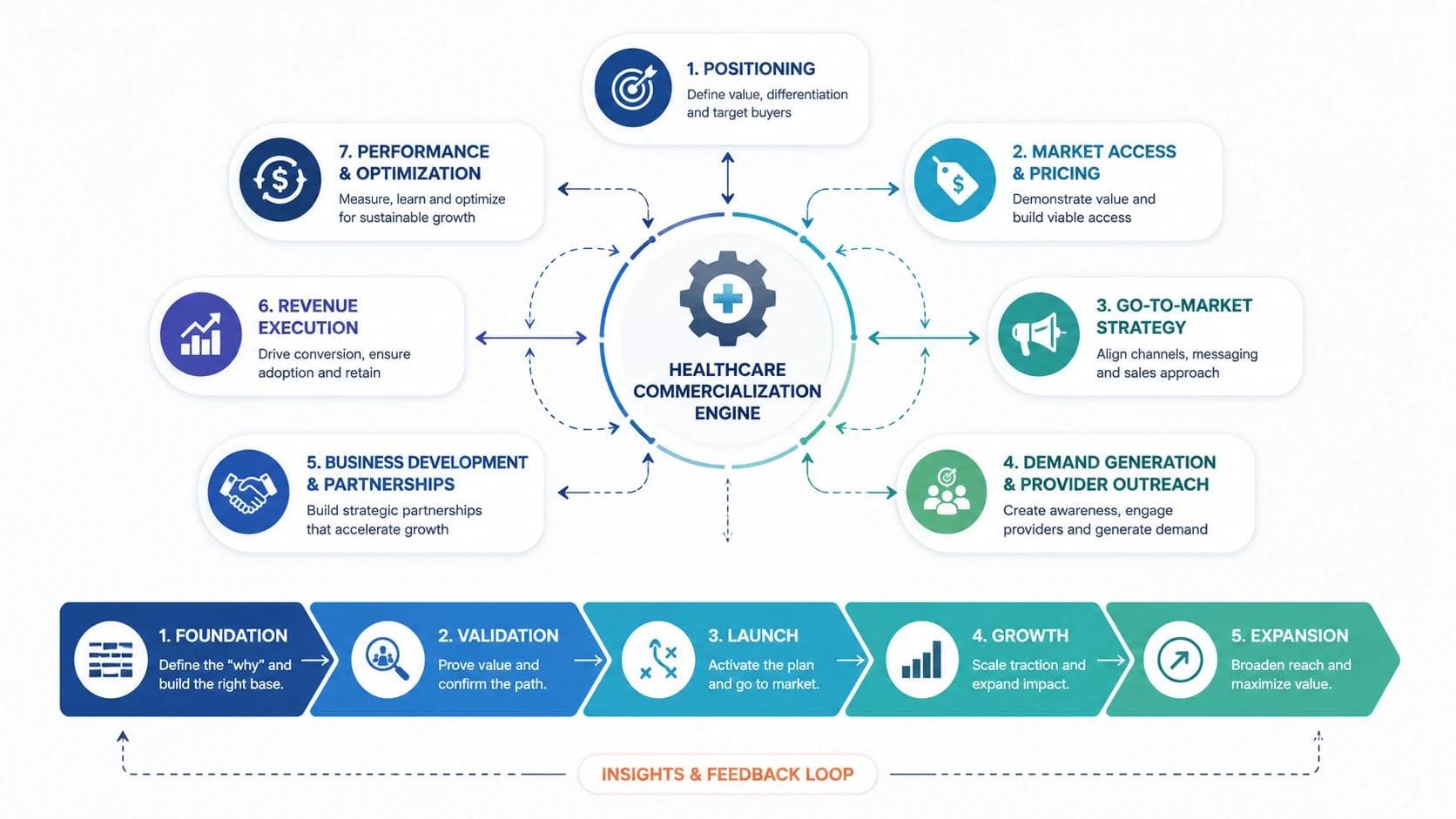
The core components of the model are:
- Positioning and value proposition. The sharp, defensible answer to who the product is for, what it replaces, and why it is worth the switch. Everything downstream inherits the quality of this decision.
- Market access and reimbursement. The coverage, coding, and payment pathway that makes the product economically viable for the buyer to adopt. Our overview of market access and reimbursement strategy covers how payer logic shapes adoption.
- Pricing and packaging. How the offer is structured, tiered, and priced so it matches how buyers actually purchase and budget. Pricing is a positioning decision as much as a finance one, which is why pricing and packaging strategy deserves its own attention.
- Go-to-market design. The choice of channels, buyer segments, and motion that fits the product and the sales cycle, from direct outreach to partner-led distribution.
- Demand generation and provider outreach. The engine that creates qualified interest among the clinicians and organizations who prescribe, refer, or purchase. In healthcare this leans heavily on clinical credibility, a theme we expand in provider marketing that earns trust.
- Business development and partnerships. Deals, licensing, and channel relationships that open markets faster than a company could reach alone. This is often the most valuable component for early-stage and cross-border companies; see healthcare business development strategy for the strategic view.
- Revenue execution. The disciplined motion that converts qualified interest into signed, expanding accounts, including the handling of pilots, procurement, and renewals.
None of these components stands alone. Pricing that ignores reimbursement fails. Outreach that runs ahead of positioning burns pipeline. Partnerships that outpace access create demand a company cannot fulfill profitably. The model works when the components are treated as one connected engine.
What are the stages of healthcare commercialization?
If the model describes the parts, the stages describe the order. A practical commercialization framework moves through five stages, each with a clear exit condition before the next begins.
- Foundation and positioning. Define the target buyer, the clinical and economic value, and the differentiated position. Exit condition: a value proposition that a skeptical buyer in your category finds specific and credible.
- Access and pricing. Establish the reimbursement or payment pathway and the pricing and packaging that fit it. Exit condition: a buyer can adopt the product without a financial dead end.
- Go-to-market design. Choose the segments, channels, and motion, and build the messaging and materials that support them. Exit condition: a repeatable way to reach and qualify the right buyers.
- Demand and pipeline. Run outreach and demand generation to create qualified opportunities, and build the early relationships that healthcare buying depends on. Exit condition: a pipeline with enough qualified volume to test conversion.
- Revenue execution and expansion. Convert opportunities into contracts, move pilots to signed agreements, and expand within accounts. Exit condition: revenue that repeats and grows without a heroic effort behind every deal.
The stages are sequential in logic but overlapping in practice. Most teams revisit positioning as they learn from the market, and access work often continues in parallel with early demand generation. The value of the sequence is that it prevents the most common and expensive mistake, which is scaling outreach before the foundation can support it.
Healthcare commercialization vs. marketing vs. sales: what is the difference?
The terms get used interchangeably, which causes teams to buy the wrong help at the wrong time. A short comparison keeps the roles distinct.
- Marketing creates awareness and demand. It answers "how do the right people learn about and want this?"
- Sales converts specific opportunities into signed deals. It answers "how do we close and expand this account?" The selling motion has its own depth, from process design to closing tactics, and shows up in how you build and manage a healthcare sales pipeline.
- Commercialization is the system that contains both, plus the parts that sit before either can work: positioning, access, pricing, partnerships, and the go-to-market design that decides which motions to run at all.
Put simply, marketing and sales are motions inside commercialization. A company can have competent marketing and competent sales and still fail commercially if access is unsolved, positioning is soft, or the go-to-market model does not fit the buyer. Commercialization is the level at which those decisions get made.
Mid-article CTA
Need help building your healthcare growth engine?
Medix helps healthcare startups, clinics, pharma companies, and provider-focused platforms build scalable commercial pipelines.
Book a Strategy CallHow do you build a healthcare commercialization engine?
A commercialization engine is what turns the model from a diagram into repeatable revenue. It is the combination of people, process, and feedback loops that lets a company run the components consistently rather than reinventing them for every deal.
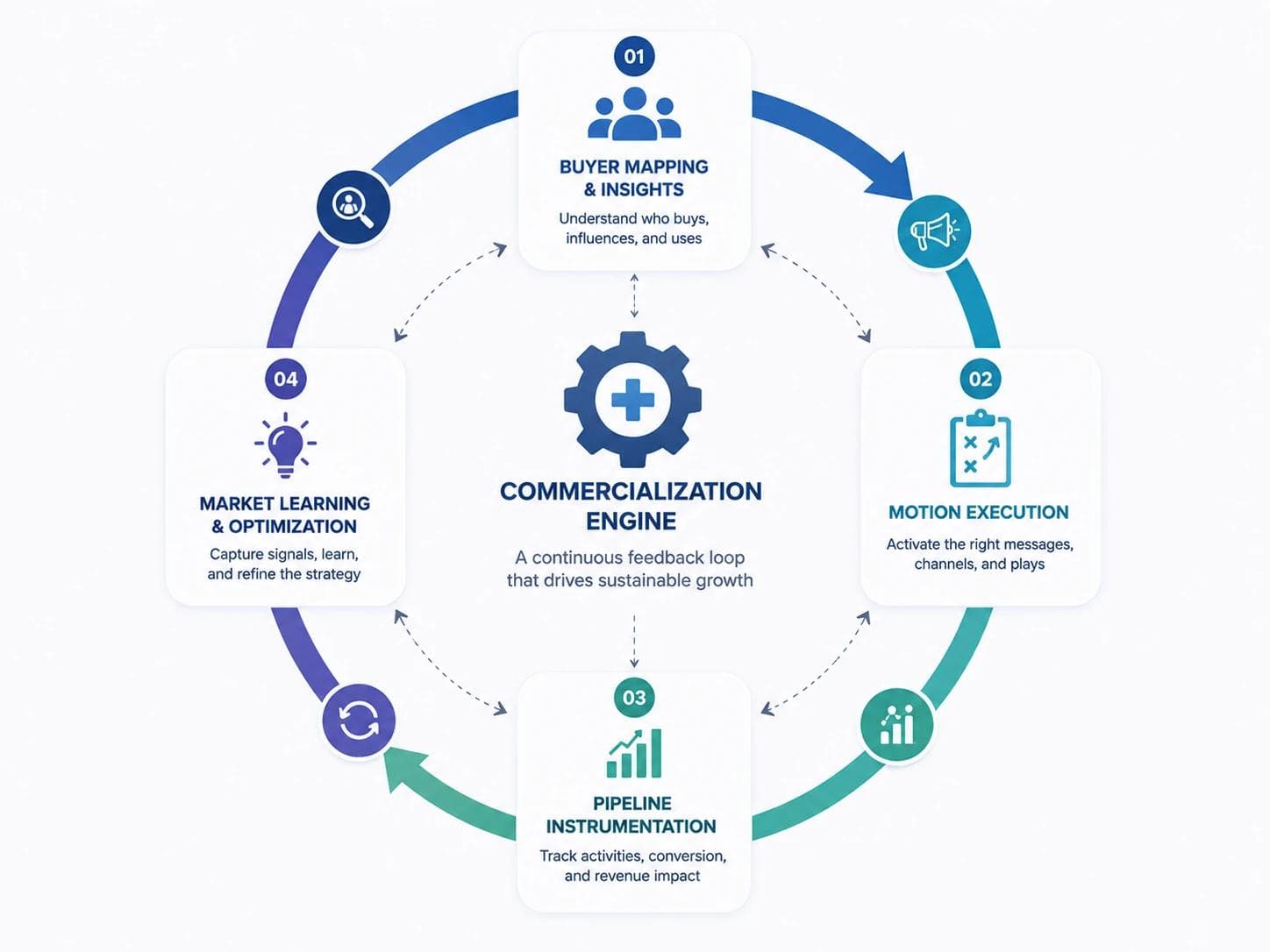
Building the engine comes down to a few disciplines:
- Start from the buyer, not the product. Map every stakeholder in the buying decision, what each one evaluates, and what has to be true for each to say yes. In healthcare that map is longer than most teams expect.
- Sequence, do not parallelize everything. Solve positioning and access before scaling outreach. Spending on demand generation while the value story is soft is how good budgets disappear.
- Instrument the pipeline. Track where opportunities stall, not just how many enter. In healthcare the expensive leaks are late, at procurement, security review, or the pilot-to-contract gap, so the pipeline needs visibility all the way through.
- Build clinical credibility into the motion. Buyers weigh who is saying something as heavily as what is said. A commercialization engine that speaks the buyer's clinical language converts better than one that sounds like generic software sales.
- Close the loop. Feed what the market says back into positioning, pricing, and targeting. The first version of any of these is a hypothesis, and the engine improves only if the loop is real.
Companies build this engine in different ways, from an in-house commercial team to an outsourced partner to a hybrid. That build-versus-buy decision is significant enough to weigh on its own terms, and it depends on stage, budget, and how specialized the buyer is. The point here is narrower: whatever the staffing choice, the engine has to exist as a designed system, not an accumulation of individual reps and campaigns.
How do you know your product is ready to commercialize?
Readiness is not a feeling, it is a checklist. Before pouring money into outreach and sales, a healthcare company should be able to answer yes to most of the following. Treat weak answers as the work to do next, not reasons to stop.
- Regulatory status is clear. Clearance, approval, or the applicable regulatory pathway is in hand or on a known timeline.
- The buyer is defined. You can name the clinical champion, the economic buyer, and the procurement gatekeeper for your target segment.
- The value story holds both ways. You can state the clinical value and the economic or operational value in the buyer's own terms.
- There is an access pathway. Coverage, coding, reimbursement, or the purchasing route is understood, even if not yet finalized.
- Pricing fits how buyers buy. Your packaging and price match how your target budgets and procures, not just how you would like to sell.
- Early proof exists. A reference customer, a pilot result, or credible clinical evidence supports the claims.
- The first motion is chosen. You know whether the fastest path is direct outreach, partnerships, or a channel, and why.
A product that clears most of this list is ready to commercialize with intent. A product that clears only the regulatory box is ready to sell in theory and likely to stall in practice.
When should you bring in a commercialization partner?
Many healthcare companies reach a point where the product is ready but the commercial motion is not moving, and the internal debate turns to whether to keep building the function alone or bring in outside help. A commercialization partner earns its place in specific situations rather than as a default.
Clear signals that outside commercialization support is worth considering:
- The founders are the only ones who can sell the product, and that does not scale.
- The buyer is a healthcare specialist, such as a hospital, payer, or specialty provider, and the team lacks that domain access.
- A launch or market entry has a real deadline and no time to hire and train a full commercial team first.
- Pipeline exists but conversion stalls at access, procurement, or the pilot-to-contract step.
- The company is entering the United States from abroad and needs a local commercial motion quickly.
The deeper question of whether to build that capability in-house, outsource it, or run a hybrid is a strategic decision with its own trade-offs around cost, control, and speed, and it deserves a dedicated analysis rather than a quick answer. What matters at the pillar level is recognizing the signals above for what they are: evidence that the commercialization gap is a capability gap, not an effort gap, and that more activity from the same setup will not close it.
How Medix Outreach approaches healthcare commercialization
Medix Outreach is a pharmacist-led healthcare commercialization and business development firm that treats the whole model as one system rather than a set of disconnected campaigns. The starting point is clinical credibility, because in healthcare the person carrying the message is part of the message. A team that speaks the buyer's language earns meetings and trust that generic outreach does not.
The work runs across the components described above: sharpening positioning, aligning pricing and access, designing the go-to-market motion, and executing provider outreach and business development through to revenue. That end-to-end scope lives in our healthcare commercial growth and go-to-market service, and the broader set of capabilities, from provider network development to partnerships and licensing, sits across our healthcare growth solutions.
The approach is concrete rather than theoretical. For a peptides company, that meant building a nationwide B2B pipeline reaching clinics and wellness providers from positioning through outreach. For a pharma company expanding across borders, it meant running licensing outreach to open an international market rather than a slow direct build. Different products, same discipline: connect the components into an engine that produces revenue. More on the pharmacist-led model and the people behind it is on our about page.
The bottom line
Healthcare commercialization is the difference between a product that works and a business that works. The product earns the right to compete; the commercialization system decides whether it wins. That system has recognizable parts, a workable sequence, and clear readiness signals, which means it can be built deliberately instead of hoped for. The companies that treat commercialization as a core discipline, not a phase, are the ones that turn clinical strength into durable revenue.
If your product is ready but the commercial motion is not, the fix is rarely more effort applied to the same setup. It is a designed commercialization engine matched to how healthcare buyers actually decide. Medix Outreach builds that engine with healthcare companies from positioning through revenue, grounded in clinical credibility. If the gap between your product and your pipeline has become the constraint, that is the conversation worth having.
Frequently Asked Questions
What is healthcare commercialization in simple terms?
Healthcare commercialization is the process of turning an approved or market-ready healthcare product into repeatable revenue. It includes positioning, market access and reimbursement, pricing, go-to-market design, provider and payer outreach, partnerships, and the selling motion that closes and expands accounts. In short, it is everything a company does to make sure a good product actually gets bought, used, and renewed by the right customers.
How is healthcare commercialization different from sales and marketing?
Sales and marketing are motions inside commercialization, not substitutes for it. Marketing creates awareness and demand, and sales converts specific opportunities into signed deals. Commercialization is the wider system that also decides positioning, access, pricing, and go-to-market model, which are the choices that determine whether marketing and sales can succeed at all. A company can run competent marketing and sales and still fail commercially if those upstream decisions are wrong.
Who needs a healthcare commercialization strategy?
Any company selling into the U.S. healthcare system benefits from a commercialization strategy, including healthtech and healthcare SaaS companies, medical device and medtech firms, biotech and pharma companies, diagnostics providers, and healthcare services and specialty pharmacies. The strategy differs by product and buyer, but the need is shared, because healthcare buying involves multiple stakeholders, reimbursement rules, and long decision cycles that reward a planned approach over an improvised one.
When should a healthcare company start commercialization planning?
Commercialization planning should begin before a product is ready to sell, not after launch stalls. Positioning, access pathways, and pricing take time to get right, and starting them late forces expensive rework once outreach is already running. A practical rule is to begin foundation and access work as the product approaches regulatory clearance or product-market fit, so the go-to-market motion is ready when the product is.
Should you build a commercialization team in-house or bring in a partner?
It depends on stage, budget, deadline, and how specialized the buyer is. An in-house team offers the most control and works well when a company has time and healthcare commercial expertise to hire. A partner or hybrid model is often faster when the buyer is a specialist, a launch has a real deadline, or the founders are still the only ones who can sell. The right answer is a deliberate build-versus-buy decision rather than a default, and it should be judged on speed, cost, and access to the specific buyer you need to reach.