

Physical therapy marketing succeeds when it fills evaluation slots and keeps patients through their plan of care, not when it raises raw website traffic. A clinic can rank well, run ads, and still lose money if new patients do not convert to evaluations and if existing patients drop out after three visits. Growth in PT is a conversion-and-retention problem wearing a marketing costume.
This guide covers the levers that actually move a PT schedule: the dual referral engine behind patient volume, the local search and reputation work that captures self-referring patients, and the retention mechanics that make the economics work. It is written for clinic owners and marketing leads who want fuller schedules, not more vanity metrics.
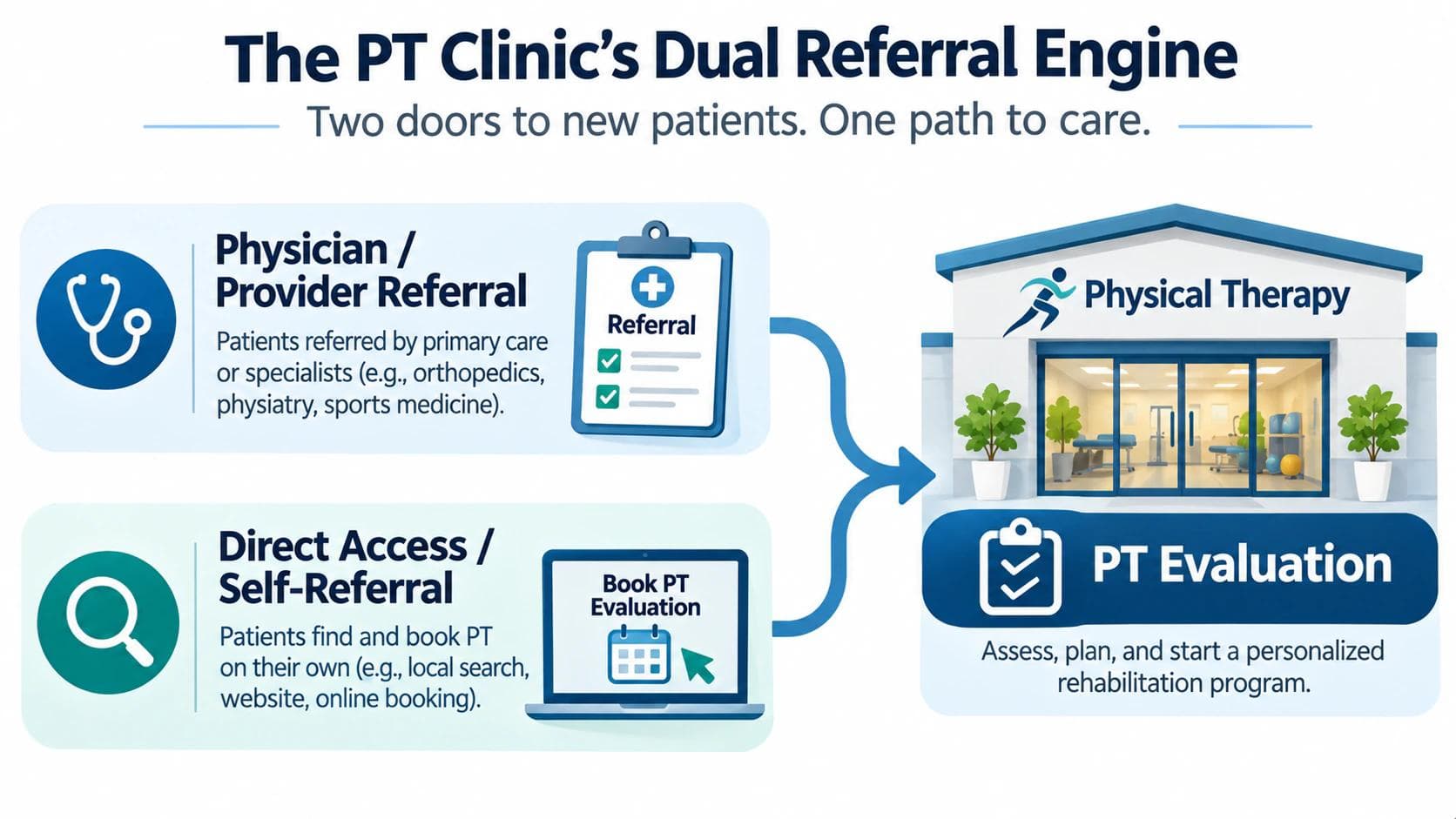
Understand your dual referral engine
Patients reach a physical therapy clinic through two very different doors, and healthy clinics feed both.
- Physician and provider referrals. Primary care, orthopedics, and surgeons still route significant PT volume. These relationships are durable and lower-cost than paid acquisition, but they are built through outreach, not ads, and they erode if no one tends them.
- Direct access (self-referral). Patients can now begin physical therapy without a physician referral in every state, though the specifics of what a therapist may do and for how long vary by state. That shift turns PT into a consumer-search category: patients in pain look for a clinic online and choose one before a doctor is ever involved.
The mistake is betting everything on one door. Clinics overly dependent on a few referring physicians are one retirement or hospital acquisition away from a volume cliff; clinics that only chase self-referral leave durable provider volume on the table. Map both, and invest in both.
Win the self-referral search moment
Because patients can self-refer, a growing share of PT demand now starts with a search for help with a specific pain or injury. Capturing it is mostly local SEO and condition content.
- Own local search per location. An accurate Google Business Profile, strong per-clinic location pages, and real reviews decide which clinic a searcher picks. Follow Google's guidelines for representing each location, and keep hours, services, and insurance clear.
- Publish condition-led content. Patients research their symptoms (low back pain, rotator cuff, post-op knee) before they book. Pages that answer those questions, and increasingly feed AI answers, earn both rankings and trust. Build them to be genuinely useful and credible, the way clinical credibility is earned, not claimed.
- Make booking effortless. Online scheduling and clear "you don't need a referral to start" messaging convert a searcher who is in pain and ready.
Keep the physician-referral channel healthy
Self-referral gets the attention, but physician referrals remain the backbone for many clinics. They are won and kept the same way any physician liaison program works: consistent, useful contact with referring offices, fast and professional communication back to the referring provider, and making it easy to send a patient your way.
- Report back. The fastest way to lose a referring physician is silence. Timely progress notes and outcomes keep referrals flowing.
- Reduce friction. Simple referral pathways, quick scheduling for referred patients, and clear communication beat any brochure.
- Treat it as a system. A named owner, a target list of referring offices, and a cadence turn ad-hoc relationships into a referral network that compounds.
Retention is where PT economics are won or lost
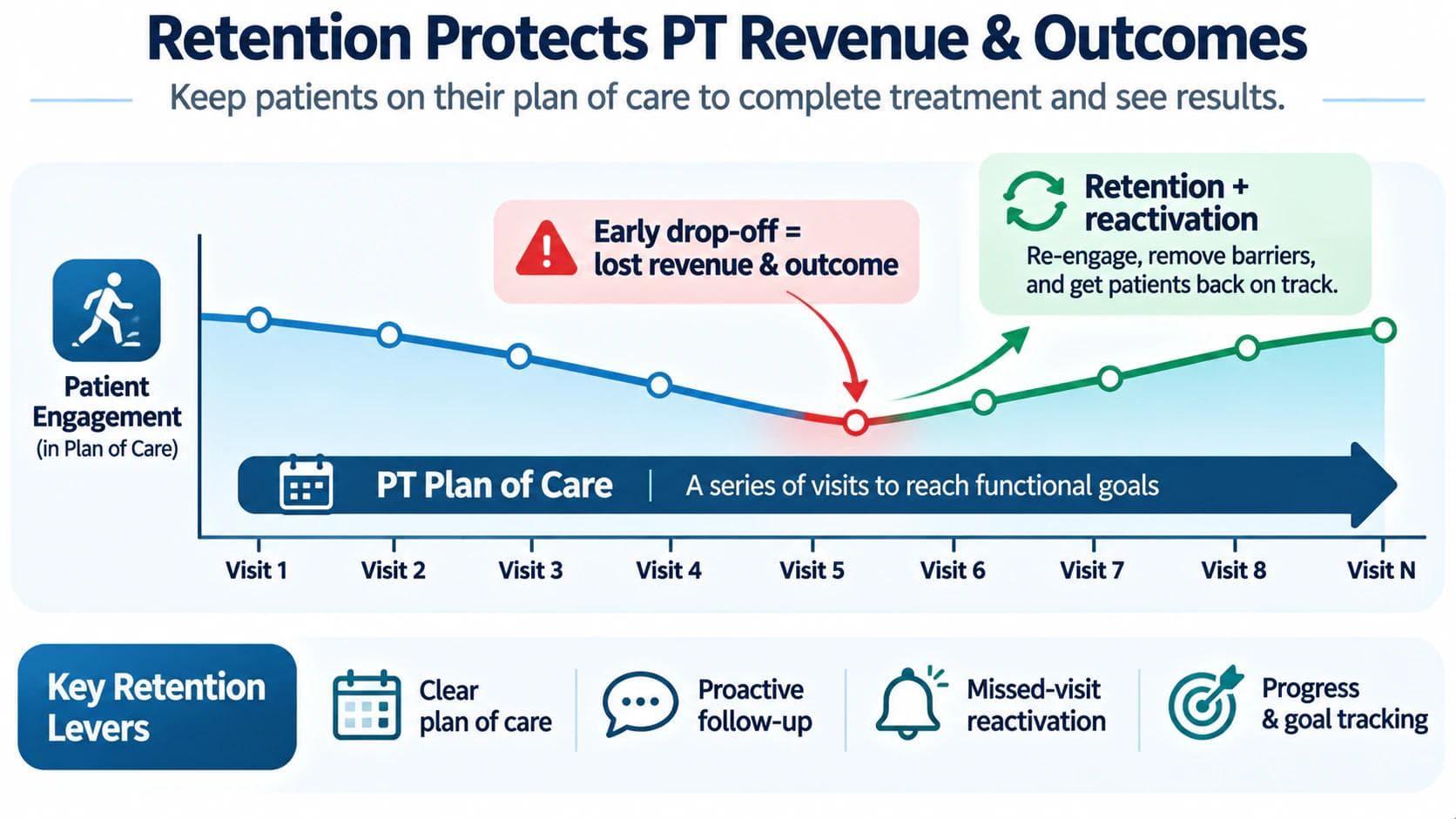
A physical therapy episode is a plan of care across many visits. When patients drop out early, the clinic loses the back half of the revenue and the clinical outcome suffers. The highest-ROI "marketing" in PT is often keeping scheduled patients engaged.
- Reduce early drop-off. Clear expectations at evaluation, reminders, and simple re-engagement when a patient misses a visit protect the plan of care.
- Reactivate past patients. A prior patient with a new or recurring issue is your cheapest new "acquisition." An email or recall program to past patients routinely outperforms cold channels.
- Build cash-pay and wellness continuity. Maintenance, wellness, and performance services keep patients connected after insured care ends and smooth the revenue curve.
Mid-article CTA
Need help building your healthcare growth engine?
Medix helps healthcare startups, clinics, pharma companies, and provider-focused platforms build scalable commercial pipelines.
Book a Strategy CallGrow the B2B channels most clinics ignore
Beyond patients and physicians, two employer-adjacent channels produce durable PT volume: worksite and workers'-compensation relationships, and value-based or ACO arrangements where PT reduces downstream cost. These are relationship sales, not ad campaigns, and they are exactly the kind of outreach that turns a clinic from schedule-dependent into partnership-driven.
Measure what actually matters
- Cost per new evaluation by channel, and paid-channel payback period, not cost per click.
- Lead-to-evaluation and evaluation-to-plan conversion, the real funnel for a PT clinic.
- Plan-of-care completion and visits-per-episode, the retention signal that drives revenue.
- Referral mix across physician, self-referral, and employer channels, so you see concentration risk early.
Compliance guardrails
- Market inside your state's direct-access rules. What a clinic can advertise about treating patients without a referral depends on state law; confirm the specifics for each state you operate in. The APTA is a useful starting reference for the profession and direct access.
- Keep claims and reviews honest. Outcome claims and patient testimonials must be truthful and substantiated under the FTC's health-products guidance.
- Protect patient data. Pixels, retargeting, and intake forms touch protected health information; build on HIPAA-compliant tooling per HHS guidance.
Frequently asked questions
What is the best marketing strategy for a physical therapy clinic?
Feed both referral doors. Win self-referral demand with local search, condition content, and easy online booking, and keep physician referrals healthy with a liaison cadence and fast report-backs. Then protect the economics with plan-of-care retention and reactivation of past patients.
Do patients still need a physician referral for physical therapy?
Patients can begin physical therapy through direct access in every state, though the scope and duration vary by state law. That makes PT a consumer-search category, which is why local search and condition content now matter as much as physician relationships.
How do physical therapy clinics get more referrals?
Treat referrals as a system: a named owner, a target list of referring offices, consistent contact, fast report-backs to referring physicians, and friction-free scheduling for referred patients. For self-referrals, win the local search moment and make booking effortless.
Why is patient retention a marketing issue in physical therapy?
Because a PT episode spans many visits, early drop-off erases the back half of revenue and hurts outcomes. Reducing drop-off and reactivating past patients is usually higher-ROI than buying more new leads.
Building a PT practice that fills its own schedule
Physical therapy growth is won by feeding both referral doors, converting self-referring searchers, and keeping patients through their plan of care. Clinics that treat referrals as a system and retention as a growth lever stop depending on a handful of physicians or a single ad channel.
Medix Outreach helps physical therapy clinics and groups build patient-acquisition engines and the physician and employer referral relationships that make them durable. See how positioning accelerates clinic adoption in our provider-positioning case study, or start with the broader medical practice marketing playbook.