
For psychiatry practices evaluating online patient acquisition, the question of Zocdoc vs Psychology Today psychiatrist often comes down to a misunderstanding.
These platforms can both help patients discover psychiatrists.
But they are not identical channels.
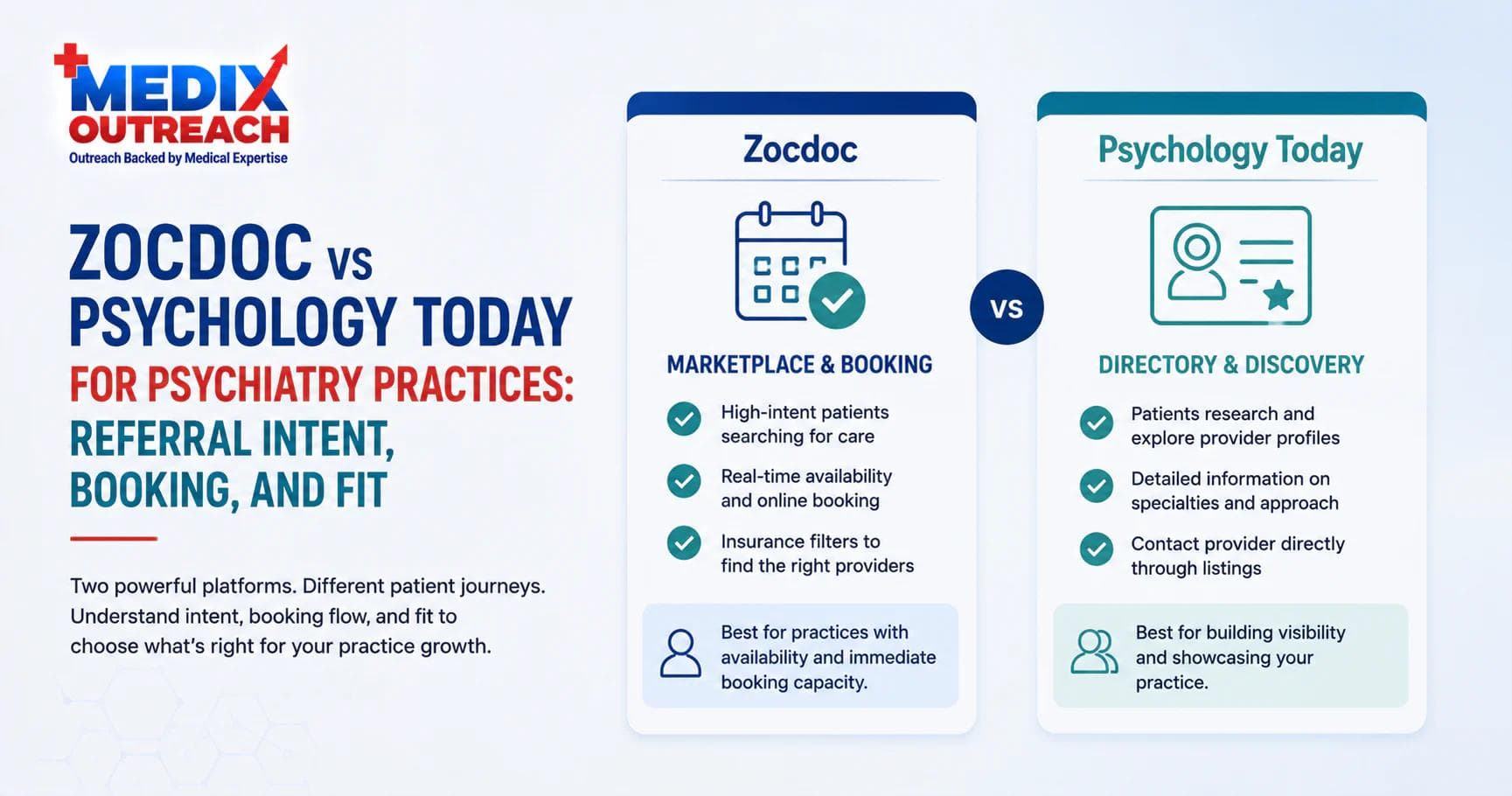
Zocdoc is built around healthcare marketplace discovery and booking.
Psychology Today operates primarily as a mental-health directory.
The distinction affects patient intent, the booking journey, profile discoverability, and how each channel fits into a psychiatry practice’s growth strategy.
Zocdoc and Psychology Today are not identical channels
Zocdoc’s Marketplace allows patients to search for providers using criteria such as insurance, visit reason, and location, then review profiles, reviews, photos, and availability before booking.
Psychology Today’s U.S. directory allows patients to search specifically for psychiatrists and psychiatric nurse practitioners and review detailed provider information, including areas of expertise, credentials, fees, payment options, and accepted insurance.
Both improve discoverability.
But the user journey is different.
Patient journey on each platform
Zocdoc
The Zocdoc journey is highly appointment-oriented.
A patient searches.
The platform returns relevant providers.
The patient evaluates the available options.
The patient selects an available appointment.
The booking is completed through the platform.
That makes appointment availability a central component of the experience.
Psychology Today
A Psychology Today psychiatrist listing is more profile-oriented.
Patients can explore provider information and evaluate factors such as specialty, credentials, insurance, fees, and other profile details.
The platform therefore functions primarily as a discovery and evaluation environment.
That difference matters when thinking about patient intent.
Profile and search filters
Both platforms depend on accurate provider information.
For Zocdoc, relevant information can include:
- Insurance
- Visit reason
- Location
- Availability
- Provider profile
- Reviews
For Psychology Today, provider profiles can include:
- Clinical specialties
- Credentials
- Treatment approach
- Accepted insurance
- Fees
- Payment options
Psychology Today’s current psychiatrist directory also allows users to narrow searches based on provider type and location.
The practical lesson is simple:
A profile is not just a listing.
It is part of the patient’s decision process.
Booking and conversion path
This is where the two channels become especially different.
Zocdoc has a direct booking workflow.
The patient can find an available appointment and book it.
Psychology Today is more centered on provider discovery and profile evaluation.
That means the practice’s own response and scheduling process can play a larger role after discovery.
For a psychiatry practice, neither model is automatically better.
It depends on what the practice needs.
A clinic with open appointment capacity may value a direct booking channel.
A practice focused on profile visibility may place greater value on a directory.
Insurance and availability considerations
Insurance can influence patient intent on both platforms, but the way patients encounter that information differs.
Zocdoc’s search experience explicitly incorporates insurance as one of the criteria patients can use when looking for providers.
Psychology Today provider profiles can display accepted insurance and other payment information.
Practices should keep this information accurate.
Incorrect insurance or availability information can create friction after discovery and undermine the value of the channel.
Mid-article CTA
Need help building your healthcare growth engine?
Medix helps healthcare startups, clinics, pharma companies, and provider-focused platforms build scalable commercial pipelines.
Book a Strategy CallPractice-control and brand considerations
A psychiatry practice should also consider what happens outside the platform.
Does the channel generate a patient who becomes part of the practice’s long-term relationship?
Or does the practice remain dependent on the external platform for discovery?
This is why online marketplaces and directories should be considered part of a broader channel mix.
They can generate discovery.
They should not replace the practice’s own relationships with PCPs and other healthcare partners.
Can a psychiatry clinic use both?
Yes, the strategic question is whether using both makes sense for the practice.
A clinic may use Zocdoc when it wants a direct booking channel for available appointments.
It may use Psychology Today to strengthen psychiatrist discoverability and provide patients with detailed provider information.
The two channels can therefore complement each other rather than being treated as mutually exclusive.
But practices should measure the results independently.
Track:
- New-patient acquisition
- Booking
- Attendance
- Conversion
- Payer mix
- Capacity
- Retention
The goal is to understand what each channel actually contributes.
Compare the referral journey, not just price
A common mistake in platform comparisons is focusing entirely on cost.
Cost matters.
But the more important question is what happens after discovery.
A channel that produces a low-cost inquiry but poor completion may be less valuable than one that produces fewer but better-fit patients.
The same principle applies to psychiatry.
The value of a channel depends on the entire patient journey.
Discovery → evaluation → booking/contact → appointment → ongoing care.
Zocdoc, Psychology Today, and direct referrals
Neither platform should automatically replace direct referral relationships.
PCPs and other healthcare partners can provide a different kind of access to patients.
A provider referral can come with clinical context and an established professional relationship.
A marketplace or directory can create direct patient discovery.
The practice may benefit from having both.
The strategic goal is channel diversification without losing sight of referral relationships.
The Medix Outreach perspective
Medix Outreach evaluates patient acquisition channels based on fit and downstream economics rather than visibility alone.
Zocdoc and Psychology Today can both have a role.
But the right choice depends on:
- Patient access
- Practice capacity
- Insurance participation
- Booking workflow
- Profile quality
- Patient intent
- Follow-up
- Retention
A platform should support the practice’s growth model rather than become the growth model.
Conclusion
The Zocdoc vs Psychology Today psychiatrist comparison is ultimately about patient intent and workflow.
Zocdoc emphasizes marketplace discovery and online booking.
Psychology Today provides a mental-health directory experience centered on provider profiles and discovery.
For some psychiatry practices, using both may make sense.
For others, neither may address the most important growth constraint.
The right decision comes from understanding what happens after discovery and measuring the complete patient journey.