
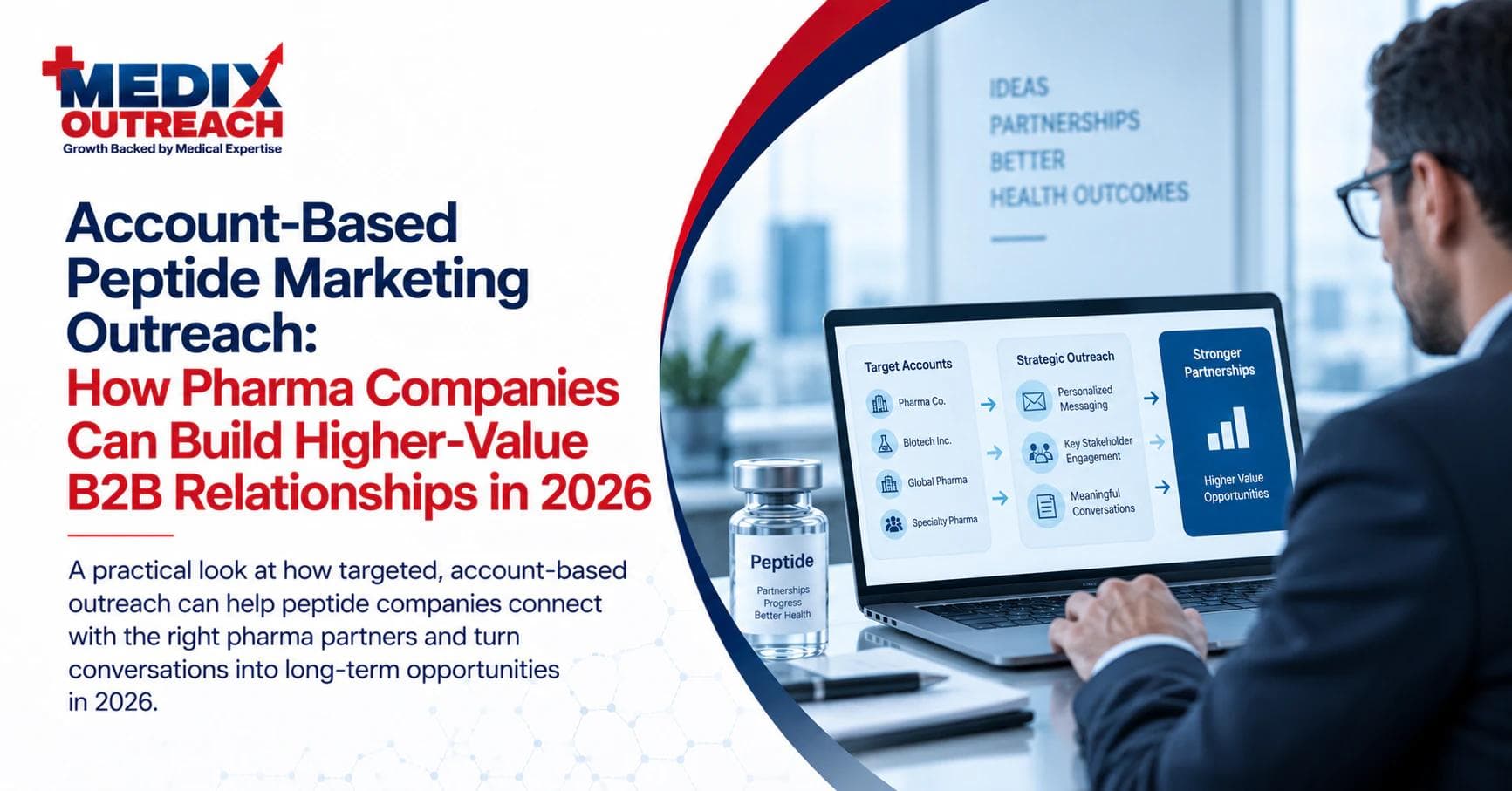
The peptide market is becoming too specialized for generic B2B outreach. Pharmaceutical companies have different pipelines, development stages, technical requirements, manufacturing models, and commercial priorities. Sending the same message to hundreds of companies is unlikely to create the strongest opportunities. A more focused approach is account-based peptide marketing outreach.
What account-based outreach means
Account-based outreach starts with the company rather than the contact list. Instead of asking “how many leads can we generate?” the better question is “which organizations have the highest potential fit for our capabilities?” That changes the entire process.
Step 1: Build a target-account universe
The first stage is identifying organizations that fit the company's commercial strategy. Potential criteria include:
- Peptide pipeline
- Development stage
- Therapeutic focus
- Manufacturing model
- Geographic market
- Partnership activity
- Commercial expansion plans
- Technical requirements
The objective is a qualified account universe rather than a large database - the same targeting discipline behind any effective peptide commercial pipeline.
Step 2: Map the organization
Once an account is identified, understand who influences the decision. Depending on the opportunity, that may include the CEO, COO, chief scientific officer, CMC leadership, manufacturing leadership, procurement, business development, and commercial leadership. Complex pharma purchases rarely depend on one person.
Step 3: Connect capabilities to business problems
The next step is positioning. A peptide company should be able to explain “our capability matters to this company because...” - based on evidence rather than assumptions. A company approaching scale-up requires a very different conversation from an early-stage biotech evaluating development and market-entry partners.
Mid-article CTA
Need help building your healthcare growth engine?
Medix helps healthcare startups, clinics, pharma companies, and provider-focused platforms build scalable commercial pipelines.
Book a Strategy CallStep 4: Build personalized outreach
Personalization should not mean simply adding someone's first name; it should reflect the business context. A strong message can reference a relevant pipeline development, a new program, a geographic expansion, a manufacturing requirement, a strategic partnership, or a commercialization milestone.
Step 5: Measure relationship progression
Traditional sales metrics often emphasize emails sent, contacts reached, and meetings booked. These can be useful, but complex B2B healthcare commercialization requires deeper measurement. Teams can also track:
- Target-account engagement
- Qualified conversations
- Technical discussions
- Multiple-stakeholder engagement
- Partnership discussions
- Commercial opportunities
- Account progression
The goal is to measure movement toward a business relationship.
Why this model fits peptide B2B sales
Peptide commercialization often involves complex technical and business decisions. A high-value account may require months of relationship development before a commercial agreement is possible. That means peptide B2B sales should not be evaluated only through short-term lead volume. The quality of the account, the relevance of the conversation, and the potential lifetime value of the relationship all matter.
Where a healthcare growth agency can add value
A healthcare growth partner working with peptide companies can support the process across research, account identification, stakeholder mapping, messaging, outreach, qualification, and relationship development. The key is maintaining healthcare context throughout - particularly for pharmaceutical audiences, where technical credibility and commercial relevance influence whether an outreach conversation continues.
Peptide marketing outreach should become more selective
As peptide markets become more competitive, the advantage may not come from contacting more companies. It may come from understanding fewer companies more deeply. That is the central principle behind account-based peptide marketing outreach.
Final takeaway
The future of peptide B2B sales is not about maximizing the number of prospects in a funnel. It is about identifying the accounts where technical capability, commercial need, timing, and strategic fit intersect. For peptide companies seeking sustainable growth in 2026, a focused healthcare commercialization strategy turns outreach from a volume exercise into a business development system - the same philosophy Medix brings to strategic partnerships and market expansion.