
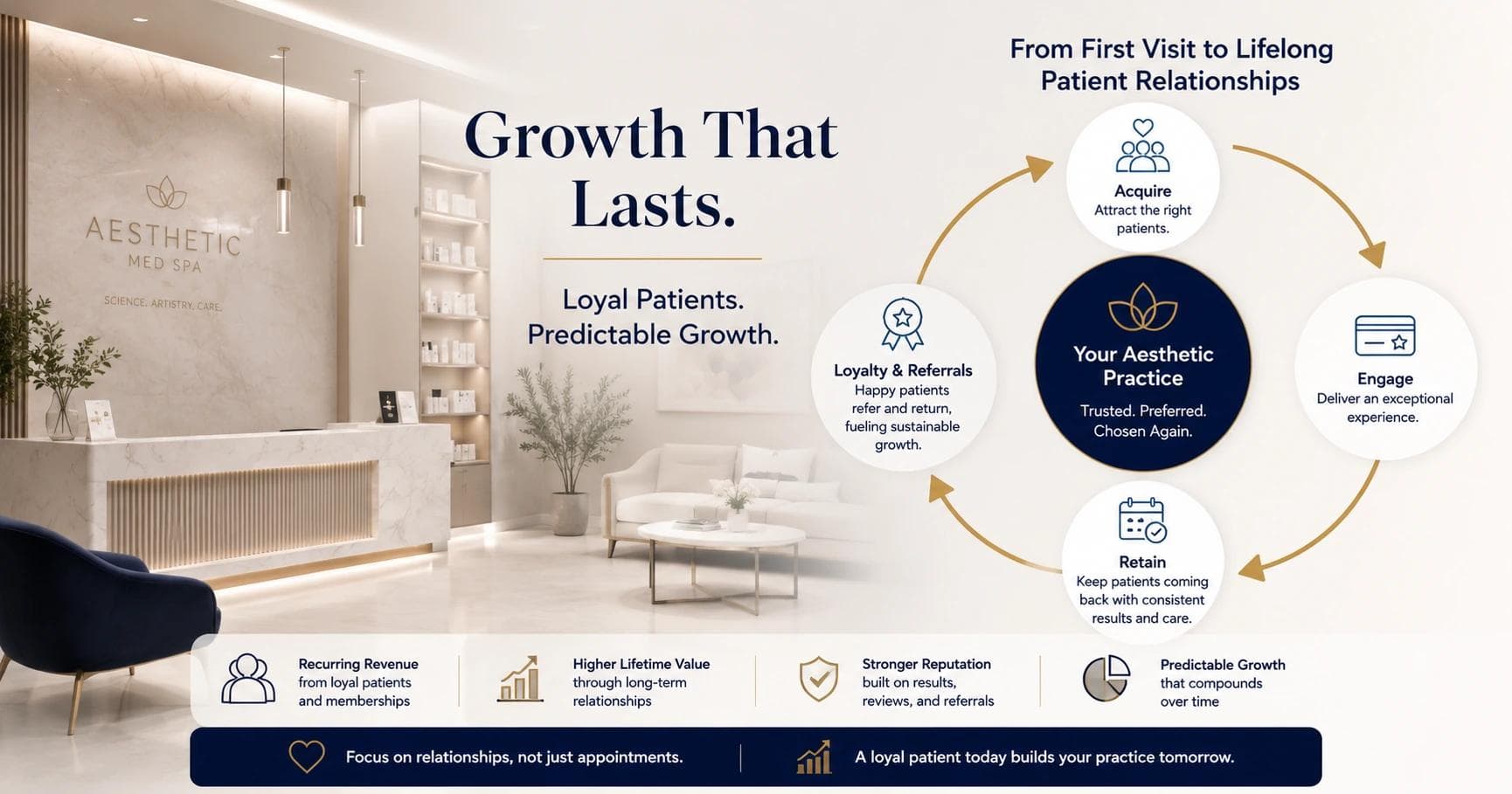
Medical aesthetics is one of the fastest-growing and most competitive segments in healthcare. Injectables, energy-based devices, skin treatments, and body procedures have moved from a niche into the mainstream, and new med spas and aesthetic practices open constantly. That growth is real, but it has a shadow: patient acquisition keeps getting more expensive, and a practice that treats every patient as a one-time transaction is running uphill against rising costs and rising competition.
The practices that grow profitably have figured out something the newcomers have not. Aesthetic patients are, by nature, recurring. Injectables wear off, skin needs ongoing care, and satisfied patients want to keep coming back. The entire economic advantage of the category is retention and lifetime value, and the practices that build for that beat the ones chasing an endless stream of first-time bookings. This is a practice-growth and business guide, not a clinical or device one.
Short version: aesthetic practice growth is won on retention, reputation, and referrals, not on being the practice with the newest laser. Build recurring relationships and membership economics, engineer a reputation-and-referral engine that lowers acquisition cost over time, and market within the FTC and medical-practice rules. Do that and growth compounds instead of costing more every month.
Compete on the Experience, Not the Device
New aesthetic practices often anchor their entire identity on equipment - the newest injectable, the latest device - and it is a weak foundation. Equipment is available to competitors, quickly matched, and invisible to most patients, who cannot evaluate a device but can absolutely evaluate how they were treated, how natural their results look, and whether they trust the provider.
What patients actually choose and stay for is the experience and the outcome: the skill and aesthetic judgment of the provider, the sense of safety and expertise, the personalization, and the way the practice makes them feel. A practice that competes on genuine clinical skill and an exceptional patient experience builds something a competitor cannot buy off a vendor's price list. This is the same reason clinical credibility and reputation beat advertising across all of healthcare - patients trust demonstrated expertise, not equipment specs.
Our work accelerating aesthetic clinic adoption through strategic positioning is a direct example: the win came from sharper positioning and a stronger value story, not a new machine.
The Retention Math
The most important number in an aesthetic practice is not the cost to acquire a patient; it is what that patient is worth over time. An aesthetic patient who returns for maintenance treatments across years is worth a large multiple of a one-time visit, and that lifetime value is the entire economic engine of the category.
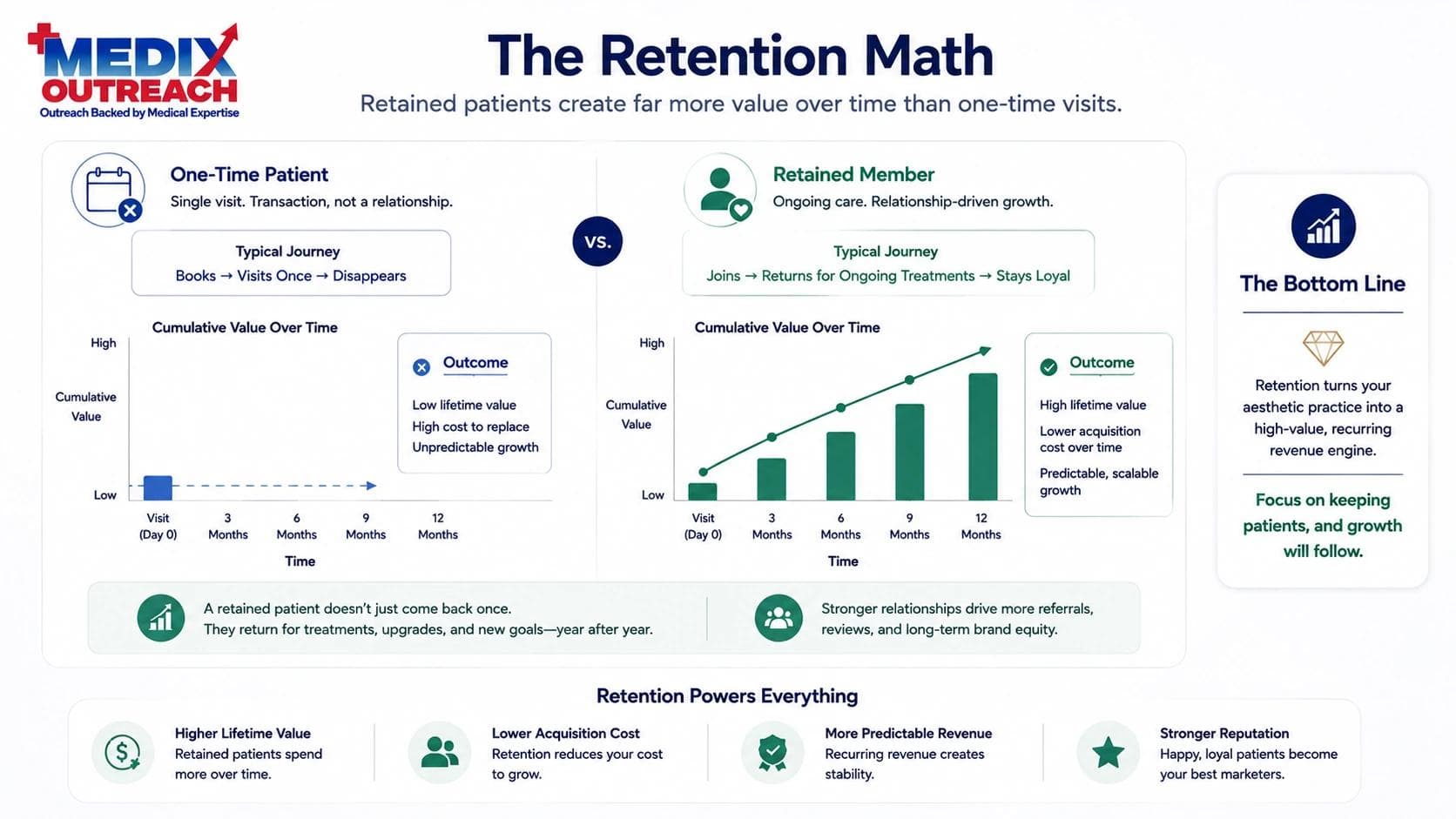
Building for retention reshapes the practice:
- Membership and loyalty models that convert episodic patients into recurring members with predictable revenue. Well-designed memberships align the practice and the patient around ongoing care and dramatically increase retention and lifetime value.
- Treatment planning and recall that keep patients on a cadence, so maintenance is a planned relationship rather than a hope that they rebook.
- A patient experience worth returning for, because in a category where patients have endless options, the practice that makes them feel expertly cared for keeps them.
A practice that pours money into acquisition while patients churn after one visit is subsidizing its competitors' growth, because those patients often end up loyal somewhere else. Fixing retention is usually the highest-return growth move available, and it costs far less than buying more first-time traffic.
A Reputation and Referral Engine
In aesthetics, results are visible and personal, which makes reputation and referral the most powerful and cheapest acquisition channel that exists. A patient thrilled with their results is a walking advertisement, and their friends ask where they went. Practices that engineer this on purpose lower their acquisition cost every year; practices that leave it to chance keep paying for ads.
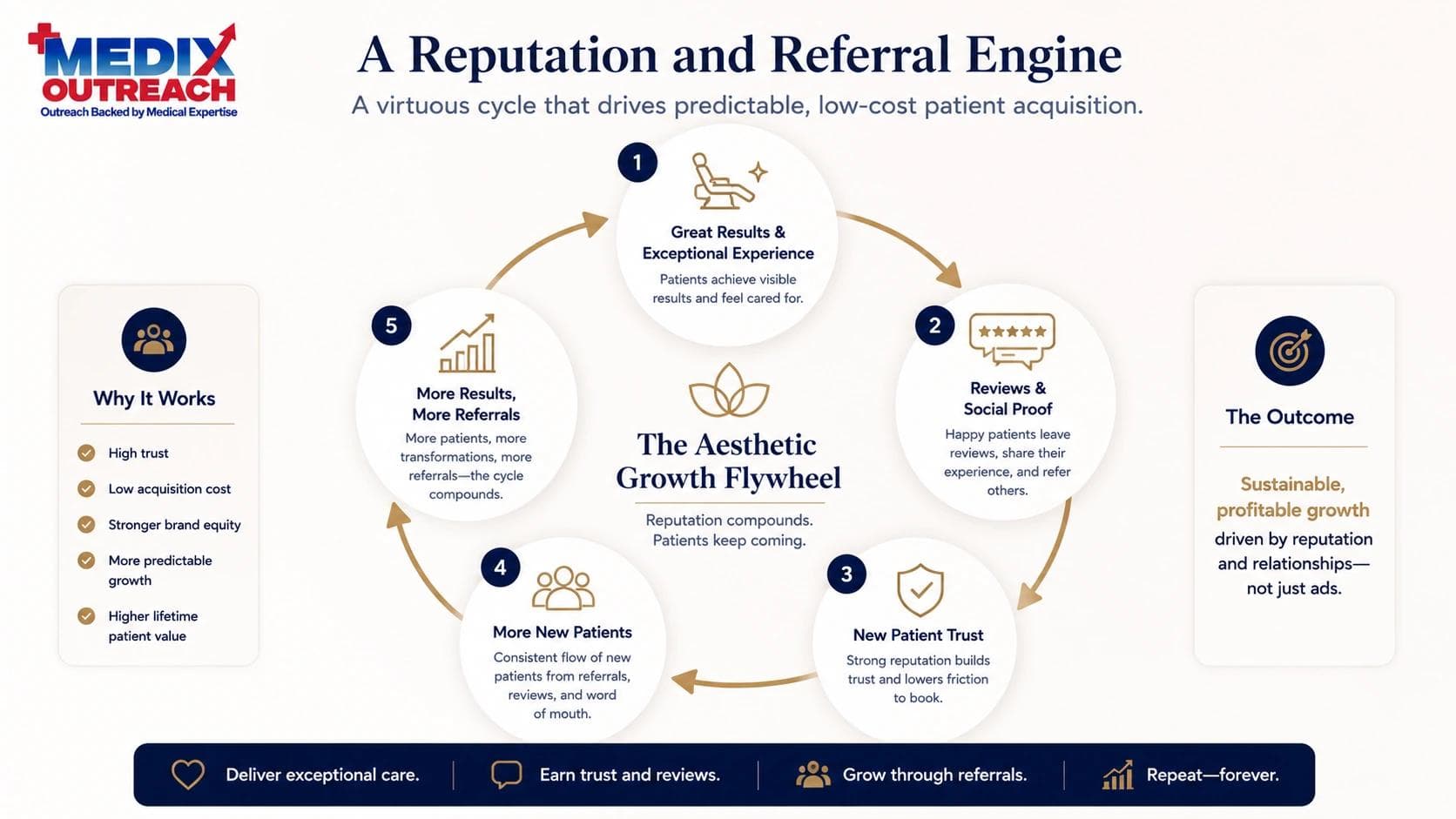
The engine compounds:
- Deliver results and an experience worth talking about, which is the fuel for everything downstream.
- Systematically generate reviews and social proof, honestly and with appropriate disclosures, because prospective aesthetic patients research heavily before booking.
- Make referrals easy and rewarding for existing patients, turning satisfaction into a steady stream of pre-trusted new patients.
- Build referral relationships with adjacent providers - primary care, gynecology, weight-management programs, and others whose patients overlap. This is the same referral development discipline used across healthcare, and it pairs naturally with programs like medical weight loss, where patient interest in aesthetics and wellness overlaps heavily.
The reputation-and-referral engine is the aesthetic practice's version of a compounding asset. Paid ads stop working the day you stop paying; a strong reputation and referral base keep producing.
Mid-article CTA
Need help building your healthcare growth engine?
Medix helps healthcare startups, clinics, pharma companies, and provider-focused platforms build scalable commercial pipelines.
Book a Strategy CallMarket Within the Rules
Aesthetic marketing sits inside real legal constraints, and ignoring them is a genuine risk. The Federal Trade Commission's endorsement and advertising rules govern how you can use testimonials, reviews, influencer endorsements, and before-and-after imagery, and enforcement in the aesthetics space is active.
The practical guardrails:
- Handle testimonials, reviews, and before-and-after content honestly, with required disclosures, and never fabricate or deceptively incentivize endorsements.
- Avoid unsubstantiated or exaggerated claims about results, safety, or outcomes.
- Respect medical direction and scope-of-practice rules, which govern who may perform and supervise medical aesthetic procedures and vary significantly by state. A growth strategy that ignores these creates regulatory and liability exposure.
Compliant marketing is not a limitation on growth; it is part of building the trusted brand that drives retention and referrals. Patients and regulators both reward practices that operate cleanly. Generating new-patient interest the right way follows the same principles as any healthcare lead generation, where quality and honesty are what make the leads worth having.
Diversify Beyond Paid Acquisition
Because aesthetic patients research and choose deliberately, and because paid channels get more expensive as competition rises, the strongest practices build a diversified acquisition mix. Paid ads have a place, but a practice that depends on them alone is exposed to rising costs and platform changes. The durable mix leans on reputation, referrals, memberships, and the kind of local trust that a practice earns over time - the same fundamentals behind growing any clinic or private practice.
Where Medix Fits
Medix Outreach helps aesthetic practices and med spas grow the durable way. Our patient acquisition and practice growth work builds retention and membership economics, engineers the reputation and referral engine that lowers acquisition cost over time, and keeps marketing compliant and credible - so first visits turn into loyal, recurring patients. We help you build a practice that grows on loyalty, not on an ever-rising ad budget.
Frequently Asked Questions
How do you grow an aesthetic practice or med spa profitably?
Compete on the patient experience and clinical skill rather than equipment, build retention and membership models that turn one-time patients into recurring members, and engineer a reputation-and-referral engine that lowers acquisition cost over time. Because aesthetic patients are naturally recurring, lifetime value and retention are the economic engine, so the highest-return move is usually keeping patients rather than constantly buying new ones.
Why is patient retention so important for a med spa?
Because an aesthetic patient who returns for maintenance treatments over years is worth a large multiple of a one-time visit, and that lifetime value is the category's entire economic advantage. A practice that churns patients after one visit is subsidizing competitors, since those patients often become loyal elsewhere. Membership models, treatment recall, and an experience worth returning for convert episodic patients into predictable recurring revenue.
What is the best marketing channel for an aesthetic practice?
Reputation and referrals are the most powerful and cost-effective channels, because aesthetic results are visible and personal, so satisfied patients naturally attract others. Practices that systematically generate honest reviews, make referrals easy, and build relationships with adjacent providers lower their acquisition cost every year. Paid advertising has a role but gets more expensive over time, so it should complement rather than carry the growth.
What are the marketing compliance rules for med spas?
The FTC's endorsement and advertising rules govern testimonials, reviews, influencer endorsements, and before-and-after imagery, all of which must be handled honestly with required disclosures and without fabrication. Claims about results and safety must be substantiated, and practices must respect medical-direction and scope-of-practice rules that govern who can perform and supervise procedures and vary by state. Operating cleanly protects the practice and builds the trusted brand that drives growth.
Should a med spa use a membership model?
For most aesthetic practices, yes. Well-designed membership and loyalty models convert episodic patients into recurring members, which increases retention, lifetime value, and revenue predictability. Because the category is inherently recurring - injectables wear off and skin needs ongoing care - memberships align the practice and patient around continued treatment, turning maintenance into a planned relationship instead of a hoped-for rebooking.