
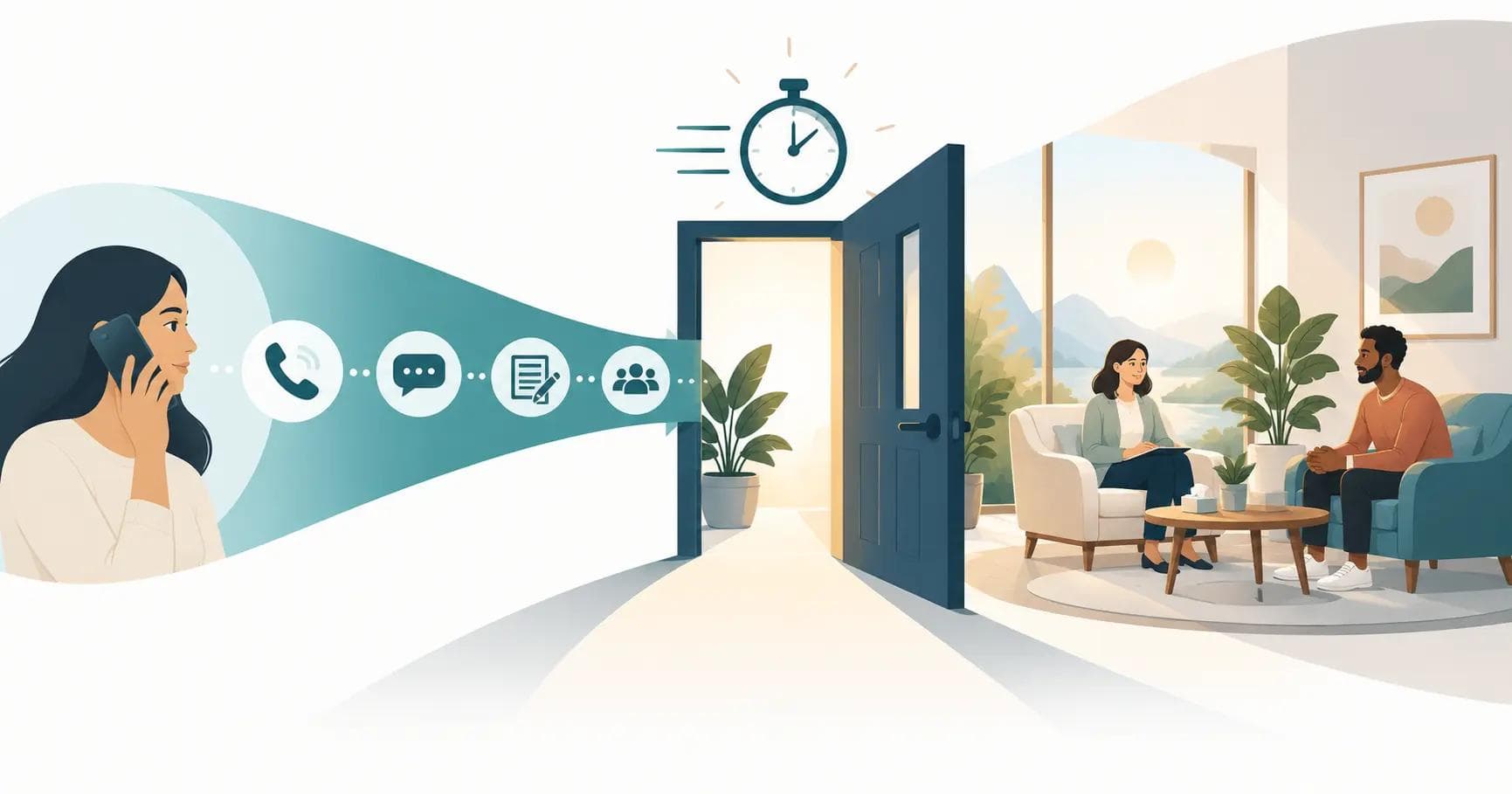
Behavioral health admissions - or intake - is the process that converts an inquiry or referral into an admitted patient, through fast response, clinical screening, benefits verification, and a bed or appointment offer. It is the most underinvested part of most behavioral health growth strategies, and it is where the majority of hard-won referrals quietly leak away. This guide lays out the admissions funnel, the operational levers that move conversion, and the KPIs to run it by.
Admissions is the second half of a system whose first half is addiction treatment referral growth. You can build every referral relationship perfectly and still lose the patient at the front door. In a crisis, the right pathway is always the 988 Suicide and Crisis Lifeline or 911 - admissions is about non-emergent access to care.
Why admissions is a conversion problem, not just an operations one
In behavioral health, the moment someone reaches out is often a narrow window of readiness. A person or family who finally decides to seek help, and then hits a full voicemail box, a two-day callback, or a confusing benefits process, may not try again. This is why admissions belongs in your growth strategy, not just your operations manual: every leak in the funnel is a person who did not get care and a referral source who learned not to trust you.
The admissions funnel
Map admissions as a funnel and you can see exactly where you lose people. Each transition has a predictable failure mode.
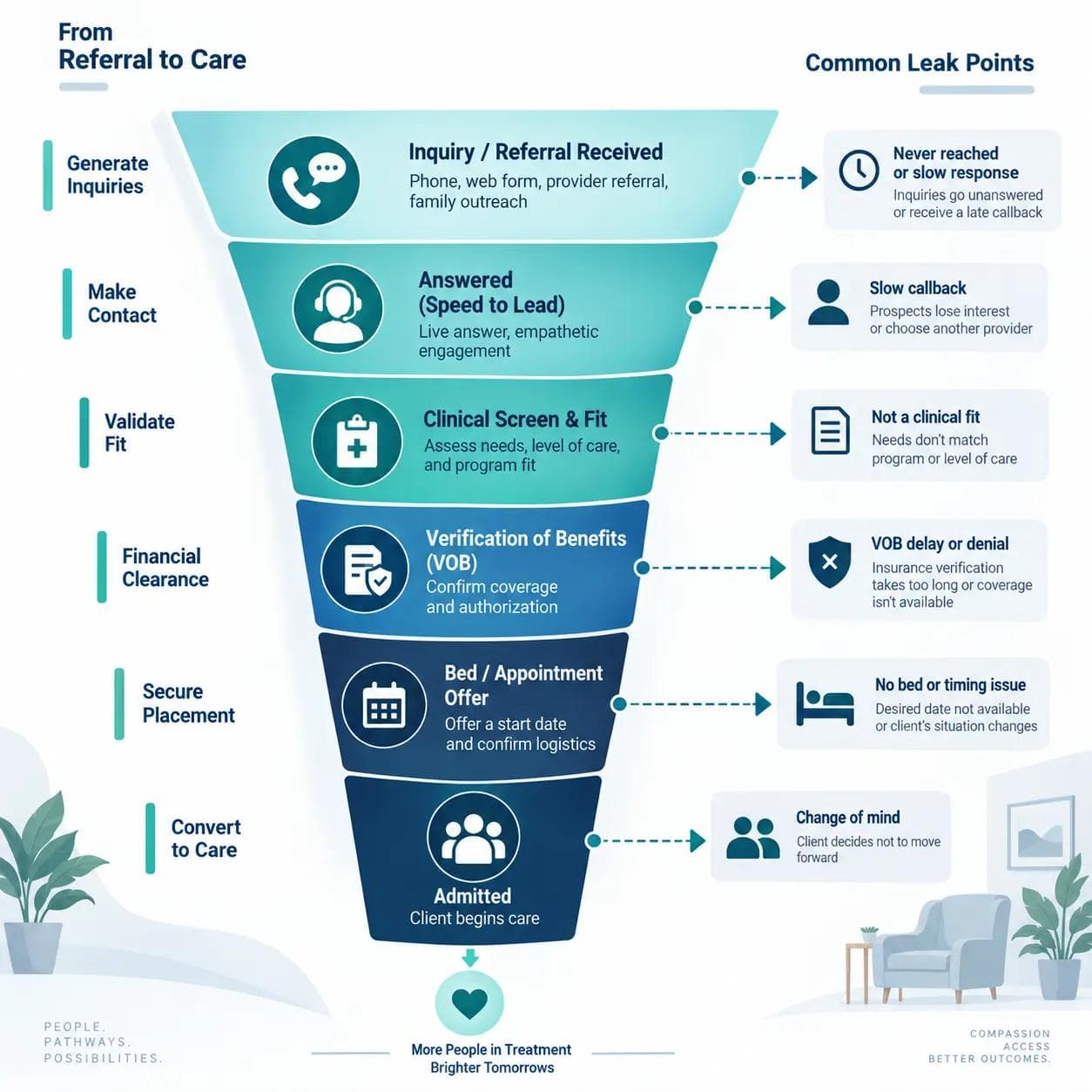
- Inquiry / referral received - from a person, family, or referring provider.
- Answered (speed to lead) - the biggest single leak; slow or missed first contact loses the reachable-and-ready.
- Clinical screen and fit - level-of-care and appropriateness assessment against your protocols.
- Verification of benefits (VOB) - a frequent stall point; slow or opaque VOB drives people away.
- Bed or appointment offer - no availability at the moment of need is a hard leak.
- Admitted - the conversion that actually matters.
This is the same drop-off logic behind how you measure referral leakage, applied to the intake process specifically.
The levers that move admissions conversion
Speed to answer
Answer live whenever possible, and if you cannot, call back in minutes, not hours. Staff your admissions line for the hours people actually reach out - including evenings and weekends. Measure and post your speed-to-answer; it is the highest-leverage number in the funnel.
A human, clinical first contact
The first conversation should be warm, clinically competent, and oriented to the person's needs, with appropriate clinical triage and routing to the right level of care. Scripts help consistency but must not make the caller feel processed.
Frictionless verification of benefits
Make VOB fast and transparent. Set expectations, move quickly, and never let a benefits question freeze a clinically appropriate admission. A slow VOB is one of the most common and most fixable leaks.
Bed and capacity management
Know real-time availability across your levels of care so admissions can make an offer immediately. If you have no bed, a warm handoff or a scheduled follow-up beats a dead end.
No wrong door
When you are not the right fit, guide the person to appropriate care anyway - using the national treatment locator or a trusted partner. It is the ethical thing to do, it protects your referrer relationships, and it builds the reputation that brings appropriate patients back to you.
Mid-article CTA
Need help building your healthcare growth engine?
Medix helps healthcare startups, clinics, pharma companies, and provider-focused platforms build scalable commercial pipelines.
Book a Strategy CallAdmissions KPIs
- Speed to answer - average and worst-case time to first live contact.
- Inquiry-to-admit conversion - the headline outcome, tracked by referral source.
- Stage drop-off - where in the funnel people are lost (answer, screen, VOB, bed).
- Time to admission - hours or days from inquiry to admit.
- Abandonment - calls and inquiries that never reach a human.
- Referrer satisfaction - whether referring providers see their patients handled well.
Closing the loop with referrers
Staffing and technology for a modern admissions function
Speed-to-answer and smooth VOB are people-and-systems problems. The organizations that convert well invest in both:
- Extended-hours coverage - staff or an answering solution for evenings and weekends, when many inquiries actually arrive.
- Clinically capable intake staff - the first contact should be able to screen and reassure, not just take a message.
- A CRM or intake system - so every inquiry is logged, timed, and followed up, and none fall through voicemail.
- Real-time capacity visibility - admissions must see availability across levels of care to make an immediate offer.
- A VOB workflow with clear ownership - fast, transparent benefits checks that never freeze a clinically appropriate admit.
- Follow-up cadence for non-admits - many people are not ready on day one; a respectful follow-up path recovers them.
Admissions is also where you keep referral sources. When a provider refers a patient, a fast closed-loop referral workflow update - received, admitted, in care - is what makes them refer again. A referral engine and an admissions engine that do not talk to each other will underperform both. Medix's Provider Network Development team helps behavioral health providers tighten the whole path from referral to admit.
Frequently Asked Questions
What is behavioral health admissions?
Behavioral health admissions - often called intake - is the process that converts an inquiry or referral into an admitted patient: answering the contact, clinically screening for fit and level of care, verifying benefits, and offering a bed or appointment. It is the operational bridge between marketing/referrals and clinical care.
Why do behavioral health facilities lose so many referrals at intake?
The most common causes are slow speed-to-answer, cumbersome verification of benefits, no available bed at the moment of need, and a fragmented handoff. Each is an operational leak, and together they can lose a large share of hard-won referrals before anyone is admitted.
What is 'no wrong door' in behavioral health?
No wrong door means a person who reaches out for help is guided to appropriate care regardless of which door they came through - even if your program is not the right fit. It reduces harm, protects referrer trust, and, done well, still routes appropriate patients to you.
What is the most important admissions KPI?
Speed-to-answer and the inquiry-to-admit conversion rate. In behavioral health, the window of readiness can be short; a fast, human, well-handled first contact is the single biggest lever on conversion.