

Addiction treatment centers grow durable admissions by building ethical, well-managed referral relationships across hospitals, providers, community partners, and alumni - not by buying leads. The addiction treatment field has a history of aggressive and sometimes illegal marketing, which makes the ethical, relationship-based path both the safer and the more sustainable one. This guide maps the legitimate referral sources, the compliance lines you cannot cross, and the playbook for building relationships that keep sending patients.
If you or someone you know needs help now, the SAMHSA National Helpline offers free, confidential support, and the national treatment locator lists licensed treatment. This article is about how legitimate providers grow responsibly.
Why relationships beat lead brokers
Purchased leads are seductive because they look like instant volume. They are also the most fragile and most legally fraught way to grow. Lead quality is inconsistent, costs rise as competitors bid, and pay-per-admission arrangements can run headlong into patient-brokering and anti-kickback laws. Relationship-based referrals, by contrast, compound: a hospital discharge planner or a primary care physician who trusts you refers again and again, at no marginal acquisition cost.
The goal is a diversified referral network built the same way as any strong psychiatry referral network - many sources, real relationships, and a system to manage them.
The addiction treatment referral-source map
Most centers underuse the range of legitimate sources available to them. Map all of them, then prioritize by fit and volume potential.
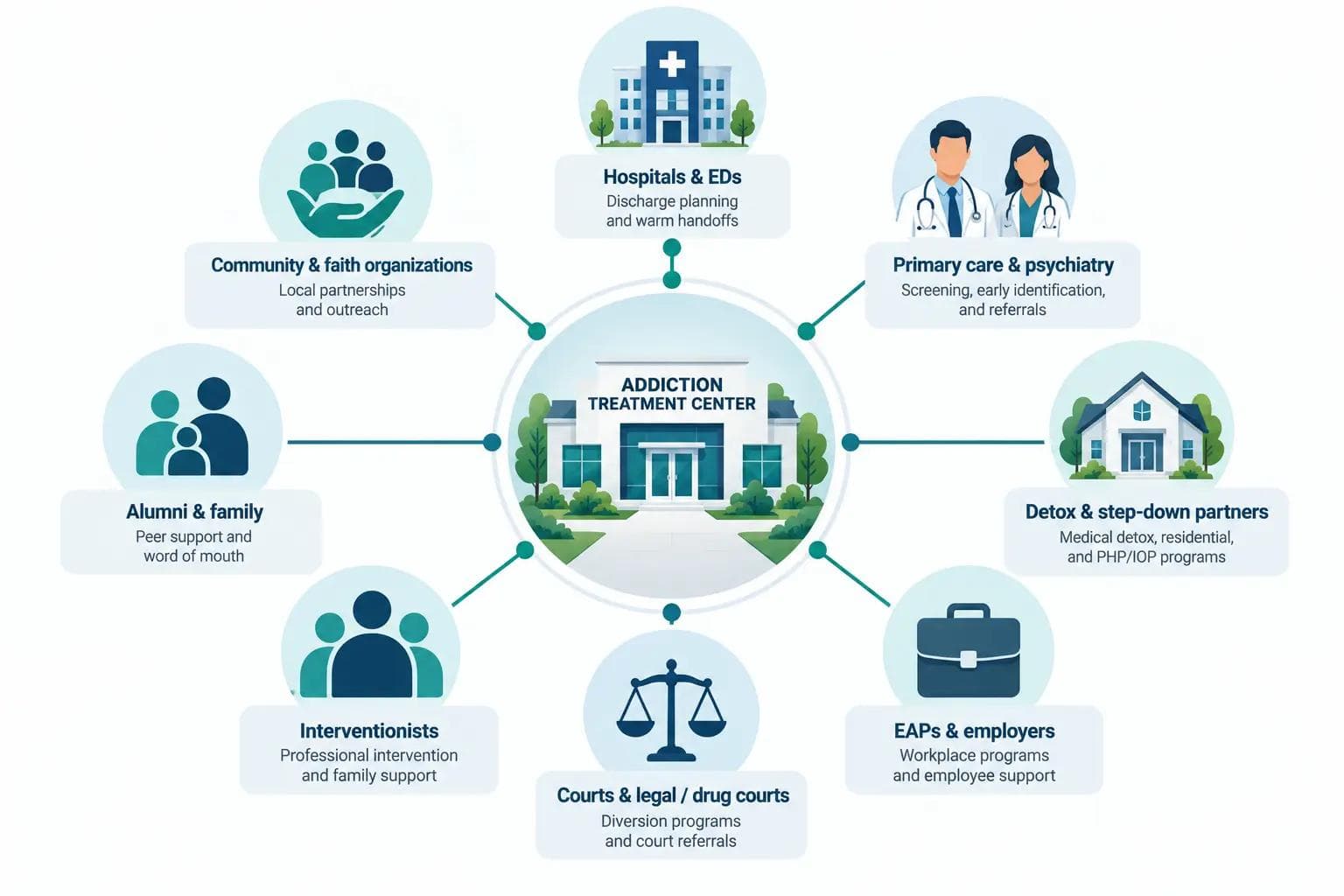
- Hospitals and emergency departments - a major, underworked source; overdose and crisis presentations need fast, reliable step-down partners. See our guide to hospital discharge and ED referral pathways.
- Primary care and psychiatry - providers managing substance use who need a trusted place to refer for higher levels of care.
- Detox and step-down partners - reciprocal relationships along the continuum of care (detox, residential, PHP, IOP, outpatient).
- EAPs and employers - employee assistance programs and self-funded employers with members who need treatment.
- Courts and the legal system - drug courts, probation, and legal referrals, which require reliable reporting and communication.
- Interventionists - professionals who place clients and value responsiveness and outcomes.
- Alumni and family - the most durable source of all; former clients and their families refer when the experience was good.
- Community and faith organizations - trusted local referrers close to people who need help.
The compliance lines you cannot cross
Referral growth in addiction treatment sits inside a strict legal frame. The core principle is simple: you may build relationships and improve access, but you may not pay for patients. Practical guardrails:
- Do not pay per referral or per admission. Federal and many state patient-brokering and anti-kickback laws prohibit paying for patients; violations carry criminal exposure.
- Vet marketing arrangements. 'Marketing' contracts that are really pay-per-head are a common trap. Have counsel review any lead, marketing, or call-center arrangement.
- Advertise transparently. Represent your services, licensure, and outcomes honestly. Deceptive claims draw regulator and platform action.
- Meet platform requirements. Major ad platforms require independent vetting such as independent treatment marketing certification before you can advertise treatment.
- Protect patient privacy. Substance use records carry heightened federal confidentiality protections; handle referral data accordingly.
Mid-article CTA
Need help building your healthcare growth engine?
Medix helps healthcare startups, clinics, pharma companies, and provider-focused platforms build scalable commercial pipelines.
Book a Strategy CallThe relationship playbook
- Lead with access and reliability. The single most valuable thing you offer a referrer is a patient seen quickly and handled well. Same-day response and clear admission criteria beat any brochure.
- Make referring effortless. A clear, fast referral pathway and a real person who answers removes the friction that sends patients elsewhere.
- Warm up relationships properly. Discharge planners, case managers, and clinicians refer to people they trust - the trust-building approach in earn trust before the first meeting applies directly.
- Close the loop. Report back to referrers on admission and progress, within privacy rules. A closed-loop referral workflow is what turns a one-time referral into a standing relationship.
- Invest in alumni. A strong alumni program is a compounding, no-cost referral engine and a marker of real outcomes.
Referrals are wasted if admissions leak
Common mistakes in treatment center referral growth
- Single-channel dependence - relying on purchased leads until the channel tightens or a compliance issue appears.
- Treating admissions as separate from referrals - a great referral relationship dies at a slow admissions line.
- Neglecting alumni - the most durable, lowest-cost referral source, routinely left unmanaged.
- Over-promising in marketing - deceptive outcome claims invite regulator and platform action and erode referrer trust.
- Ignoring the legal review - assuming a 'marketing' contract is fine when it is really pay-per-head.
- No closed loop - failing to update referrers, so a first referral never becomes a standing one.
The hardest-won referral is lost if the person cannot reach admissions, waits days for a callback, or gives up during verification of benefits. Referral growth and admissions conversion are two halves of one system - build both together. Medix's Provider Network Development team helps treatment providers build ethical, diversified referral networks and the intake discipline that converts them.
Frequently Asked Questions
How do addiction treatment centers get referrals?
Durable referrals come from relationships with hospitals and EDs, primary care and psychiatry, detox and step-down partners, EAPs and employers, the legal system, interventionists, and alumni and family networks - supported by compliant, transparent marketing. Sustainable programs build many sources rather than depending on purchased leads.
Is buying patient leads for addiction treatment legal?
It depends on structure and jurisdiction. Federal and many state patient-brokering and anti-kickback laws restrict paying for patient referrals, and arrangements that look like paying per admission carry serious legal risk. Any lead or marketing arrangement should be reviewed by qualified counsel before you sign.
What is LegitScript certification and do I need it?
LegitScript certification is an independent vetting widely required to advertise addiction treatment on major platforms. It signals that a provider meets legitimacy and compliance standards, and it is often a practical prerequisite for paid advertising eligibility.
What is the biggest mistake treatment centers make in referral growth?
Depending on a single channel - usually paid leads - instead of building diversified, relationship-based referral sources. When one channel tightens or a compliance issue surfaces, single-channel programs collapse. Diversified referral networks are far more durable.