
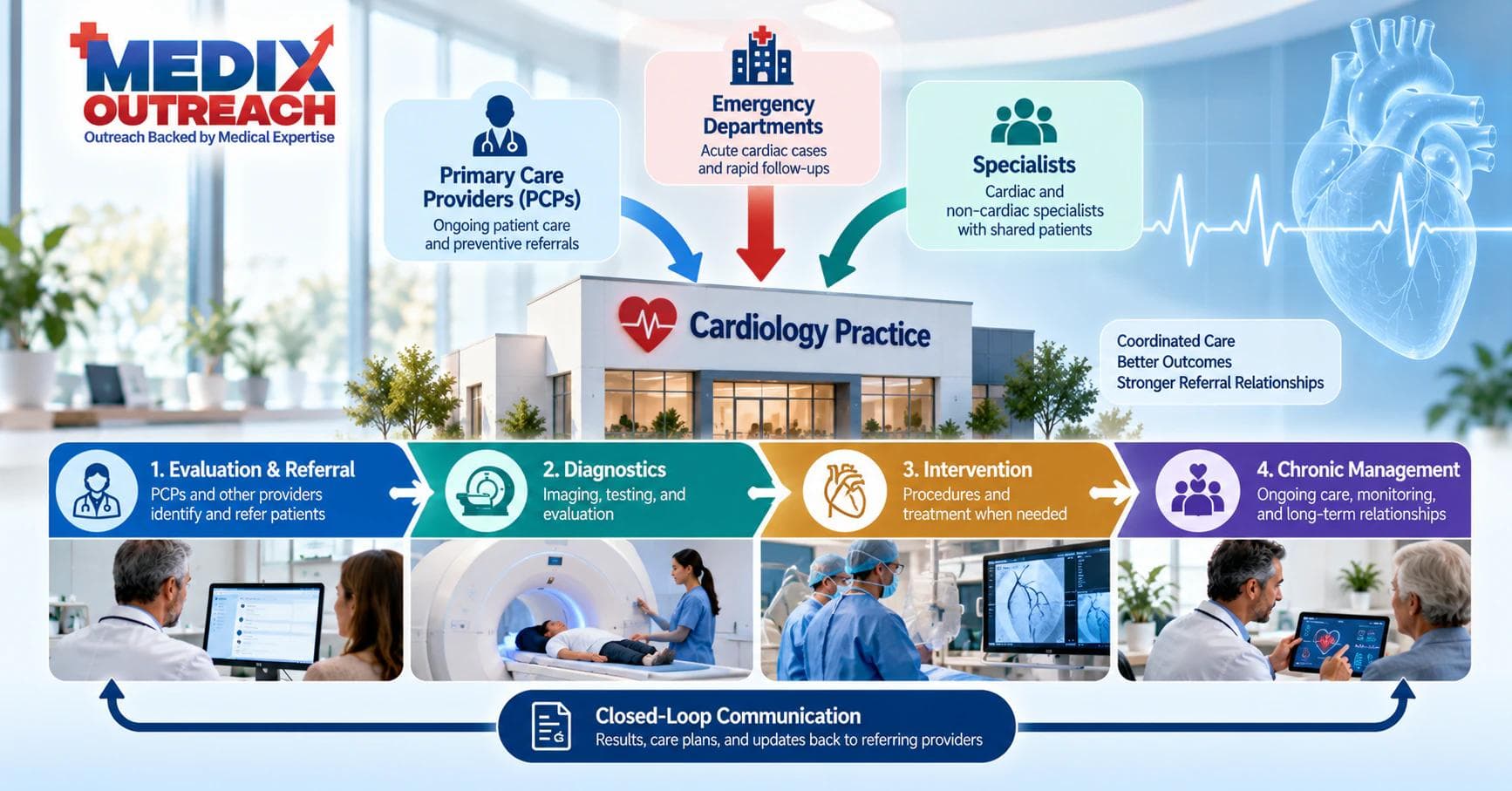
Cardiology is one of the most referral-dependent specialties in medicine. A cardiology practice does not grow by attracting patients directly; it grows when primary care physicians, emergency departments, and other specialists consistently send the right patients at the right stage of the cardiac journey. The practices that scale treat referral development as an operating system, not an occasional outreach effort.
This guide covers where cardiology referrals come from, what referring physicians actually want, how value-based care is reshaping the cardiac referral landscape, and how to grow referral volume inside the rules that govern physician referrals.
Map referral sources across the cardiac journey
Cardiology referrals do not come from one place. They flow in at different stages of the patient's cardiac journey, and each source needs a different relationship.
- Primary care physicians — the largest volume source, referring for everything from hypertension and arrhythmia symptoms to abnormal test results.
- Emergency departments and hospitalists — for acute events and post-discharge follow-up, where fast access prevents readmissions.
- Other specialists — nephrology, endocrinology, pulmonology, and OB-GYN, who manage patients with cardiac comorbidities.
- Within-practice and sub-specialty referrals — general cardiology to electrophysiology, structural heart, heart failure, and advanced imaging.
Growth starts with seeing this map clearly: which sources send volume, which are declining, and which should refer but do not. That is the referral-analytics discipline Medix applies across specialties — tracking referral sources and conversion.
What referring physicians want from a cardiology practice
Referrers choose a cardiology practice on whether it makes care easier and safer for their patient. The levers:
- Timely access. Fast appointments for urgent and semi-urgent cases, and reliable post-discharge follow-up. Access is the number-one driver of where a PCP or ED sends a cardiac patient.
- Closed-loop communication. The referring physician wants to know the patient was seen, what was found, and the plan — delivered promptly into their workflow. Referral leakage and silence are the fastest way to lose a referrer.
- Clinical trust and breadth. Confidence in the cardiologists, and a practice that can handle the full journey from diagnostics through intervention and chronic management.
- A frictionless referral process. Easy order submission and EHR-integrated results reduce the effort of referring to you.
The American College of Cardiology provides the clinical standards and guidelines that underpin that trust; demonstrating alignment with current guidelines reassures referrers.
Value-based care is reshaping cardiac referrals
As cardiology moves into accountable and value-based arrangements, referral decisions increasingly run through networks, not just individual relationships. Clinically integrated networks and ACOs steer referrals to preferred cardiology partners based on quality, cost, and care-coordination performance. A practice that wants durable referral growth has to be a strong network partner, not just a well-liked one — the dynamic Medix covers in how value-based networks reshape referrals. Being measurably good at access, outcomes, and closing the loop is becoming a referral requirement, not a differentiator.
Grow referrals within Stark and Anti-Kickback rules
Cardiology referral development operates inside strict federal rules.
- The Physician Self-Referral Law (Stark) restricts referrals for designated health services when a financial relationship exists, unless an exception applies — relevant to cardiac imaging and diagnostics. See CMS physician self-referral.
- The Anti-Kickback Statute prohibits inducements for referrals of federally reimbursed services — see the OIG fraud and abuse laws.
The compliant growth path is the same one that actually works: earn referrals through access, service, clinical quality, and communication — never through inducements. Have counsel review any liaison program, co-management arrangement, or referral relationship.
Mid-article CTA
Need help building your healthcare growth engine?
Medix helps healthcare startups, clinics, pharma companies, and provider-focused platforms build scalable commercial pipelines.
Book a Strategy CallBuild a cardiology referral-development program
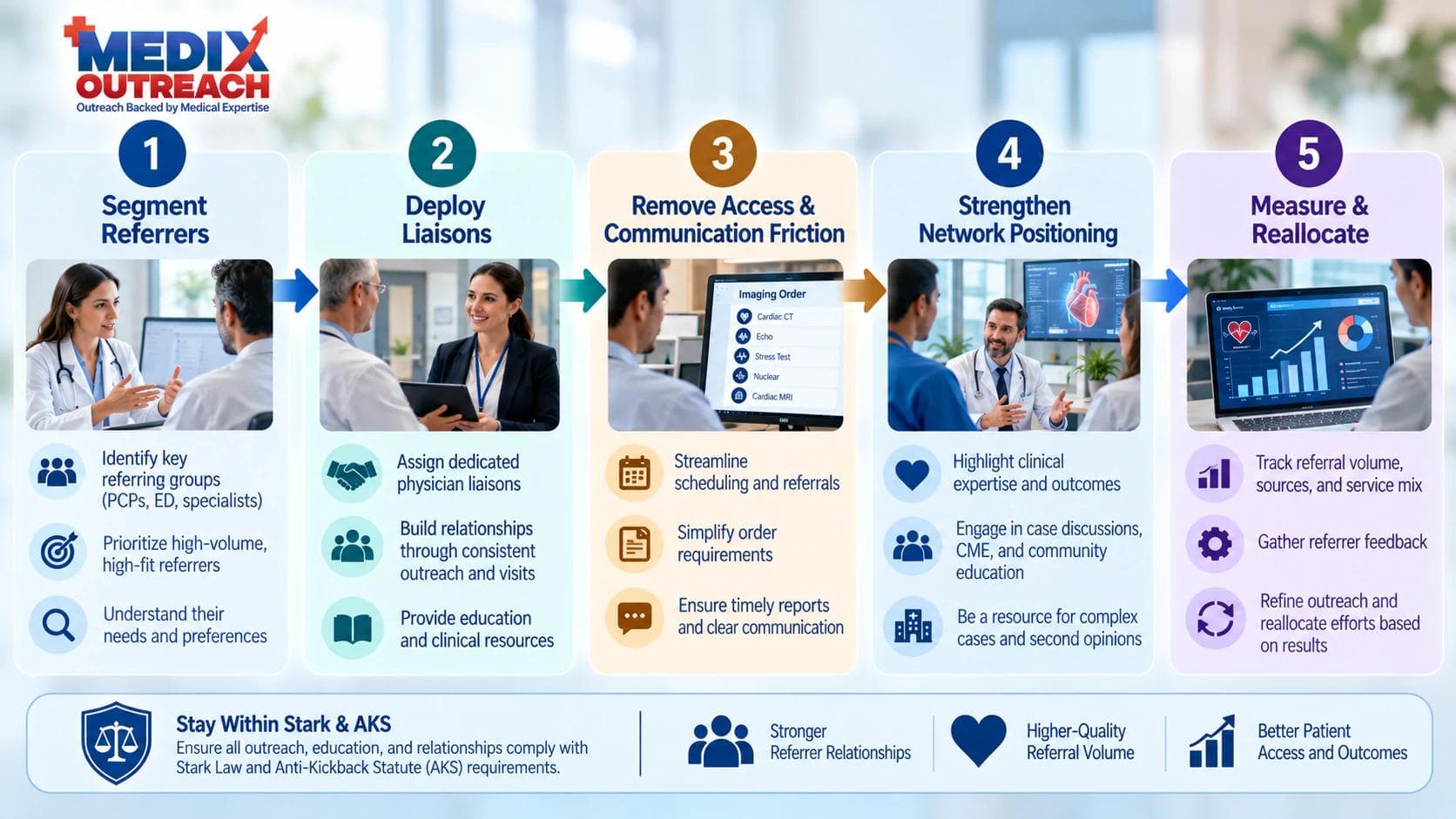
Durable cardiology referral growth is a repeatable program, the same structure Medix uses across specialties like orthopedic referral growth:
- Segment referrers by source type and volume potential (grow, protect, win back).
- Deploy physician liaisons to build relationships, carry a consistent message, and surface friction — see the Medix physician-liaison program guide.
- Remove access and communication friction — urgent-slot availability, post-discharge pathways, and closed-loop reporting.
- Strengthen network positioning with CINs and ACOs so you are a preferred cardiology partner.
- Measure and reallocate based on referral volume and conversion by source.
Measure what grows the practice
- Referral volume by source and trend (PCP, ED, specialist, sub-specialty).
- Referral-to-appointment conversion and time-to-appointment — especially for urgent and post-discharge referrals.
- New referrers activated and lapsed referrers recovered.
- Network / value-based referral share as accountable arrangements grow.
Frequently asked questions
How do cardiology practices get more referrals? By mapping referral sources across the cardiac journey, delivering fast access and closed-loop communication, earning clinical trust, and managing referrer relationships through liaisons — all within Stark and Anti-Kickback limits. Strong value-based-network positioning increasingly matters too.
Who refers patients to cardiologists? Primarily primary care physicians, plus emergency departments and hospitalists for acute and post-discharge care, and other specialists managing patients with cardiac comorbidities. Sub-specialty referrals within cardiology (EP, structural heart, heart failure) are also significant.
How is value-based care changing cardiology referrals? Referrals increasingly flow through clinically integrated networks and ACOs that steer patients to preferred cardiology partners based on quality, cost, and coordination. Being a measurably strong network partner is becoming essential to referral growth.
What is the fastest way to lose cardiology referrers? Poor access and silence. If urgent patients cannot be seen quickly, or the referring physician never learns what happened, the referrals move to a competitor who closes the loop.
Becoming the cardiology practice referrers rely on
Cardiology referral growth comes from being easy to refer to, fast to access, reliable in communication, and strong as a network partner — measured rigorously and developed compliantly. Practices that build that system grow referral volume across the entire cardiac journey while competitors chase patients directly.
Medix Outreach builds compliant referral-development programs and provider networks for cardiology and other specialty practices. To grow your cardiology referral base, book a free strategy call or explore our Provider Network Development service.