
A psychiatry referral form should capture exactly what the practice needs to triage and schedule the patient safely — and nothing more. Every field beyond that is friction, and friction is where referrals leak. The form is not a compliance artifact or a data-collection opportunity; it is the on-ramp to your psychiatry referral network, and its only job is to move an appropriate patient from a referring provider's office into your intake with as little drop-off as possible. This article covers what a psychiatry referral form should include, what it should not make mandatory, and how form design directly changes referral leakage.
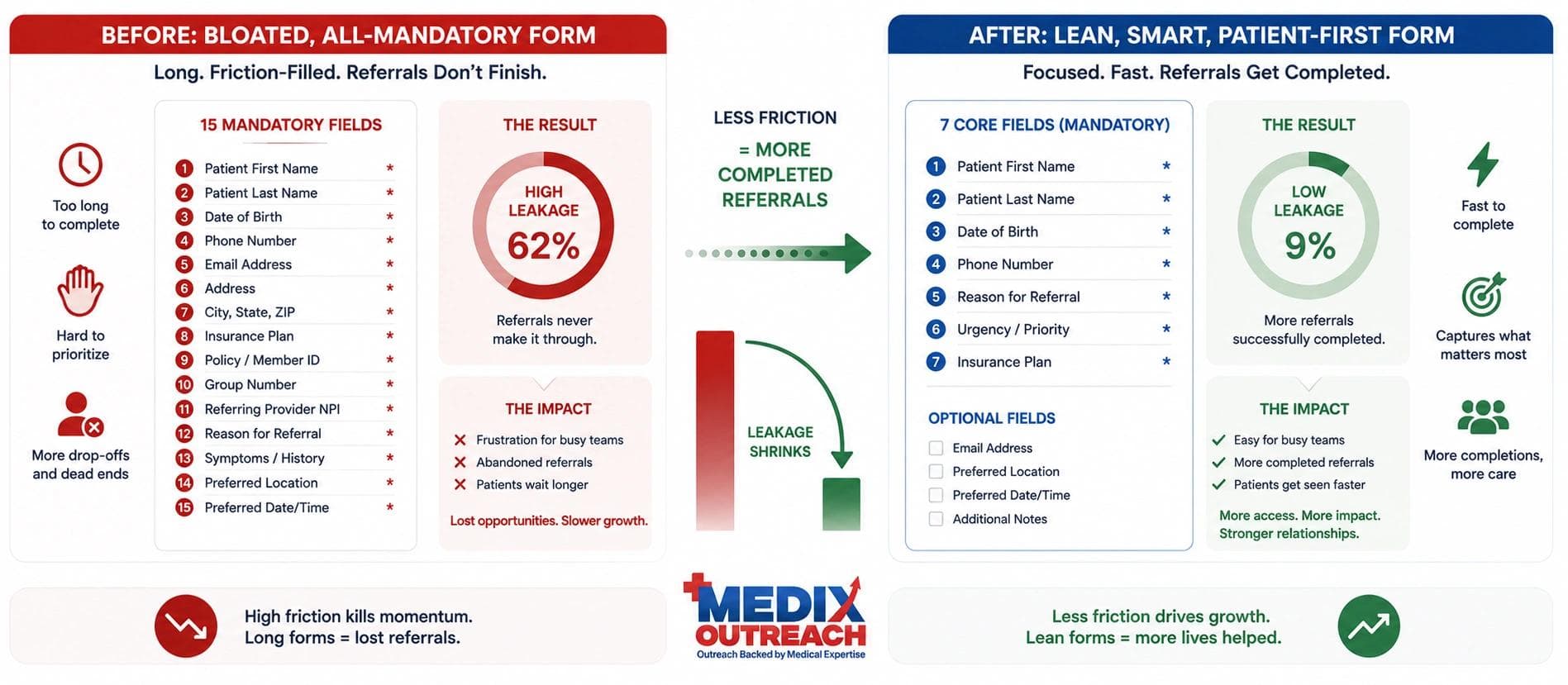
The governing principle, and the Medix point of view: every additional required field must earn its place with a real clinical or operational purpose. If a field does not change how you triage, schedule, or safely receive the patient, it should be optional or gone. A referring office that hits a twelve-field mandatory form for a straightforward medication-management referral will do one of two things — fill it in badly or not refer at all.
How do referral forms create referral leakage?
Referral leakage is the gap between patients a provider intended to refer and patients who actually reach your intake. Forms cause leakage in predictable ways: mandatory fields the referring office cannot easily answer, information the patient must supply before anything moves, unclear submission channels, and no confirmation of receipt. Each of these adds a place for the referral to stall. The referring staff who "deal with many different processes and lost information," as AHRQ describes care-coordination friction, will route around a hard form — and around the practice that uses it.
What are the core fields of a psychiatry referral form?
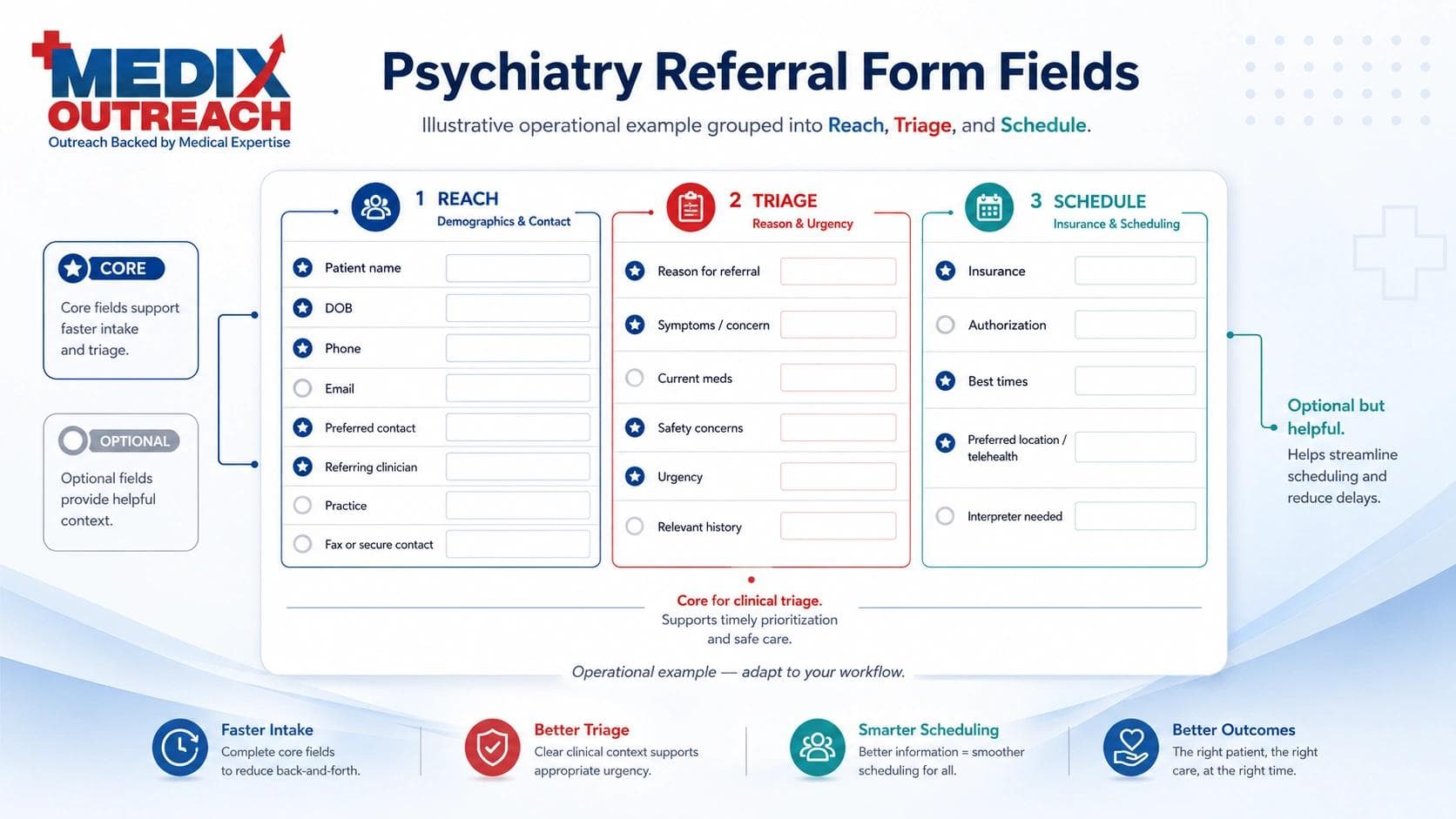
Group fields by whether they are needed to reach, triage, or schedule the patient. A practical structure:
- Patient demographics - Include: Name, DOB, phone, best contact time, address/ZIP; Why: You cannot contact or verify eligibility without these.
- Referring provider - Include: Name, practice, callback number, where to send the report; Why: Required to close the loop later.
- Reason for referral - Include: Brief clinical reason and referral question; Why: Drives clinical triage and routing.
- Urgency / safety flag - Include: Routine vs urgent; any acute safety concern; Why: Determines routing and response time.
- Insurance - Include: Plan and member ID (or a note that the patient will provide); Why: Eligibility affects scheduling — but should not block intake.
- Medication list - Include: Current psychiatric medications, when relevant; Why: Informs the evaluation; relevant for medication-management referrals.
- Relevant history / records - Include: Optional attachment of pertinent notes; Why: Helpful, not mandatory — do not gate on it.
The reason for referral and clinical triage handoff
The most valuable field is the reason for referral and the referral question — "evaluate and manage medications for treatment-resistant depression," "assess for bipolar spectrum," "postpartum depression, urgent." That single field is what lets a clinician triage the referral by urgency, appropriateness, and level of care. It is also the field that connects the form to the next step: the clinical triage handoff, where a clinician — not the form — decides routing. The form gathers the inputs; the triage decision stays clinician-owned.
Mid-article CTA
Need help building your healthcare growth engine?
Medix helps healthcare startups, clinics, pharma companies, and provider-focused platforms build scalable commercial pipelines.
Book a Strategy CallWhat should not be mandatory?
Restraint is a design feature. Fields that should generally be optional, or collected later at intake rather than gated on the referral:
- Complete medical and psychiatric history (collect at intake, not on the referral)
- Full medication reconciliation (a current psychiatric med list is enough up front)
- Prior records as a hard requirement (accept the referral, request records in parallel)
- Patient-completed questionnaires as a precondition to being contacted
- Fields that only serve internal reporting and do not change triage or scheduling
The test is simple: if a field's absence would not stop you from safely contacting, triaging, and scheduling the patient, do not make it mandatory. Reducing mandatory fields is one of the highest-leverage things a practice can do to cut leakage — it directly serves the low-friction intake that primary care practices need from a psychiatry partner.
Referral channels: EHR, secure fax, portal, and phone
Referring offices are not on one system, so a psychiatry practice should accept referrals through more than one channel and make each one work:
- EHR / directed exchange - Best for: Connected referrers; structured data; Watch-out: Only works if both sides are compatible.
- Secure fax - Best for: The still-large share of offices that fax; Watch-out: Needs same-day monitoring and acknowledgment.
- Referral portal / web form - Best for: Offices without a compatible EHR; Watch-out: Keep it short; long forms leak.
- Phone (warm referral) - Best for: Urgent or safety-sensitive cases; Watch-out: Capture the same core fields on the call.
Whatever the channel, acknowledge receipt. A referral that is received but never confirmed feels, to the referrer, exactly like a referral that was lost — and that is where the closed-loop referral workflow begins.
Frequently asked questions
What should a psychiatry referral form include?
Patient demographics and contact details, referring provider details and where to send the report, the reason for referral and referral question, an urgency/safety flag, insurance, and a current psychiatric medication list when relevant. Additional history should be optional.
What should not be mandatory on a psychiatric referral form?
Full history, complete medication reconciliation, prior records as a hard gate, and patient-completed questionnaires as a precondition to contact. If a field's absence would not stop safe triage and scheduling, make it optional.
How do referral forms cause referral leakage?
Through excessive mandatory fields, information the patient must supply before anything moves, unclear submission channels, and no confirmation of receipt — each adds a place for the referral to stall or be abandoned.