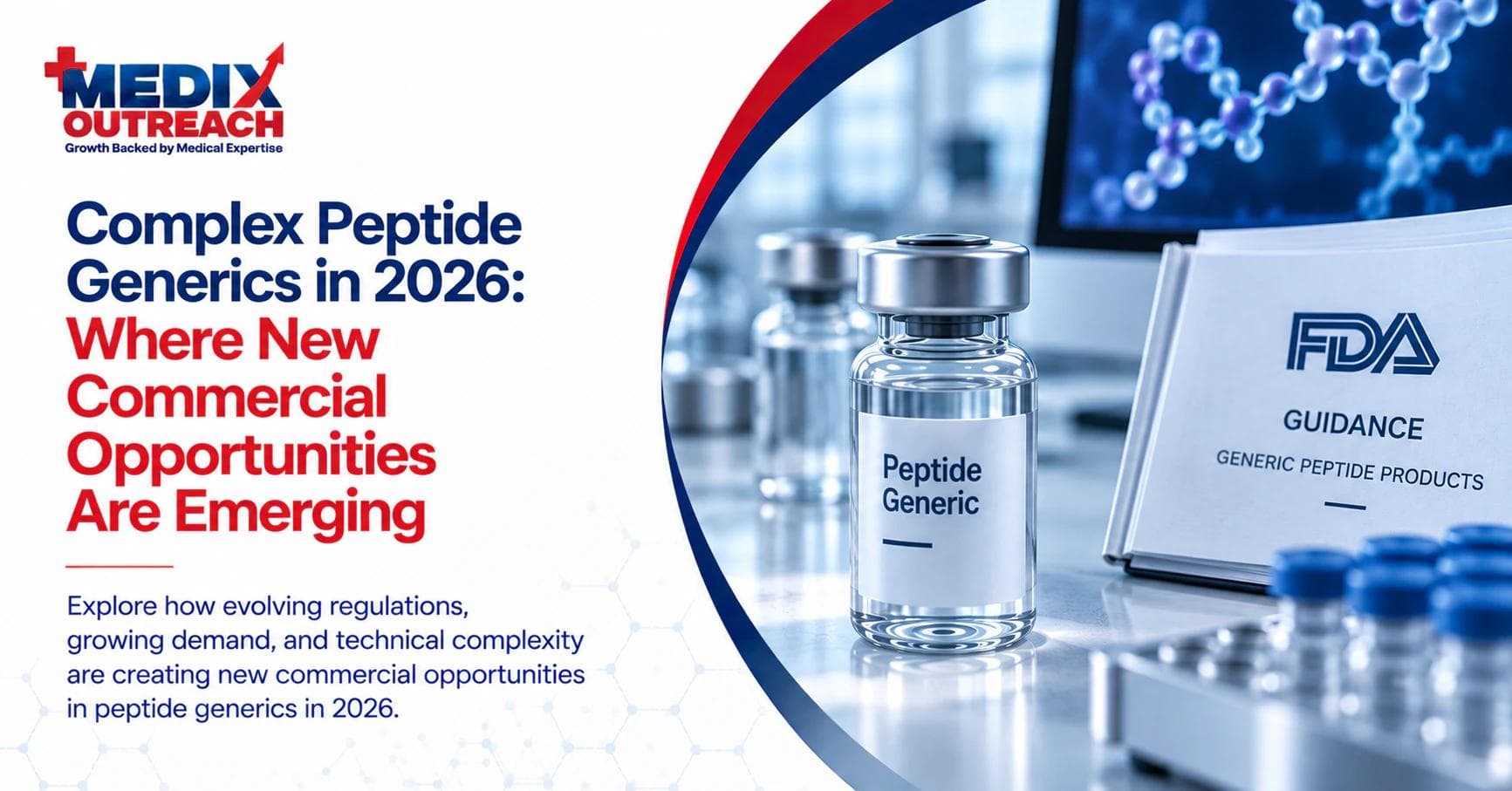
Peptides are increasingly being treated as an important category within complex generic drug development.
In July 2026, FDA published 17 revised draft product-specific guidances covering peptide products including semaglutide, tirzepatide, liraglutide, glucagon, teriparatide, pegcetacoplan, and vosoritide.
FDA's updated recommendations address areas including peptide production approaches, impurity thresholds, higher-order structure, biological activity, and innate immune response testing.
For businesses operating in peptide development and manufacturing, this creates a significant commercial conversation.
Why complex generics matter
FDA describes complex generic products as products involving complex active ingredients, formulations, routes of delivery, dosage forms, or drug-device combinations.
Peptides are specifically included among examples of complex active ingredients.
That complexity creates demand for specialized knowledge and capabilities.
Companies entering this market may need expertise across:
- Peptide manufacturing
- Analytical testing
- Characterization
- Bioequivalence
- Formulation
- Quality
- Regulatory strategy
- Commercial development
The opportunity for peptide companies
The emergence of clearer regulatory expectations can help companies identify where specialized services may be needed.
For example, a company considering a generic peptide program may need to evaluate:
- How the peptide will be produced
- Which analytical methods are required
- How impurities will be assessed
- How higher-order structure will be characterized
- How biological activity will be demonstrated
Each requirement can create potential partnership opportunities.
Why B2B sales needs technical context
A generic sales message is unlikely to explain why a particular capability matters.
Compare:
"We provide peptide analytical services."
with:
"We support peptide programs requiring characterization and analytical strategies aligned with evolving regulatory expectations."
The second message starts with the buyer's development problem.
That is the foundation of effective peptide B2B sales.
Mid-article CTA
Entering the complex-generics market?
Medix helps healthcare and pharma companies build scalable commercial pipelines through targeted business development and provider outreach.
Book a Strategy CallFDA's guidance is also a business development signal
Regulatory updates can be used as market intelligence.
A commercial team can monitor:
- Newly issued PSGs
- Revised guidance
- Products receiving new regulatory attention
- Planned generic guidance
- Development pathways
- Emerging technical requirements
FDA's August 2026 update also identifies complex generics as an area of continuing product-specific guidance activity.
Building targeted peptide marketing outreach
Once a relevant market signal is identified, the next step is account research.
A commercial team can identify companies that:
- Are developing related products
- Operate in relevant therapeutic areas
- Have generic development programs
- Need specialized peptide capabilities
- Are entering new markets
The outreach can then be tailored around the specific opportunity.
Commercialization requires more than regulatory knowledge
Regulatory intelligence may open the conversation, but commercial development still requires:
- Relationship building
- Technical credibility
- Manufacturing capabilities
- Strategic partnerships
- Market understanding
This is why healthcare commercialization should connect regulatory intelligence with broader business development.
Final takeaway
The evolution of peptide generic-drug guidance is creating a more defined commercial environment.
For peptide companies, suppliers, analytical organizations, and development partners, regulatory changes can reveal where new capabilities and partnerships may be required.
The opportunity is to turn those signals into informed B2B conversations rather than simply reacting after procurement begins.