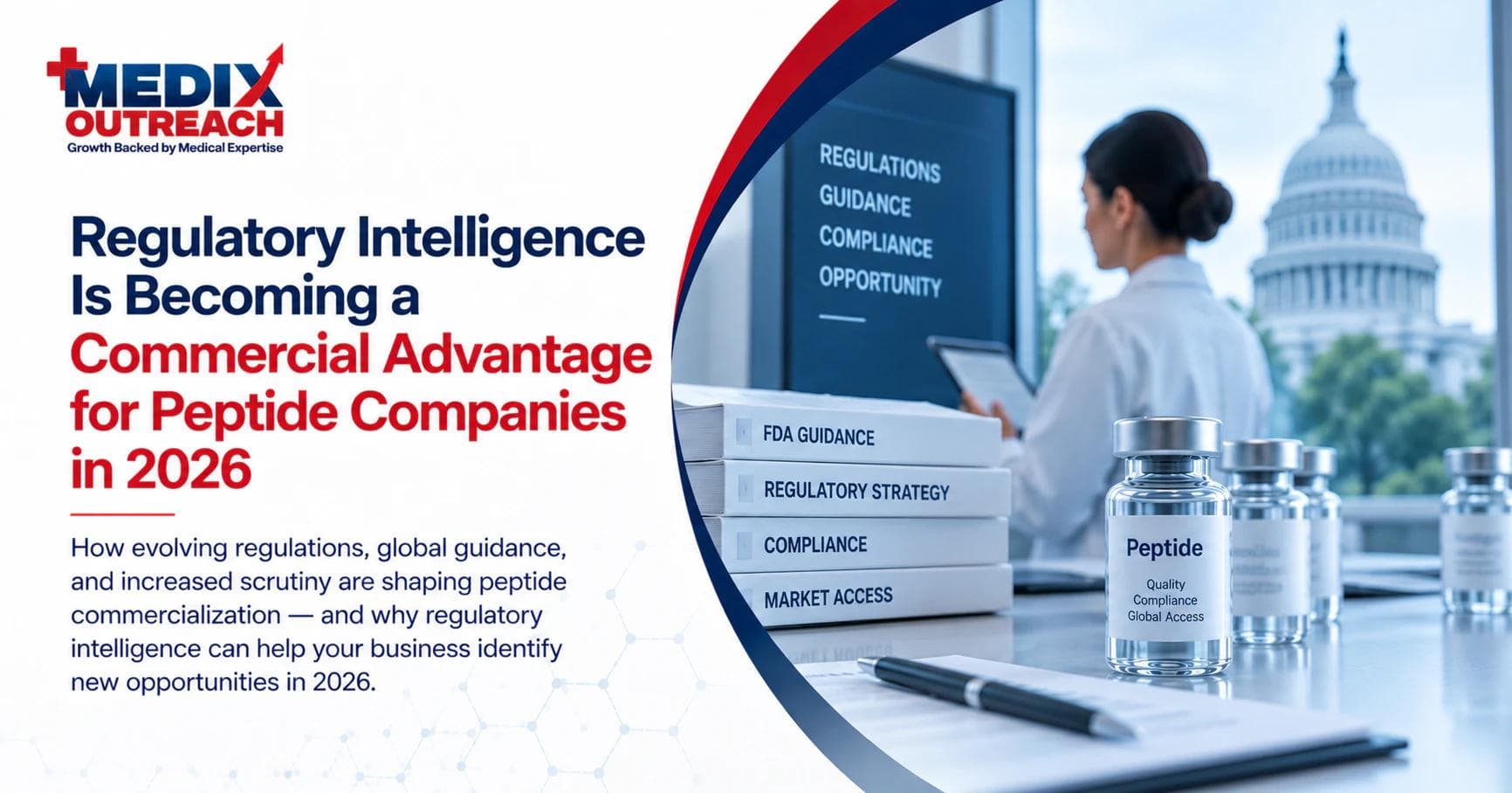
In peptide markets, regulatory developments can change commercial opportunities quickly. A new FDA guidance, enforcement action, or regulatory interpretation can affect manufacturing decisions, development programs, market positioning, and partnership priorities. That makes regulatory intelligence more than a compliance function - it can become a business development advantage.
2026 is an important regulatory year for peptides
In July 2026, the FDA published revised draft product-specific guidances covering 17 peptide products - including semaglutide, tirzepatide, liraglutide, glucagon, and teriparatide - addressing areas such as impurity thresholds, higher-order structure assessment, immune-response testing, and biological-activity assessment.
At the same time, the FDA has continued clarifying its position on compounded GLP-1 products, including a proposal affecting semaglutide, tirzepatide, and liraglutide and repeated concerns about misleading marketing of non-FDA-approved compounded products. For businesses across the peptide ecosystem, these developments influence how opportunities should be evaluated.
Why regulatory intelligence matters to business development
Consider a pharmaceutical company evaluating a peptide program. Its priorities may shift based on regulatory pathway, product classification, manufacturing requirements, development evidence, supply considerations, competitive landscape, and potential market-access challenges. A business development team that understands these issues can have a more relevant conversation than one relying on generic sales messaging.
Compliance should shape marketing outreach
Peptide marketing outreach should be especially careful when discussing products that involve regulatory uncertainty. The FDA has explicitly emphasized concerns around misleading marketing of non-FDA-approved compounded GLP-1 products. For B2B companies, this reinforces an important principle: commercial communication should be based on what can actually be substantiated.
That means distinguishing clearly between:
- Approved products
- Products in development
- Research-stage capabilities
- Manufacturing services
- Regulatory expectations
- Future commercial possibilities
Mid-article CTA
Need help building your healthcare growth engine?
Medix helps healthcare startups, clinics, pharma companies, and provider-focused platforms build scalable commercial pipelines.
Book a Strategy CallTurning regulatory knowledge into useful conversations
Regulatory intelligence becomes commercially valuable when it helps identify the right conversation. Instead of an outreach message focused entirely on company capabilities, a business development team can identify a regulatory development that may affect a target company's peptide program and use that context to create a relevant discussion. The objective is not to provide regulatory advice through marketing; it is to demonstrate that the company understands the environment in which its customers operate.
The opportunity for pharma business development
This creates a valuable intersection between regulatory intelligence, market intelligence, pharma business development, and peptide marketing outreach. Together, these capabilities help identify organizations approaching a meaningful development or commercialization decision.
A practical intelligence-to-outreach workflow
A healthcare commercialization team can structure its process across six steps - monitor, interpret, identify, prioritize, engage, and develop:
- Monitor relevant regulatory and market changes.
- Interpret which types of companies may be affected.
- Identify specific organizations and programs.
- Prioritize those with a strong capability fit.
- Engage with outreach specific to the commercial context.
- Develop the relationship over time.
Why generic outreach is increasingly weak
The peptide industry is becoming more sophisticated, and pharma and biotech teams receive large volumes of vendor communication. A generic “we provide high-quality peptide services - would you like to schedule a meeting?” does little to demonstrate understanding. A message that reflects the recipient's program, development stage, market environment, and potential requirements has a stronger foundation - the same principle behind effective peptide B2B sales.
Final takeaway
Regulatory intelligence can influence more than compliance. For peptide companies, it can inform market intelligence, account prioritization, messaging, partnership development, and healthcare commercialization strategy. The strongest peptide outreach strategies in 2026 will combine commercial ambition with regulatory discipline.