
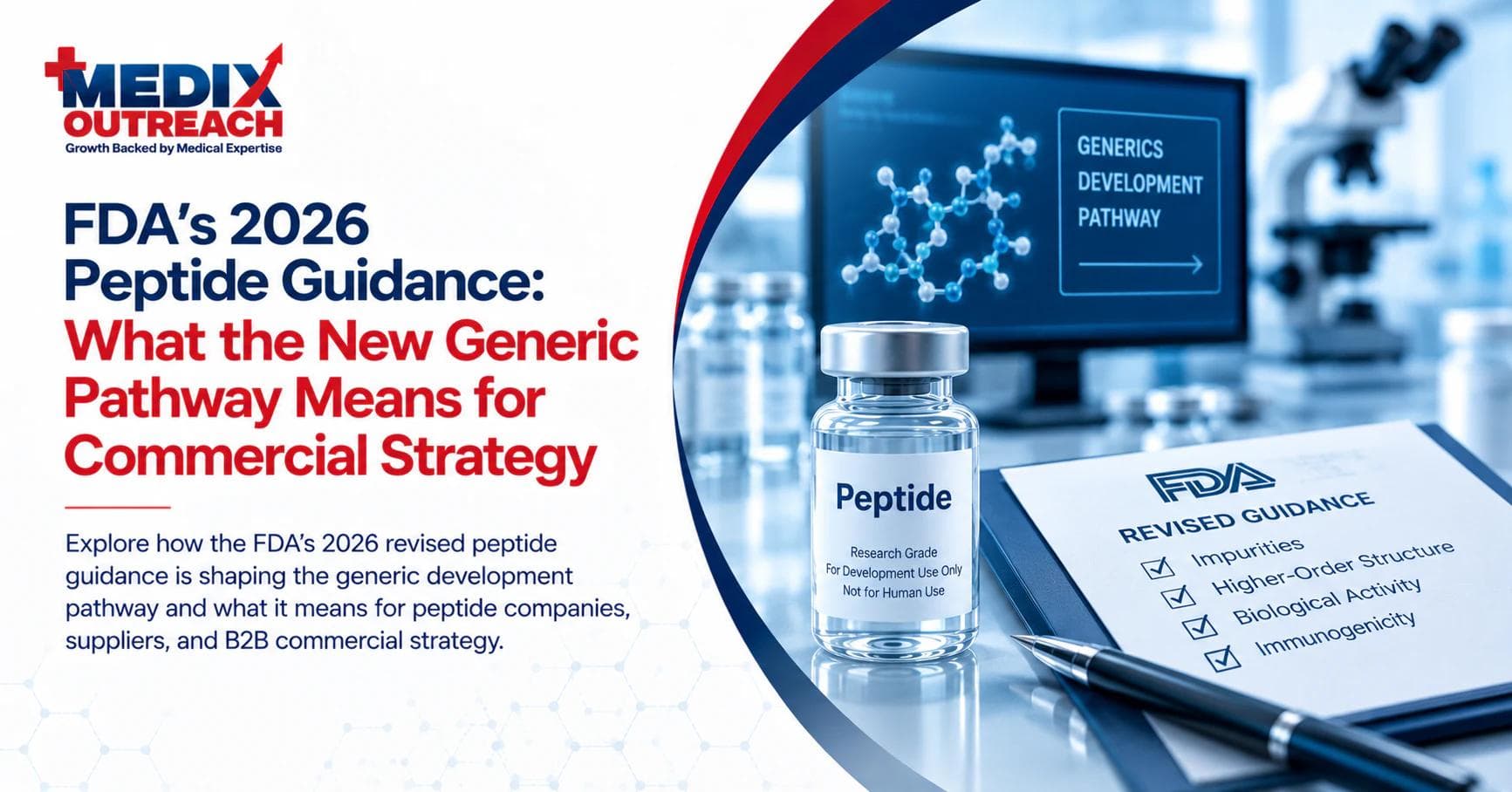
The peptide market is entering a more defined regulatory environment.
In July 2026, the U.S. Food and Drug Administration published 17 revised draft product-specific guidances covering peptide products including semaglutide, tirzepatide, liraglutide, glucagon, teriparatide, and others.
The guidance addresses areas including peptide manufacturing approaches, impurity thresholds, higher-order structure assessment, biological activity, and immune response testing.
For companies operating across peptide development and manufacturing, these developments have implications beyond regulatory planning.
They can also influence commercial opportunities.
Why regulatory clarity can create commercial activity
When development expectations become clearer, companies can make more informed decisions about how to move programs forward.
That can increase demand for specialized capabilities.
Depending on the program, organizations may need expertise in:
- Peptide synthesis
- Analytical characterization
- Impurity assessment
- Manufacturing
- Quality systems
- Bioequivalence development
- Regulatory strategy
- Drug-device considerations
For companies providing these capabilities, regulatory developments can therefore become important business development signals.
The commercial opportunity behind regulatory intelligence
Regulatory intelligence is often treated as a compliance function.
But it can also inform commercial strategy.
A peptide company monitoring FDA activity can identify:
- Which products are receiving new guidance.
- Which technical requirements are becoming more important.
- Which companies may be developing related products.
- Which capabilities may become more valuable.
- Where potential partnerships may emerge.
This creates a bridge between regulatory intelligence and pharma business development.
Why generic peptide development deserves attention
FDA states that product-specific guidances are intended to help facilitate generic drug development and support the assessment of abbreviated new drug applications.
This creates a potentially important commercial ecosystem around peptide products.
Companies may need partners capable of addressing specific technical and manufacturing requirements.
The opportunity is therefore not limited to companies developing finished products.
It can extend to organizations supporting the development process.
Mid-article CTA
Need help building your healthcare growth engine?
Medix helps healthcare startups, clinics, pharma companies, and provider-focused platforms build scalable commercial pipelines.
Book a Strategy CallWhat this means for peptide B2B sales
B2B sales teams should understand that regulatory changes can affect different accounts differently.
One pharmaceutical company may be preparing a generic peptide program.
Another may be focused on innovative peptide development.
A third may be supplying manufacturing services.
The commercial conversation should reflect those differences.
Generic outreach can miss that context.
Turning regulatory developments into outreach signals
A useful peptide marketing outreach workflow could look like:
Regulatory update ↓ Identify affected products ↓ Identify relevant companies ↓ Map development activity ↓ Identify potential capability gaps ↓ Build account-specific outreach
The goal is not to provide regulatory advice through marketing.
The goal is to use reliable regulatory information to understand where commercial conversations may become relevant.
Compliance must remain central
Peptide marketing also requires discipline around claims.
The FDA has continued taking action against misleading marketing involving non-FDA-approved compounded GLP-1 products. In February 2026, the agency stated that companies cannot represent unapproved compounded products as generic versions of FDA-approved drugs or make unsupported claims about their equivalence or clinical results.
For B2B marketers, the lesson is straightforward:
Commercial messaging should accurately distinguish approved products, products in development, research capabilities, and potential future applications.
Building credibility through substance
Pharmaceutical buyers are often evaluating technical and commercial credibility simultaneously.
That means a strong content strategy should explain:
- What changed
- Why it matters
- Who may be affected
- What capabilities may become relevant
- What organizations should consider next
This type of content can support both thought leadership and business development.
Final takeaway
FDA's 2026 peptide guidance activity is more than a regulatory development.
It is a market signal.
For companies operating in peptide development, manufacturing, analytics, and commercialization, regulatory intelligence can help identify emerging opportunities and create more relevant B2B conversations.
The strongest peptide marketing outreach strategies will connect regulatory awareness with commercial relevance while keeping claims accurate and supportable.