
Healthcare content marketing is the practice of publishing genuinely useful, accurate information to build authority with buyers and patients — and to move them through long, high-trust decision cycles. It is not blogging for its own sake. In healthcare, where a purchase can involve six to ten stakeholders over many months, or a patient is deciding whom to trust with their body, content is often the only asset that works at every stage: it earns the first click, answers the committee's questions, and is now increasingly what AI answer engines cite when someone asks.
That last point changes the job. Content that used to compete for a blue link now competes to be the source an AI summary trusts. The winners are the same either way: accurate, expert, well-structured content that puts people first. This framework shows how to build it. It is the companion to our healthcare SEO strategy pillar — content is what SEO ranks and what AI cites; the two are one system.
What healthcare content marketing is (and isn't)
It is a system for producing and distributing accurate, useful content mapped to real buyer and patient questions, designed to build durable authority and influence pipeline. It is not keyword-stuffed filler, thin AI-spun articles, or product brochures wearing a blog's clothes. In a Your-Money-or-Your-Life field, low-quality content does not just underperform — it actively damages trust with the exact clinical and executive audiences you need.
Anchor on E-E-A-T and YMYL
Google's guidance on creating helpful, reliable, people-first content is the north star. Two ideas matter most for healthcare:
- E-E-A-T — Experience, Expertise, Authoritativeness, Trustworthiness. Trust is the most important of the four, per Google's rater guidance. Demonstrate it: named expert authors and reviewers, credentials, primary sources, clear sourcing, and honest, current information.
- YMYL — for topics that affect health, finances, or safety, Google gives even more weight to strong E-E-A-T. Healthcare is the archetypal YMYL category, so the accuracy bar is higher than in almost any other industry.
Practically: cite primary sources (agencies, peer-reviewed research, standards bodies), show who wrote and reviewed the content and why they are qualified, and keep clinical claims accurate. This is where clinical credibility becomes a content requirement, not a nice-to-have.
Map content to the buyer journey
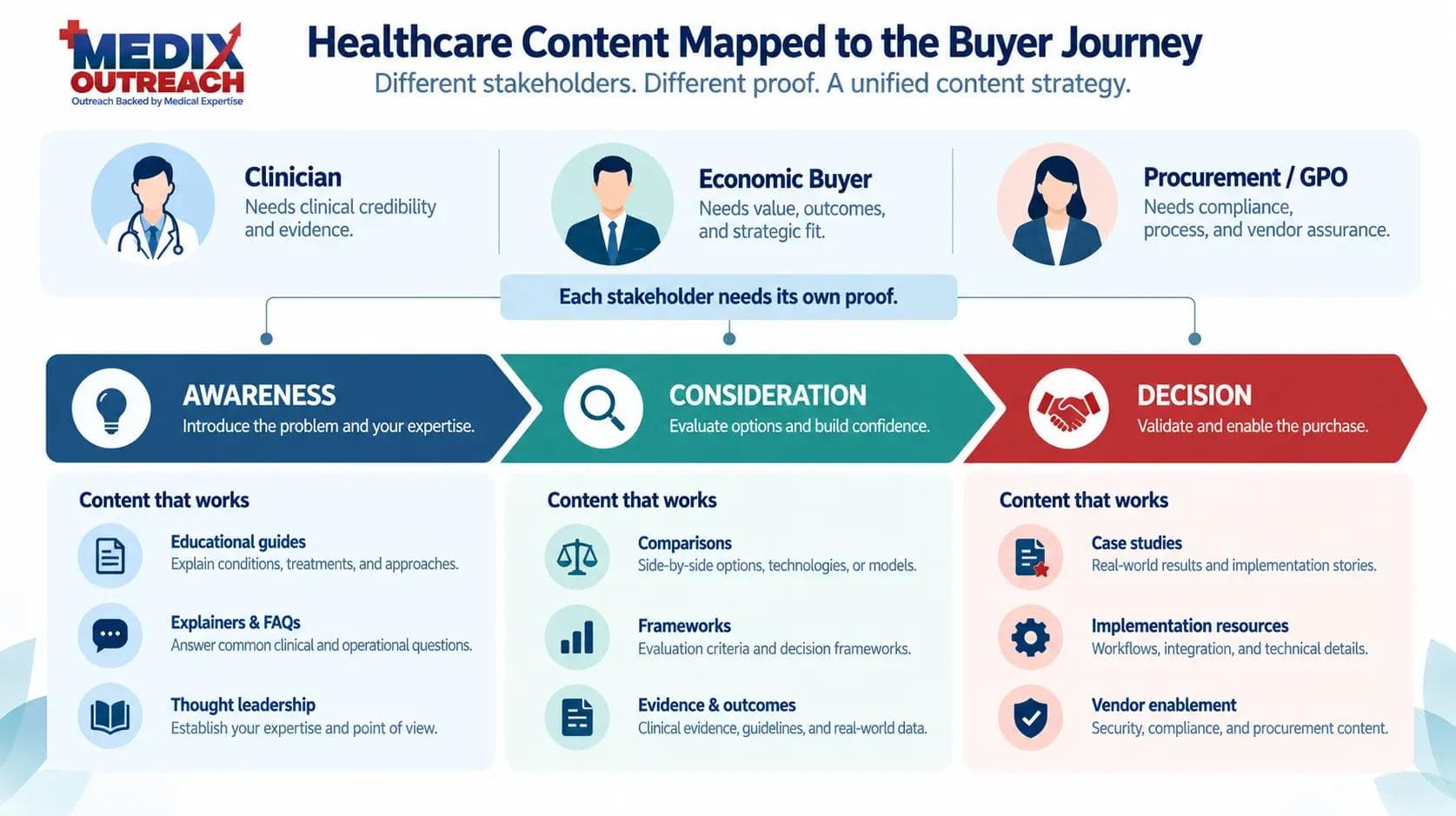
Content fails when every piece targets the same stage. Map it deliberately:
- Awareness — the problem-aware questions your buyer or patient asks first ("why is our device stuck at the value-analysis committee?", "what are my options for X condition?"). Educational guides, definitions, and explainers.
- Consideration — comparison and evaluation content: frameworks, comparisons, ROI/total-cost thinking, evidence summaries, and case studies. This is where a committee does its homework.
- Decision — proof and de-risking: detailed case studies, implementation and compliance detail, and sales-enablement assets that let a champion sell internally on your behalf.
In B2B healthcare, remember you are writing for a committee. The clinician, the economic buyer, and procurement each need different content, coordinated so it reinforces rather than contradicts. This is also the boundary between content and demand generation: content is the fuel; demand gen is the engine that distributes it to create market-wide awareness and intent.
Build topical authority with the pillar-and-cluster model
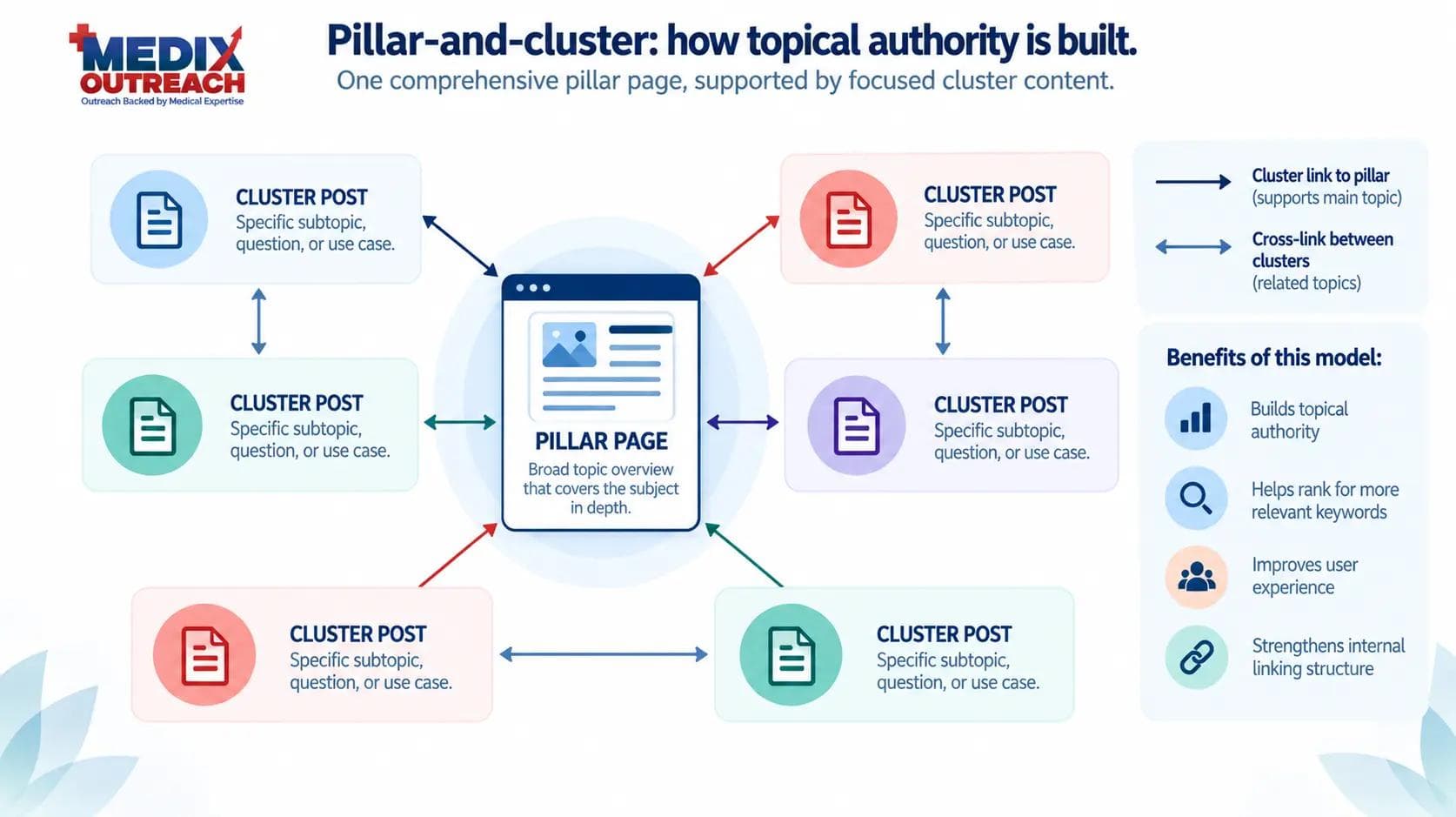
Search engines and AI systems reward demonstrated depth on a topic, not scattered one-offs. The proven structure is pillar-and-cluster: a comprehensive pillar page on a core topic, supported by focused cluster posts that each go deep on a sub-topic and link back to the pillar (and to each other). Done across your priority topics, this builds the topical authority that lifts the whole domain — the exact mechanics live in the healthcare SEO strategy pillar. For a startup working from zero, the tactical starting moves are in how healthcare startups rank and get found.
Formats that work in healthcare
Match format to job:
- Evidence and clinical summaries — translate studies and data into decision-useful summaries.
- Comprehensive guides and frameworks — the pillar assets that earn authority (and AI citations).
- Comparisons and decision tools — "X vs Y," selection criteria, and calculators, which perform strongly in B2B healthcare.
- Case studies — the highest-trust proof; the closer content, done with proper patient/client authorization.
- Video and executive briefings — for clinical demonstration and senior buyers who want the outcome, not the feature list.
Mid-article CTA
Publishing content but not pipeline?
Medix turns healthcare content into topical authority and influenced revenue.
Book a Content Strategy CallDistribute deliberately
Publishing is half the job. Distribution channels:
- Search and AI answer engines — the compounding, intent-driven channel (see the SEO pillar).
- LinkedIn — the primary B2B healthcare network for reaching decision-makers with content.
- Email — the nurture workhorse across long cycles; see email marketing in healthcare.
- Account-based marketing — targeted content delivered to named accounts and committees; see account-based marketing.
- Sales enablement — the internal-selling assets your champions use inside the buying committee.
Build for AI search (GEO)
Because AI answers now sit above or alongside classic results in healthcare, structure content to be extracted and cited: answer the core question early and explicitly, use clear question-shaped headings, state facts plainly with sources, and keep definitions and comparisons crisp. The full generative-engine-optimization approach is in the healthcare SEO strategy pillar; the content-side rule is simple — be the clearest, best-sourced answer to the question, and you become the answer.
Compliance and accuracy
Two guardrails apply to everything you publish:
- FTC — health claims must be truthful and substantiated (guidance).
- HIPAA — patient stories, testimonials, and data require authorization (HHS guidance).
In a YMYL field, a single inaccurate claim can undo years of authority. Route clinical content through qualified review.
Measure content ROI
Traffic is a leading indicator, not the goal. Measure content-influenced pipeline: which assets touch won deals, assisted conversions, engaged target accounts, email and demo requests from content, and — increasingly — visibility and citation in AI answers for your priority questions. Report the business outcome, not the pageview.
Frequently asked questions
How is healthcare content marketing different from other B2B content marketing?
The YMYL accuracy bar and the regulatory constraints (FTC, HIPAA) are higher, buying committees are larger, and cycles are longer. Trust and evidence carry more weight than volume or cleverness.
Does AI-generated content hurt healthcare SEO?
Google rewards helpful, people-first content regardless of how it is produced, but it penalizes unhelpful, unreliable content — and thin AI output is often exactly that in a YMYL field. Use AI to assist, but keep expert authorship, review, and accuracy.
How long until content marketing produces results?
Authority compounds over 6–18 months. Early pieces that target real buyer questions can influence deals sooner, but the durable gains come from sustained, structured publishing.
What is the single most important thing in healthcare content?
Trustworthiness — accurate, well-sourced, expert content. It is the most important E-E-A-T signal and the thing both patients and AI systems are ultimately evaluating.