

Healthcare SEO strategy has quietly become two jobs. The first is the familiar one: rank in Google's classic results. The second is newer and, in healthcare, now unavoidable: be the source that AI-generated answers trust and cite. Health queries trigger AI Overviews at some of the highest rates of any category — the large majority of healthcare searches now surface an AI summary, up sharply since 2023, according to BrightEdge. If your strategy only optimizes for blue links, you are competing for a shrinking slice of the page.
This framework treats both as one system, built for the reality of healthcare: a Your-Money-or-Your-Life field where accuracy is scrutinized, audiences are plural (patients, referring clinicians, payers, employers), and B2B decisions run through committees over months. It is the strategic parent to our tactical how healthcare startups rank and get found guide, and the sibling of the content marketing pillar — SEO ranks what content creates.
Why healthcare SEO needs its own strategy
Four structural facts change the playbook:
- YMYL scrutiny. Google applies its highest E-E-A-T standards to health topics. Thin or unsourced content does not just underperform — it is actively filtered.
- Multiple audiences, different words. Patients search symptoms and "near me." Referring clinicians search specialists and programs. Payers and employers search in business terms — outcomes, cost, fit. Each wants different proof, and one page cannot serve all of them.
- Committee-stage queries. In B2B healthcare, the person searching at 2 p.m. Tuesday is rarely the person who signs six weeks later. Keyword strategies that chase informational volume miss the decision-stage queries that actually convert.
- AI Overviews dominate the health SERP. With most health queries now returning an AI summary, visibility increasingly means being cited in the answer, not just ranking beneath it.
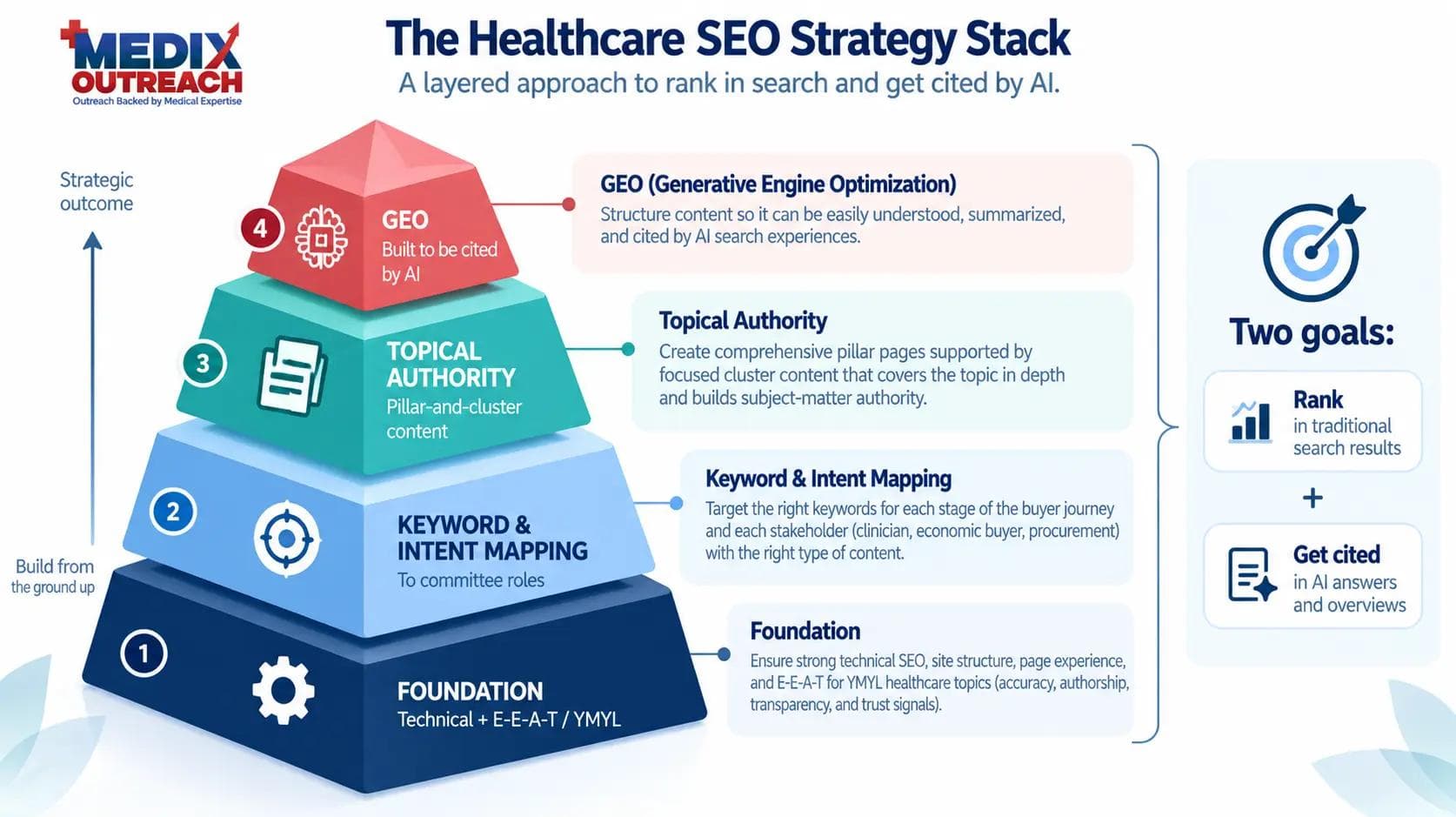
Win the E-E-A-T and YMYL foundation
Everything else rests on this. Per Google's guidance on helpful, people-first content and its E-E-A-T framework, Trust is the most important signal, and YMYL topics get extra weight on strong E-E-A-T. Concretely:
- Named, credentialed authors and reviewers. Show who wrote and clinically reviewed each piece and why they are qualified.
- Primary sourcing. Cite agencies, peer-reviewed research, and standards bodies — not competitor blogs.
- Accuracy and currency. Keep clinical and regulatory claims correct and dated. This is where clinical credibility becomes a ranking input.
- Trustworthy site signals. Clear organizational information, secure and technically sound pages, honest claims.
Map keywords to intent and to the committee — not just volume
Volume is the wrong primary filter in B2B healthcare, where the highest-value keywords often have modest volume and long cycles. Instead, map each priority query to (1) the searcher's intent stage and (2) the buying role it serves. Prioritize decision-stage and committee queries — comparisons, "for [buyer type]," compliance and reimbursement questions — over generic high-volume terms a patient might type but a buyer never would. Match the page format to the intent: a guide for research, a comparison for evaluation, a proof page for decision.
Build topical authority with pillar-and-cluster
Search and AI systems reward demonstrated depth. Organize priority topics as a comprehensive pillar page supported by focused cluster posts that link back to it and to each other. This is how a domain earns authority on a subject rather than scattering one-off posts — the content-side mechanics are in the content marketing pillar. Applied across your priority topics, it lifts rankings and makes your site the coherent, citable authority AI systems prefer.
Technical and on-page foundations
Strategy fails on a broken foundation. Ensure: fast, mobile-first, crawlable pages; clean site architecture and internal linking that expresses your topic clusters; correct indexation and canonicalization; and structured data (Organization, Article, FAQ, and relevant medical/local schema) that helps engines and AI systems understand your entities. None of this is glamorous, and all of it is prerequisite.
Mid-article CTA
Losing visibility to AI answers?
Medix helps healthcare brands become the source AI answer engines cite — and the result that converts.
Book an SEO Strategy CallGenerative-engine optimization (GEO): get cited by AI
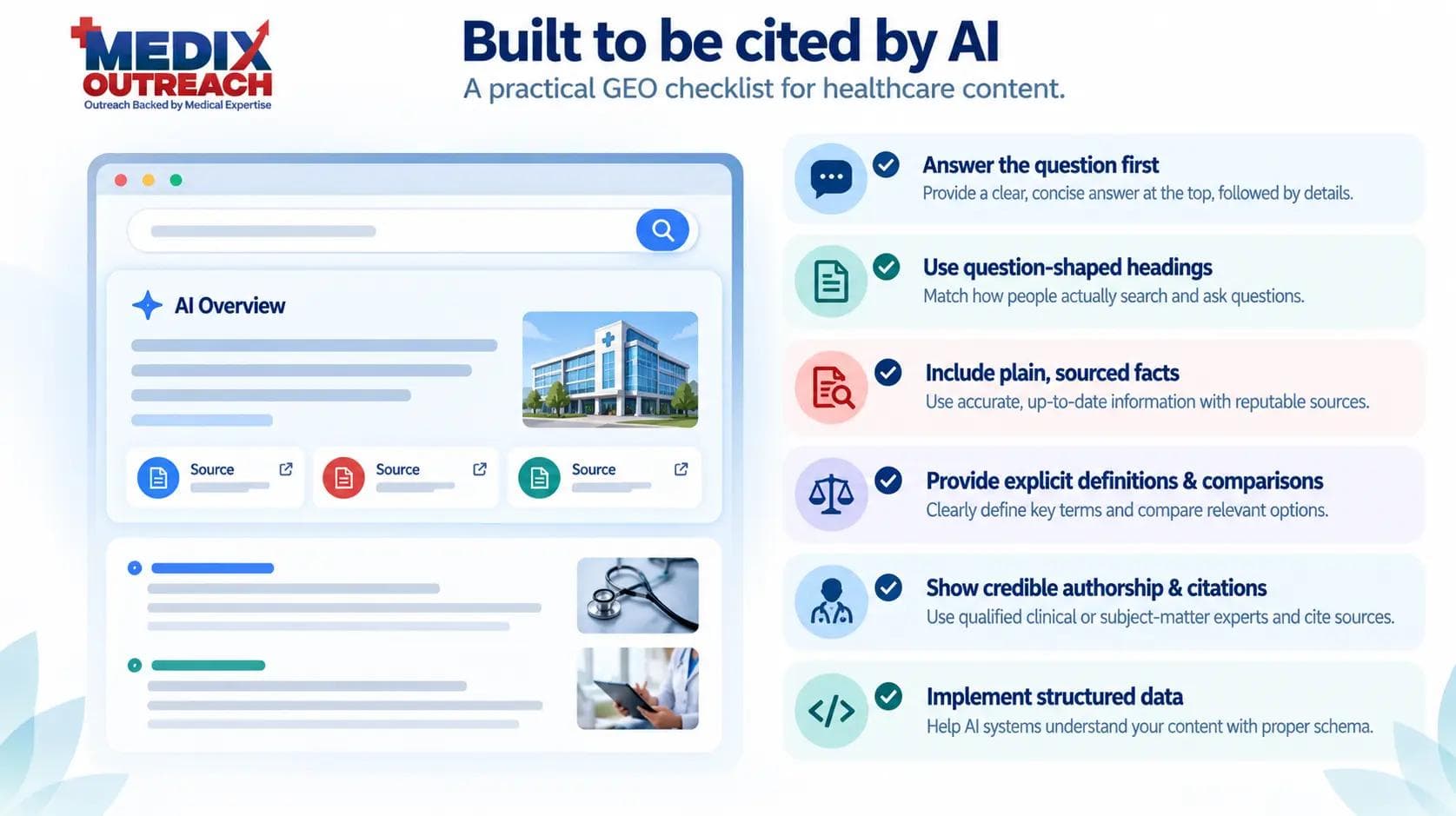
Because health SERPs are AI-dominated, optimize deliberately for citation. What AI answer engines favor, per analyses of YMYL AI Overviews, is authoritative, clearly structured, well-sourced content. Practical moves:
- Answer the question first. Lead each section with a direct, extractable answer, then support it.
- Use question-shaped headings that mirror how people ask.
- State facts plainly with sources. Machines extract clear, attributable statements, not marketing prose.
- Define entities and relationships explicitly — what something is, how it compares, when it applies.
- Earn authority signals (citations, mentions, credible authorship) that make you a source worth trusting.
Local and entity SEO for provider-facing organizations
For practices, clinics, and provider networks, local search is decisive: an accurate, complete Google Business Profile, consistent citations, location and service pages, and reviews. The applied version for practices is in medical practice marketing, and for diagnostics and vertical B2B in diagnostics marketing. Entity clarity — being an unambiguous, well-described organization across the web — increasingly drives both local rankings and AI answers.
Measurement in the AI-search era
Rankings alone no longer capture visibility. Track: rankings for priority intent clusters, AI Overview presence and citation for your key questions, organic-influenced pipeline and conversions (not just sessions), and topical coverage against your priority map. SEO's job is contribution to revenue; measure it that way. It is one channel within demand generation, not a silo.
Frequently asked questions
What is GEO, and is it different from SEO?
Generative-engine optimization is structuring content to be surfaced and cited by AI answer engines. It overlaps heavily with good SEO — authority, clarity, sourcing — but adds an emphasis on extractable, question-shaped, well-attributed content. In healthcare, where AI Overviews dominate, you need both.
Does SEO still matter if AI answers the question?
Yes, more than ever — but the goal shifts from ranking a link to being the trusted source the AI cites, which still depends on classic SEO fundamentals plus GEO structuring.
How is B2B healthcare SEO different from consumer medical SEO?
Consumer/patient SEO targets symptoms, conditions, and local intent; B2B healthcare SEO targets committee-stage, business-outcome queries with lower volume and higher contract value, and must serve multiple buying roles.
How long does healthcare SEO take?
In a YMYL field, authority builds over 6–18 months. Technical fixes and decision-stage pages can produce earlier wins, but durable visibility compounds with sustained, structured effort.