

Healthcare demand generation is the work of creating awareness, interest, and buying intent across your market — so that when a buyer is ready, they already know, trust, and prefer you. It is the discipline that fills the top of the funnel with demand, not just contacts. It is frequently confused with lead generation, and the confusion is expensive: teams over-invest in capturing leads that were never warmed and wonder why conversion is poor. In healthcare's long, committee-driven cycles, demand generation is often the difference between a pipeline that converts and one that stalls.
The short version: demand generation creates the market; lead generation captures it. You need both, in the right order. This piece explains the distinction, why healthcare especially needs demand generation, and how to build an engine that turns awareness into qualified pipeline.
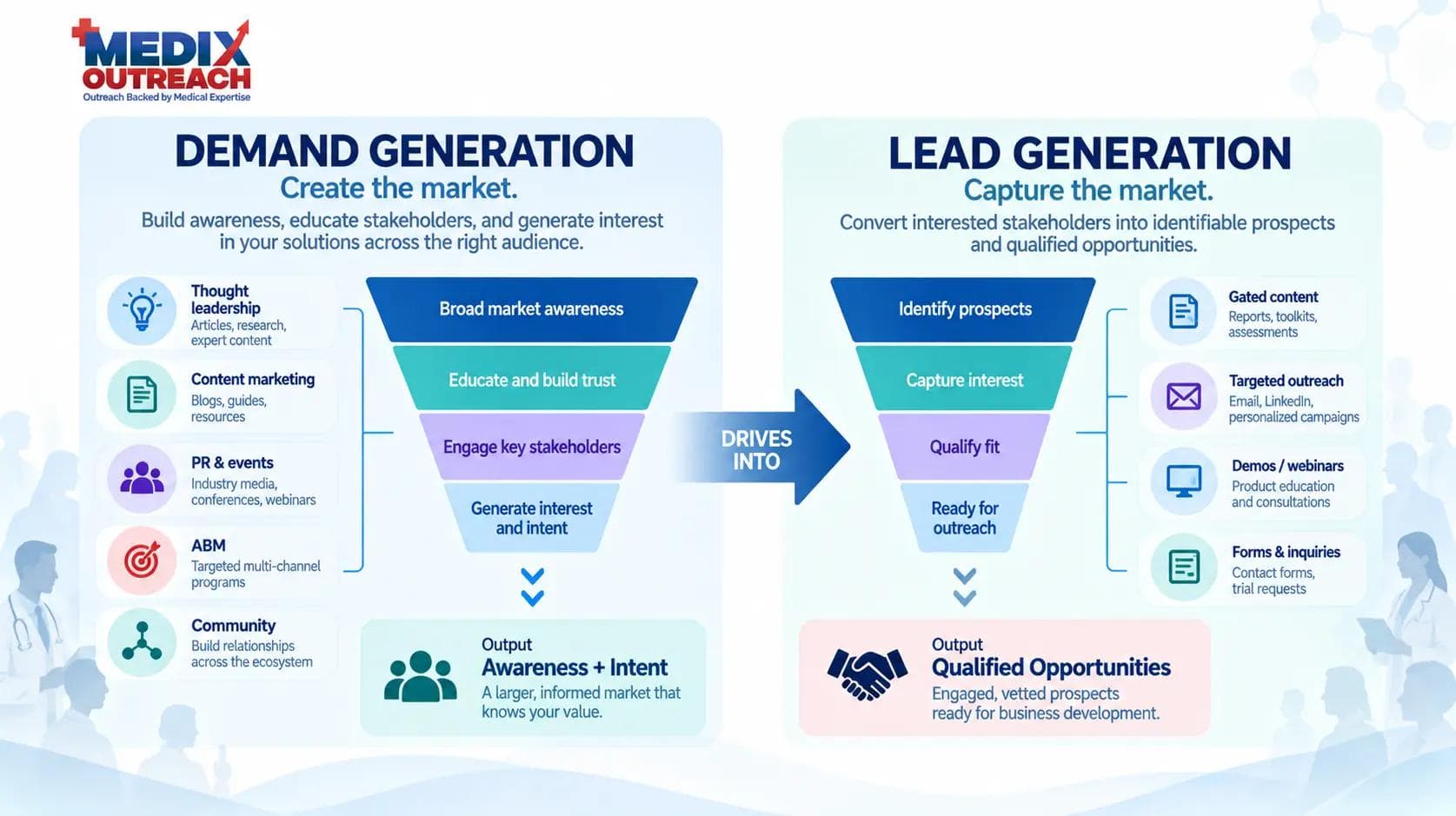
Demand generation vs lead generation
The clearest way to hold the difference, per Adobe's framing:
- Demand generation creates awareness and intent before a prospect is ready to convert. It is broad, educational, and trust-building — thought leadership, content, PR, events, and community. Its output is a market that knows and trusts you.
- Lead generation captures and qualifies the identifiable people who are ready to engage — through gated content, outreach, demos, and forms. Its output is named, qualified opportunities for sales.
Run lead generation without demand generation and you harvest a field you never planted: low-quality, low-trust contacts. Run demand generation without lead generation and you build awareness you never capture. The engine needs both, and the vertical capture plays in this batch — medical device lead generation and pharma lead generation — sit downstream of the demand you create here.
Why healthcare especially needs demand generation
Healthcare buying is uniquely demand-hungry:
- Large buying committees. A complex B2B purchase involves six to ten decision-makers, each gathering information independently, per Gartner. In healthcare, that committee spans clinical, financial, procurement, IT/security, and compliance — and demand generation has to reach all of them.
- Long cycles. Healthcare decisions routinely run 12–24 months. A lead captured "cold" today may not be ready for a year, so sustained awareness is what keeps you in the consideration set until timing aligns.
- High trust barriers. Clinical and executive buyers do not act on unfamiliar vendors. Demand generation builds the familiarity and credibility that make later outreach welcome instead of ignored.
This is why cold, capture-first tactics underperform in healthcare — a theme the site explores in why cold outreach fails in healthcare. Demand comes first.
Build the healthcare demand engine
Demand generation is powered by a few compounding channels:
- Content and thought leadership. The engine's fuel — educational, credible content that answers your market's real questions and demonstrates expertise. The system for producing it is the content marketing pillar.
- Search and AI visibility. Being found — and cited by AI answers — when buyers research. Covered in the SEO/GEO framework.
- Events, PR, and community. Conferences, webinars, podcasts, and industry presence that build reputation and relationships at scale.
- Account-based marketing. Targeted demand aimed at named high-value accounts and their committees; see account-based marketing.
- Social and peer influence. LinkedIn and peer/KOL advocacy that spread awareness through trusted networks.
The goal is a market that arrives at the sales conversation already educated and predisposed to trust you.
Mid-article CTA
Capturing leads that never convert?
Medix builds the demand that makes healthcare pipeline convert — then captures it.
Book a Growth Strategy CallTurn demand into pipeline
Awareness only pays off if you capture and qualify it. The handoff:
- Capture — offers, gated depth content, demo requests, and outreach that convert warmed interest into identifiable prospects; see B2B healthcare lead generation.
- Qualify — against fit, need, authority, and timing, so sales spends time on real opportunities. Where you draw the line between marketing and sales is the sales outsourcing vs lead generation question.
- Engage — human follow-up (often via SDRs; see outsourced SDR appointment setting) that turns qualified interest into meetings and pipeline.
Demand generation makes each of these steps dramatically more efficient, because you are capturing people who already know you.
Measurement
Measure demand generation by its contribution to pipeline, not by vanity metrics. Useful signals: brand and branded-search growth, share of voice on priority topics, engaged target accounts, content-influenced pipeline and won deals, and eventually pipeline velocity. Beware over-crediting last-touch lead capture for demand that was created upstream — that mismeasurement is what drives teams to underfund the very thing making their leads convert.
A compliance note
Healthcare demand generation runs inside privacy rules. Using patient data for targeting or marketing generally requires authorization, per HHS guidance, and major ad platforms restrict sensitive-health targeting. Build demand with content, reputation, and account-level targeting rather than patient-data tactics that create compliance risk.
Frequently asked questions
What is the difference between demand generation and lead generation?
Demand generation creates market awareness and intent before someone is ready to buy; lead generation captures and qualifies the identifiable people who are ready. Demand gen plants; lead gen harvests. Healthcare needs both.
Is demand generation just content marketing?
Content is the primary fuel, but demand generation is broader — it includes PR, events, ABM, social, and community, all aimed at creating and capturing market demand across a long cycle.
Why does healthcare need demand generation more than other industries?
Because of large buying committees, 12–24-month cycles, and high trust barriers. Sustained awareness keeps you in consideration until timing aligns, and trust built in advance makes later outreach effective.
How do you measure demand generation?
By pipeline contribution and market signals — branded search, share of voice, engaged accounts, and content-influenced pipeline — not by raw lead counts, which under-credit the demand that made those leads convert.