Healthcare companies are investing more than ever in commercialization.
New healthcare SaaS platforms launch every month. AI-powered solutions continue to reshape clinical workflows. Medical device companies are expanding into new markets, and pharmaceutical organizations are accelerating commercialization efforts.
Yet despite these investments, many healthcare companies struggle to convert interest into revenue.
The reason isn't always pricing.
It isn't the product.
And it isn't the competition.
More often, the problem is that their go-to-market (GTM) teams think like salespeople instead of healthcare professionals.
In 2026, successful healthcare commercialization requires commercial teams that understand clinical environments, provider priorities, and operational realities before they ever begin selling.
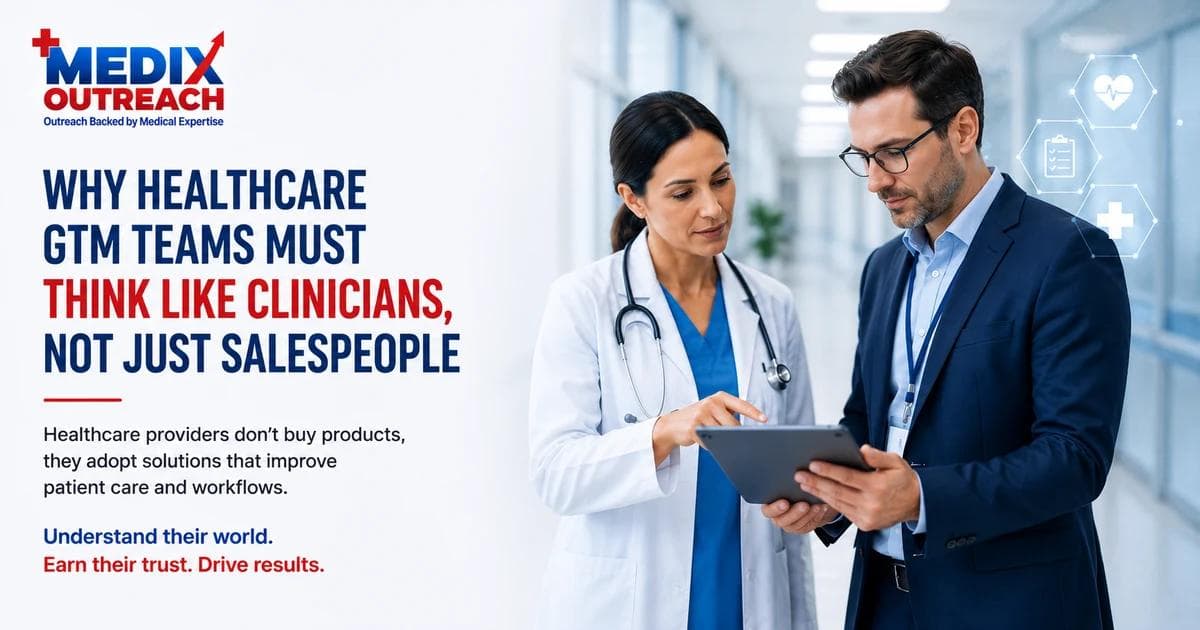
Healthcare buyers don't reward the best sales pitch.
They reward the deepest understanding of their world.
Healthcare Is Not Traditional B2B
Many organizations hire experienced B2B sales professionals and expect them to succeed in healthcare.
Unfortunately, traditional sales methodologies don't always translate.
Healthcare purchasing decisions involve:
- Patient outcomes
- Clinical workflows
- Regulatory compliance
- Operational efficiency
- Financial sustainability
- Provider adoption
- Long implementation cycles
A healthcare provider isn't buying software.
They're evaluating whether your solution can become part of patient care.
That changes every commercial conversation, and it is a big part of why it is so hard to find salespeople with genuine healthcare backgrounds.
Clinical Understanding Creates Commercial Advantage
Healthcare professionals immediately recognize whether they're speaking with someone who understands healthcare.
Providers notice:
- Clinical terminology
- Workflow knowledge
- Specialty-specific challenges
- Documentation requirements
- Operational realities
- Healthcare regulations
When conversations demonstrate genuine understanding, trust develops naturally.
When they don't, providers quickly disengage.
Clinical understanding has become one of the strongest competitive advantages in healthcare business development, and clinical credibility now functions as a go-to-market asset in its own right.
Healthcare Buyers Want Advisors, Not Sales Representatives
The traditional sales approach focuses on persuasion.
Healthcare providers expect consultation.
Before discussing products, successful GTM teams explore questions like:
- Where are workflow bottlenecks?
- What administrative challenges consume provider time?
- How does reimbursement affect operations?
- What implementation barriers exist?
- Which patient populations create the greatest complexity?
These conversations create credibility because they prioritize healthcare challenges over product promotion.
The result is stronger provider engagement and more productive commercial discussions.
Provider Outreach Should Reflect Clinical Reality
Many healthcare outreach campaigns fail because they sound generic.
Messages that could be sent to any industry rarely resonate with healthcare professionals.
Effective provider outreach is built around clinical context.
Instead of saying:
"Our platform increases efficiency."
Explain:
"Our platform helps reduce documentation time during patient visits while integrating into existing EHR workflows."
Specificity builds confidence.
Generic messaging creates skepticism. The same principle applies to how you market to doctors and provider organizations: relevance always beats reach.
Every Specialty Has Different Priorities
Healthcare isn't one market.
It's thousands of specialized markets.
Consider the differences between:
- Cardiology
- Oncology
- Orthopedics
- Allergy and Immunology
- Behavioral Health
- Primary Care
- Pulmonology
- Endocrinology
Each specialty has unique workflows, patient populations, reimbursement models, and operational challenges.
Healthcare provider marketing becomes significantly more effective when GTM teams understand these differences.
Personalization in healthcare goes beyond using someone's name.
It means understanding how they practice medicine.
Mid-article CTA
Need help building your healthcare growth engine?
Medix helps healthcare startups, clinics, pharma companies, and provider-focused platforms build scalable commercial pipelines.
Book a Strategy CallHealthcare Go-to-Market Strategy Must Start With Clinical Relevance
Many organizations build their healthcare go-to-market strategy around product capabilities.
Successful healthcare companies build it around provider needs.
A strong healthcare GTM strategy should answer:
- Which healthcare organizations benefit most?
- What clinical problems are being solved?
- How does the solution improve existing workflows?
- Which stakeholders influence purchasing decisions?
- What implementation concerns will providers have?
When strategy begins with clinical relevance, every stage of commercialization becomes more effective.
Healthcare Commercialization Requires Cross-Functional Thinking
Modern healthcare commercialization combines far more than marketing and sales.
It requires alignment between:
- Healthcare business development
- Provider outreach
- Strategic partnerships
- Healthcare demand generation
- Customer success
- Product teams
- Clinical advisors
Every department contributes to the provider experience.
When these teams operate independently, buyers receive inconsistent messaging.
When they work together, organizations build trust at every stage of the customer journey.
Technology Can't Replace Clinical Expertise
Artificial intelligence is transforming healthcare sales.
CRM automation, predictive analytics, and AI-generated outreach improve efficiency.
But technology cannot replace credibility.
Healthcare providers still expect meaningful conversations with people who understand:
- Clinical operations
- Healthcare regulations
- Provider challenges
- Patient care priorities
AI supports commercialization.
Clinical expertise drives commercialization.
The companies that combine both will outperform competitors relying on automation alone.
Building GTM Teams for the Future
Healthcare organizations should recruit and train commercial teams differently than traditional B2B companies.
The strongest GTM teams combine:
- Commercial experience
- Clinical understanding
- Healthcare communication
- Strategic thinking
- Provider relationship management
- Consultative selling
These professionals don't simply generate opportunities.
They create trusted relationships that support long-term commercial growth. Getting there usually means investing in healthcare sales enablement so every team member can speak the buyer's language, and it is one reason pharmacist-led sales teams have become such an effective model.
Why Medix Outreach Takes a Different Approach
At Medix Outreach, we believe healthcare commercialization begins with healthcare expertise.
That's why our team combines pharmacist-led clinical knowledge with healthcare go-to-market strategy and commercial growth, provider outreach, healthcare business development, healthcare sales outsourcing, strategic partnerships, and end-to-end revenue pipeline development.
Rather than acting as a traditional lead generation agency, we work as a Healthcare Commercialization and Business Development Partner, helping healthcare SaaS companies, pharmaceutical organizations, biotech firms, medical device manufacturers, diagnostics companies, and healthcare startups build commercial strategies that resonate with providers and healthcare decision-makers.
Because healthcare companies don't need more sales activity.
They need more clinically relevant conversations.
Conclusion
Healthcare buying has changed.
Providers expect commercial teams that understand clinical environments as well as they understand sales strategy.
Organizations that combine healthcare expertise with business development, provider outreach, and commercialization create stronger relationships, healthier sales pipelines, and more predictable revenue growth.
In 2026, the most successful GTM teams won't simply think like salespeople.
They'll think like clinicians first and commercial strategists second.
That's the difference between selling into healthcare and becoming a trusted partner within it.
Frequently Asked Questions
What does it mean for a healthcare GTM team to think like a clinician?
Thinking like a clinician means leading with an understanding of clinical workflows, provider priorities, reimbursement, and operational realities before discussing a product. It shifts commercial conversations from persuasion to consultation, so the team can show how a solution fits into patient care rather than simply listing features. Providers recognize this understanding quickly, and it builds the trust that drives healthcare purchasing.
Why do experienced B2B salespeople often struggle in healthcare?
Traditional B2B sales methodologies assume shorter cycles, simpler buying groups, and feature-based decisions. Healthcare purchases involve patient outcomes, compliance, workflow integration, provider adoption, and long implementation timelines. Salespeople without clinical understanding tend to sound generic to providers, which stalls conversations. The gap is not effort or talent; it is missing context about how healthcare actually operates and buys.
How is clinical understanding a commercial advantage?
Clinical understanding lets a commercial team speak credibly about the buyer's specialty, workflows, and constraints. That credibility builds trust faster, reduces objections, and produces higher-quality conversations. In a market where providers screen for relevance before evaluating features, clinical understanding often determines whether a company earns a serious conversation at all.
Can healthcare companies rely on AI and automation instead of clinical expertise?
AI and automation improve efficiency in prospecting, personalization, and campaign management, but they cannot manufacture credibility. Healthcare providers still expect meaningful conversations with people who understand clinical operations and their priorities. The strongest results come from combining automation to identify opportunities with clinically fluent people to build relationships, not from replacing expertise with tools.
How should healthcare companies build a clinically credible GTM team?
Recruit and train for a blend of commercial experience and clinical understanding, then reinforce it with enablement so every team member can speak the buyer's language. Some companies hire clinicians into commercial roles, others train commercial staff deeply on the clinical domain, and many partner with a specialized team that already has that expertise. The goal is consistent, clinically relevant conversations across every stage of the buyer journey.
<!-- EXTERNAL REFERENCES -->
- No external regulatory citation required; this is a commercial-strategy and team-building analysis with no specific regulatory or statistical claim to substantiate.