
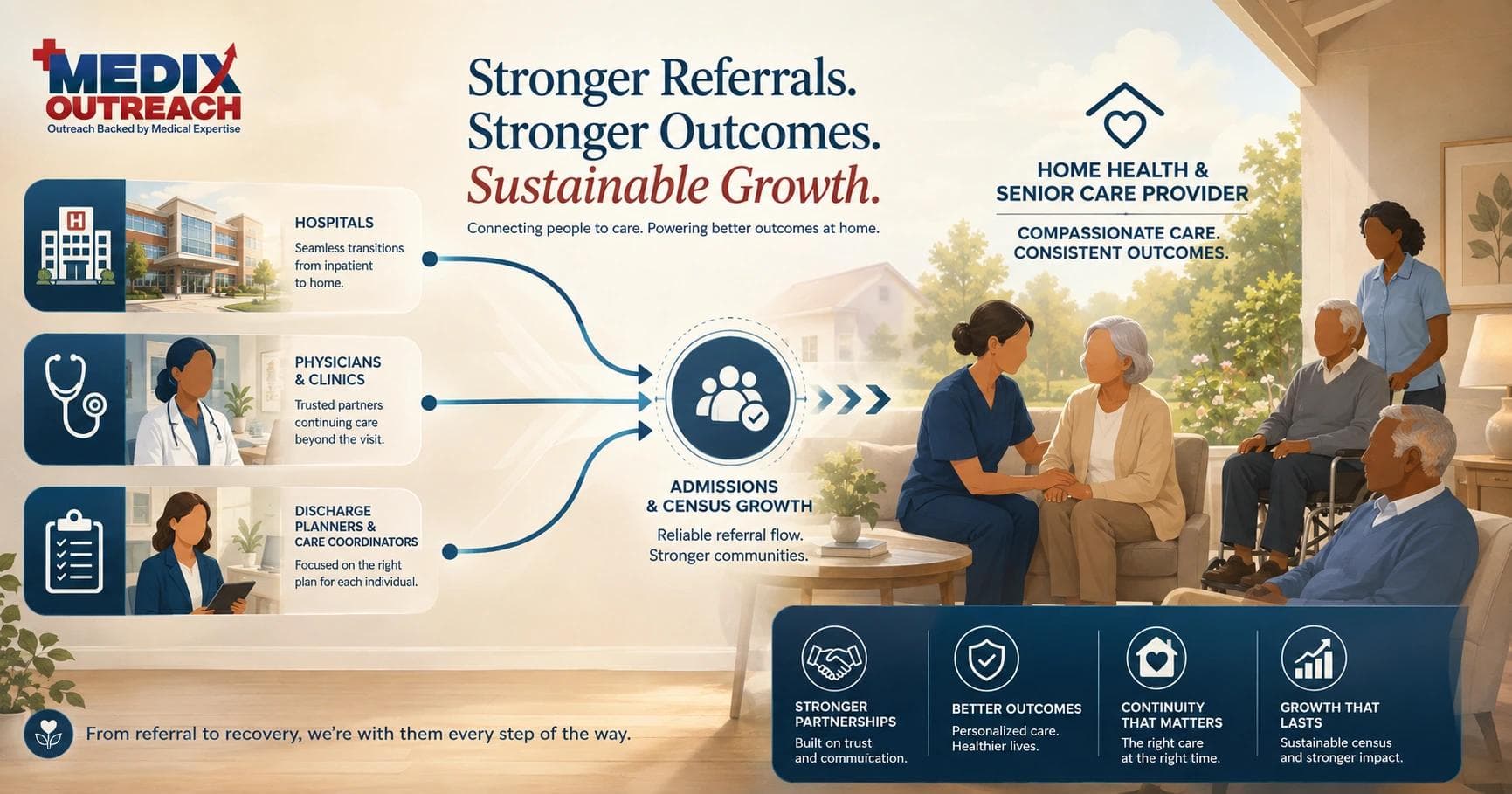
In home health, hospice, home care, and senior living, everything comes down to one number: census. And census, in almost every case, comes from referral sources. A hospital discharge planner deciding where to send a patient, a physician recommending home care, a skilled nursing facility choosing a hospice partner - these decisions fill your beds and your caseload, and they are made by a relatively small number of people whose trust you either have or do not.
That makes referral development the central growth function of the entire segment. But it is also one of the most compliance-sensitive corners of healthcare, because most of these referrals involve services paid for by Medicare and Medicaid, and the rules about what you can and cannot do to get a referral are strict and strictly enforced. Growth here is a discipline of building genuine relationships and reliable service, not of buying access.
Short version: durable census growth comes from being the provider referral sources trust to make their job easier and their patients safer. Know your referral sources, earn their confidence with reliability and outcomes rather than inducements, build a systematic outreach function, and stay firmly inside the Anti-Kickback lines. Do that and referrals become steady instead of sporadic.
Know Your Referral Sources
The first step is to stop thinking about "marketing" and start thinking about referral sources as distinct relationships, each with its own decision-maker, its own priorities, and its own approach. A home health agency and a hospice draw from overlapping but different sources, and the volume is rarely evenly distributed.
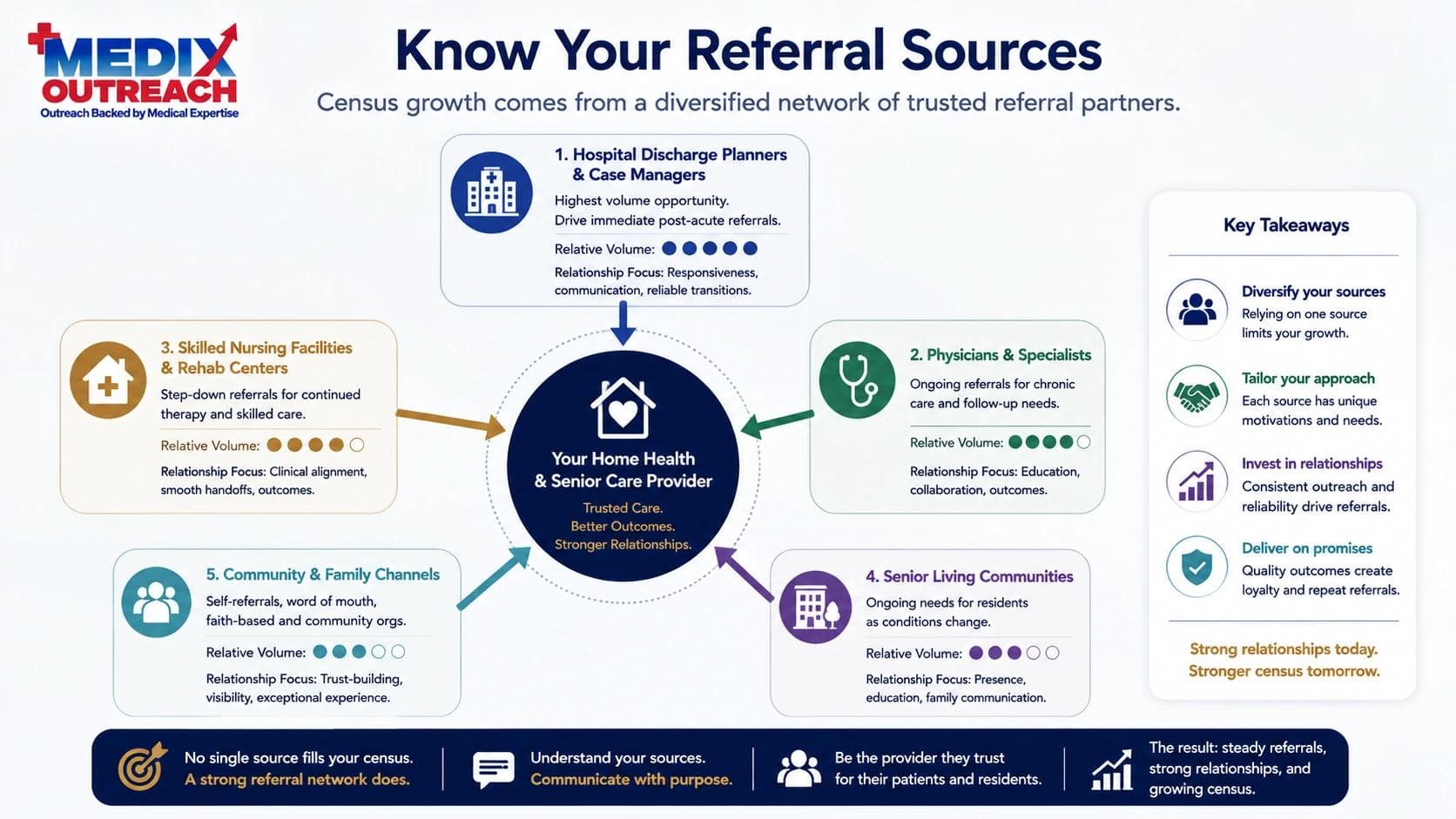
The core referral sources across the segment include:
- Hospital discharge planners and case managers, who route patients to post-acute care under time pressure and readmission scrutiny. They are often the highest-volume source, and they choose partners who make safe, fast discharges easy.
- Physicians and specialists who order home health, recommend hospice, or guide families toward senior care.
- Skilled nursing and rehab facilities that discharge to home health or partner for hospice.
- Senior living communities whose residents need home health, hospice, or additional services.
- Community and family channels, including prior patients, families, and local networks, which matter especially for private-pay senior care.
Each source requires a tailored relationship, and the highest-leverage move is usually to identify the specific individuals and institutions that drive the most appropriate referrals and concentrate on earning their trust. This is the same targeted provider network development discipline used across healthcare, applied to the post-acute referral map.
What Referral Sources Actually Want
Referral sources are not looking for a friendly liaison with branded pens. They are looking for a provider who makes their job easier and their patients safer, because their own reputation and, in the case of hospitals, their readmission metrics ride on where they send people. Understand what they actually value and you understand how to earn consistent referrals.
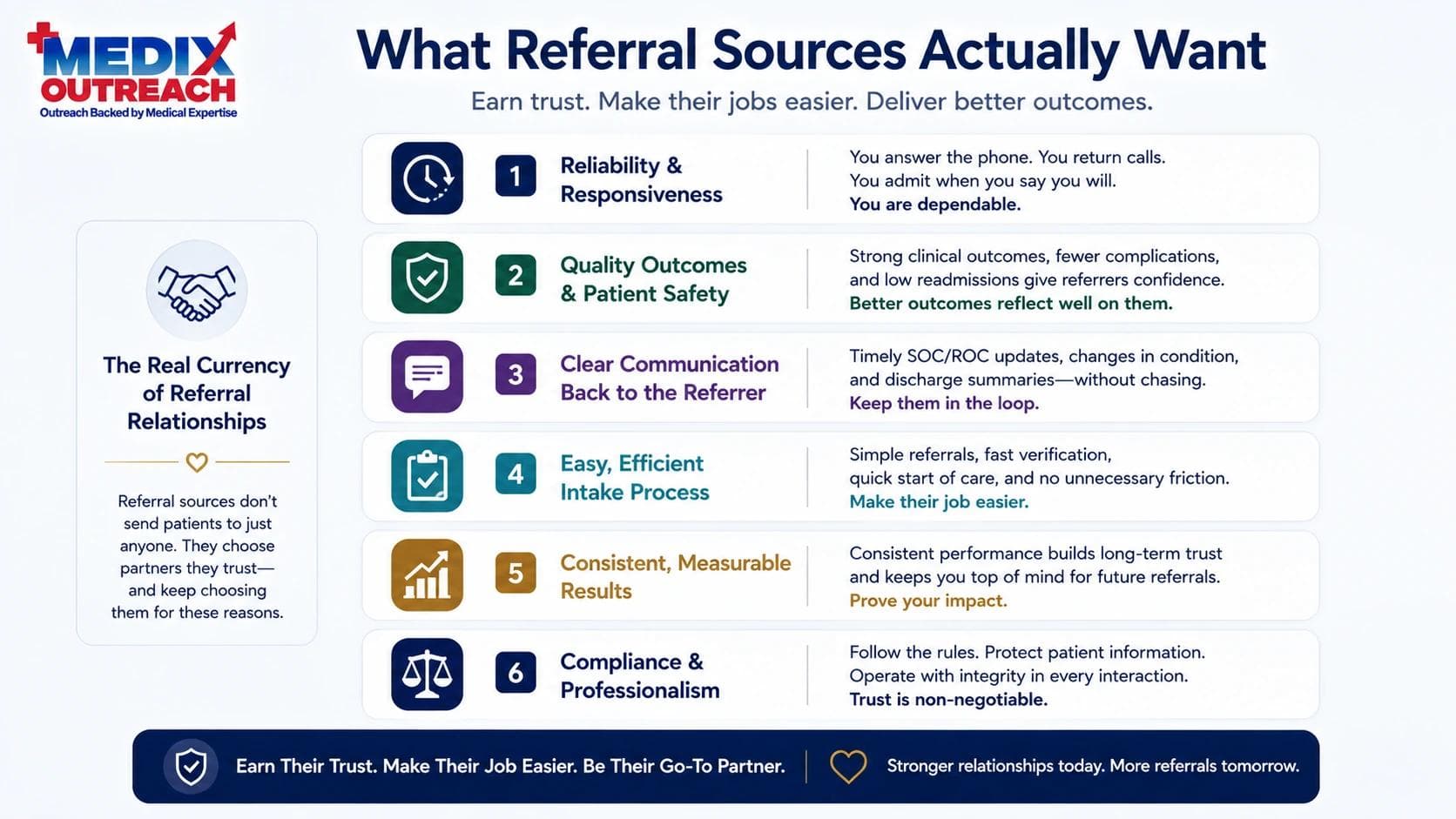
What earns the referral, again and again:
- Reliability and responsiveness. A provider who accepts referrals quickly, shows up when promised, and never leaves a discharge planner scrambling becomes the default choice.
- Quality outcomes and low readmissions. In a world of public quality reporting through tools like Medicare's Care Compare and readmission accountability, referral sources protect themselves by choosing providers with strong outcomes.
- Clear communication back to the referrer. Closing the loop - letting the physician or discharge planner know the patient is doing well - is one of the most underused trust-builders in the segment.
- Easy intake. Every point of friction in accepting and starting a referral is a reason to send the next one elsewhere.
- Compliance and professionalism, because a referral source will not risk their own standing on a provider who cuts corners.
These are service and relationship attributes, and they compound. A discharge planner who has been burned once sends elsewhere; one who has been reliably supported a dozen times refers on autopilot. This is the trust-first logic of building relationships before you need them, applied to the people who control your census.
Mid-article CTA
Need help building your healthcare growth engine?
Medix helps healthcare startups, clinics, pharma companies, and provider-focused platforms build scalable commercial pipelines.
Book a Strategy CallBuild a Systematic Referral Function
Most home health and senior care providers grow referrals by accident - a liaison who happens to have relationships, a few hospitals that happen to send patients. That works until the liaison leaves or a competitor gets more deliberate. Providers that grow durably build referral development into a real, systematic function.
The building blocks:
- A defined territory and target list of the referral sources that matter most, rather than undifferentiated outreach.
- Consistent, valuable outreach that educates referral sources on what you do well and, crucially, follows up reliably. Sporadic visits do not build trust; consistent presence does.
- Relationship tracking so you know the status and history of every key referral source, the same way a commercial team tracks accounts. This is provider outreach run as a system, not a personality.
- Feedback loops that catch and fix problems fast, because one mishandled referral can cost a source's confidence.
Our work building a local provider referral engine for a psychiatry practice is a parallel example: the win came from turning ad hoc referral relationships into a deliberate, managed engine that produced steady volume. The same approach applies to home health and senior care, and it is what turns census from a hope into a system. For the broader mechanics, see our guide to getting more physician referrals.
Stay Firmly Inside the Compliance Lines
This is the part that makes home health and senior care different from most referral marketing, and it is not optional. Because the services are largely paid for by federal healthcare programs, the Anti-Kickback Statute prohibits offering or giving anything of value to induce referrals, and enforcement in this segment is aggressive. Arrangements that look like paying for referrals - gifts, free services, sham medical directorships, and similar - have produced significant enforcement actions.
The line is clear in principle: you earn referrals by being a better, more reliable provider, not by giving referral sources things of value in exchange for sending patients. Practically, that means:
- Build referral relationships on service, reliability, outcomes, and education, not on gifts or financial inducements.
- Structure any legitimate business arrangements with referral sources carefully and with counsel, so they cannot be construed as payment for referrals.
- Train your liaisons and business-development staff on where the lines are, because a well-meaning gesture can create real exposure.
Compliance is not a brake on growth in this segment; it is the definition of sustainable growth. Providers that try to buy referrals put their entire business at risk, while providers that earn them build census that no enforcement action can touch. The same care applies to any outreach touching patient data, which we cover in the context of clinical relationships and provider engagement.
Where Medix Fits
Medix Outreach helps home health, hospice, and senior care providers build referral engines that produce steady, compliant census. Our patient acquisition and practice growth work maps your highest-value referral sources, builds the consistent, education-led outreach that earns their trust, and runs it as a managed system rather than a single liaison's rolodex - all inside the compliance lines this segment demands. We help you grow census the durable way, by becoming the provider referral sources rely on.
Frequently Asked Questions
How do home health and senior care providers grow census?
Census comes from referral sources, so growth means earning consistent referrals from hospital discharge planners, physicians, skilled nursing facilities, senior living communities, and community channels. The durable path is becoming the provider these sources trust to make their job easier and their patients safer - through reliability, strong outcomes, clear communication, and easy intake - and running referral development as a systematic function rather than relying on one liaison's relationships.
What do referral sources look for in a home health or hospice provider?
They look for reliability and responsiveness, strong quality outcomes and low readmissions, clear communication back to the referrer, and frictionless intake, because their own reputation and metrics depend on where they send patients. In a world of public quality reporting and readmission accountability, referral sources protect themselves by choosing providers with proven reliability and outcomes, and they refer repeatedly to providers who consistently make their work easier.
Is it legal to pay for home health or senior care referrals?
No. Because these services are largely paid for by Medicare and Medicaid, the Anti-Kickback Statute prohibits offering or giving anything of value to induce referrals, and enforcement is aggressive. Gifts, free services, and sham arrangements have produced major enforcement actions. Referrals must be earned through being a better, more reliable provider, and any legitimate business arrangements with referral sources should be structured carefully with legal counsel.
How do you build a referral engine for a home health agency?
Define the referral sources that matter most and build a target list, deliver consistent and valuable outreach that educates them and follows up reliably, track every key relationship like a commercial account, and maintain feedback loops that fix problems fast. The goal is to replace accidental, liaison-dependent referrals with a deliberate, managed system that earns steady volume while staying firmly within Anti-Kickback compliance.
Why is consistency so important in referral development?
Because trust in this segment is built through repeated, reliable performance, not a single introduction. A referral source who is reliably supported over many interactions refers on autopilot, while one who is burned once sends patients elsewhere. Sporadic visits and inconsistent follow-up do not build the confidence that drives steady referrals, so consistent presence and dependable service are what turn a referral source into a durable, high-volume relationship.