
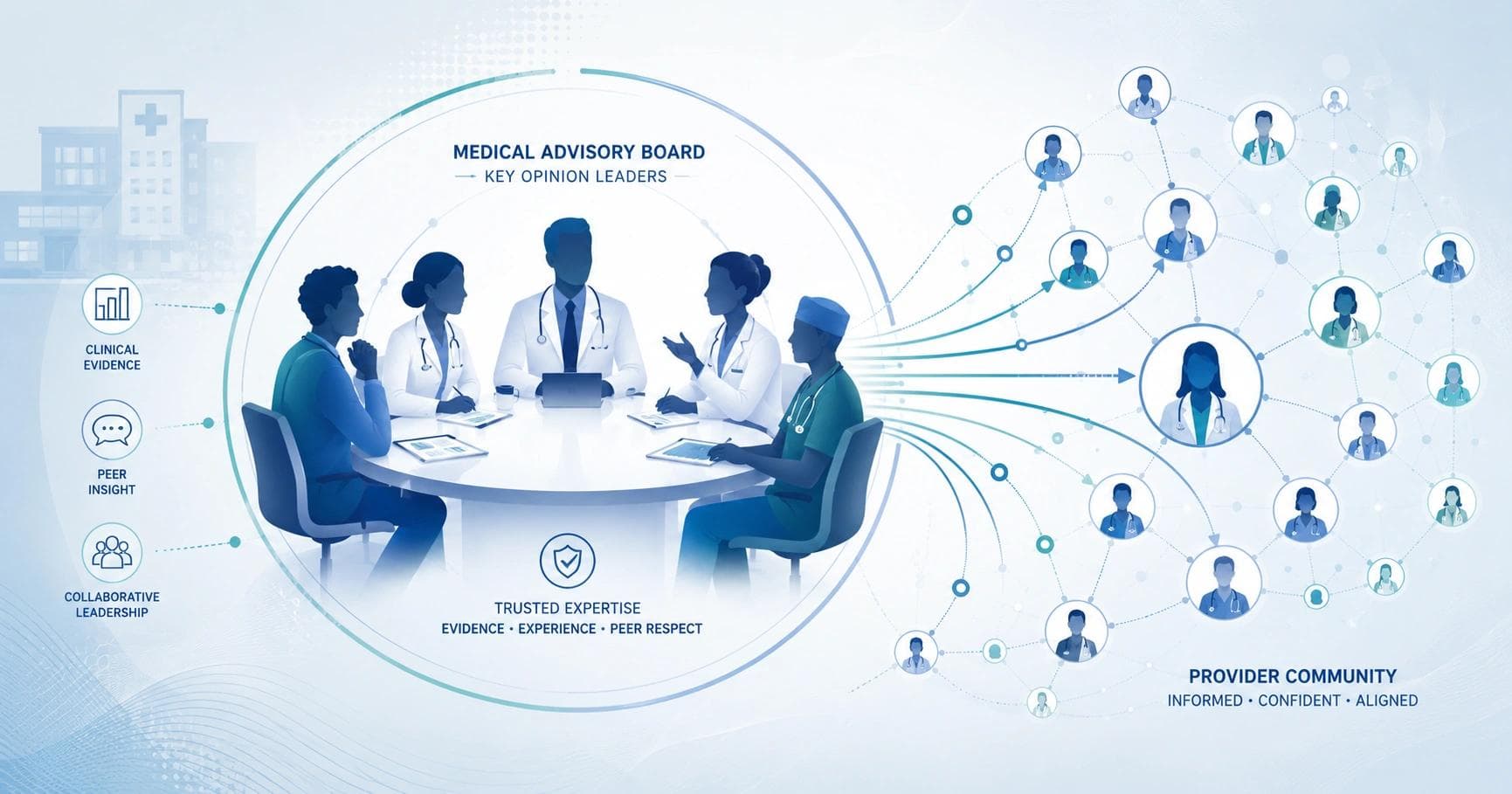
In healthcare, belief travels along peer lines. A physician is far more likely to adopt a new approach because a respected colleague endorses it than because a company says it works. That is the entire premise behind key opinion leaders and medical advisory boards: a small number of trusted clinical voices shape what a much larger community believes and does. Done well, a KOL and advisory board program is one of the highest-leverage commercial assets a healthcare company has. Done badly, it is an expensive collection of famous names who never move a single adoption decision and, worse, a compliance liability.
The difference is not budget. It is whether you treat KOL engagement as a genuine clinical-credibility program or as a box to check before launch.
Short version: a KOL and advisory board strategy works when you select leaders for real influence and relevance rather than fame, engage them as advisors whose input you actually use, activate their voice in ways that reach your target providers, and run the whole thing inside clear compliance guardrails. Miss any of those and you are paying for logos, not adoption.
What KOLs and Advisory Boards Actually Do
It helps to be precise about the roles, because companies conflate them and get neither right.
- Key opinion leaders are influential clinicians whose views shape peers, through publications, guideline involvement, conference presence, and reputation. Their commercial value is credibility and reach: when they engage with and endorse an approach, adoption follows.
- A medical advisory board is a structured group of clinical experts who advise the company on clinical strategy, evidence, product direction, and market realities. Its first value is better decisions; its second is the deep, informed advocacy that comes from clinicians who genuinely understand and helped shape what you are building.
The two overlap - advisory board members are often KOLs - but the purpose differs. One is primarily about influence in the market; the other is primarily about counsel that also builds advocates. A strong program uses both deliberately.
This is the operational engine behind clinical credibility as a go-to-market asset. Credibility is not a slogan; it is built by real relationships with real clinical experts, and KOL and advisory board work is how you build it at scale.
Choose the Right Leaders
The most common and expensive mistake is chasing the biggest names. The physician with the most publications and the busiest speaking schedule may have no real influence over the specific audience you need to reach, may be engaged with a dozen other companies, and may be impossible to actually work with. Fame is not the selection criterion. Influence and relevance are.
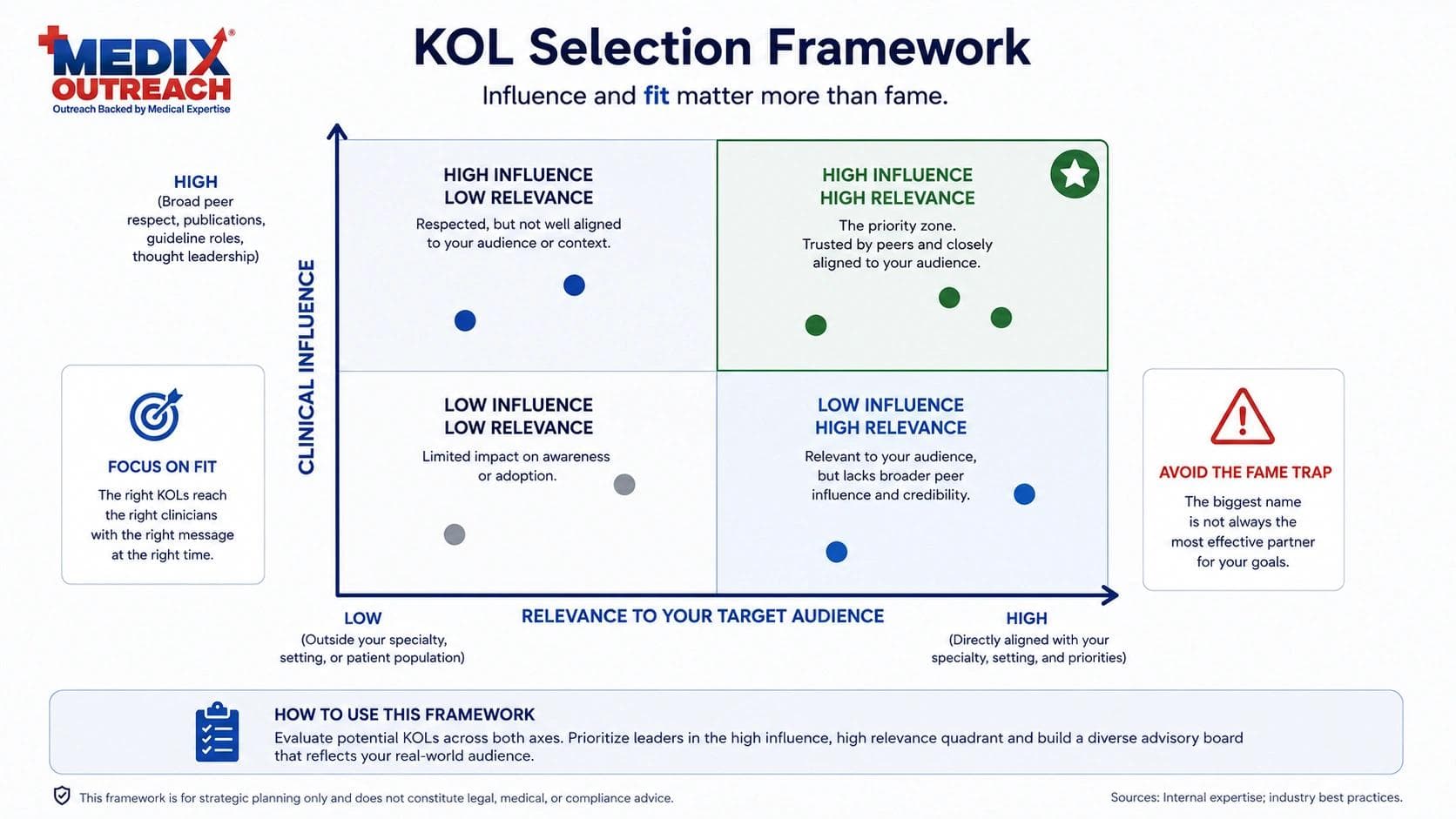
Evaluate candidates on the factors that actually predict impact:
- Influence with your specific audience. A national KOL who shapes academic medicine may be irrelevant to the community specialists who will actually order your product. Sometimes the regional leader with deep peer trust matters more than the famous name.
- Genuine relevance to your clinical area, so their endorsement is credible rather than bought.
- Willingness to engage substantively, not just lend a name. A leader who will review evidence, give hard feedback, and speak to peers is worth ten who cash a check and disappear.
- Diversity of perspective, including practicing community clinicians, not only academics, because your buyers are mostly the former.
Selecting for influence-plus-relevance rather than fame is what turns an advisory board from a trophy case into a working asset. The same discipline underlies effective provider marketing: reach the people who move your market, not the people with the biggest title.
Engage Them as Advisors, Not Endorsers
The fastest way to waste a KOL relationship is to treat a clinical expert as a billboard. Physicians of the caliber you want can tell immediately when they are being used for their name rather than their judgment, and it corrodes the relationship and the credibility you are trying to build.
The programs that work engage clinical leaders in ways that use their expertise:
- Ask for real input on evidence, positioning, and clinical strategy, and be visibly willing to change course based on it.
- Involve them early, when their perspective can still shape the product and the message, not just at launch when you want a quote.
- Create genuine two-way value: access to peers and data, a role in advancing something they believe in, and intellectual engagement, not just honoraria.
When clinicians help shape what you are doing, they become authentic advocates, and authentic advocacy is what actually moves peers. This is the relationship-first logic behind building trust before the first call, applied to the most influential people in your market.
Mid-article CTA
Need help building your healthcare growth engine?
Medix helps healthcare startups, clinics, pharma companies, and provider-focused platforms build scalable commercial pipelines.
Book a Strategy CallRun It Like a Program, Not a Meeting
A single advisory board dinner accomplishes almost nothing. The value comes from a sustained program with a clear purpose and follow-through.
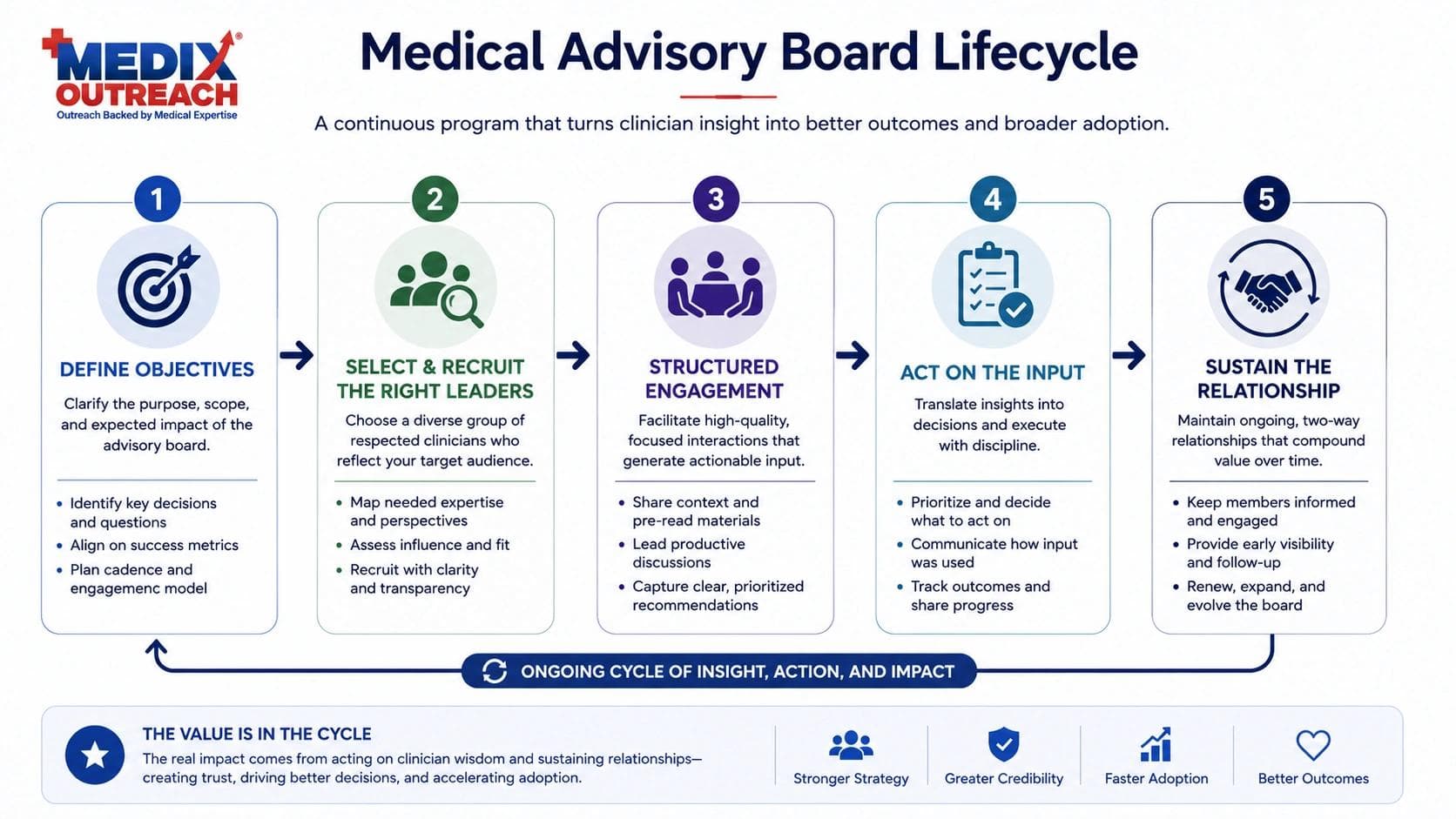
A well-run program has a lifecycle:
- Define the objective. Are you seeking clinical guidance, launch advocacy, evidence direction, or all three? The objective determines who you recruit and how you engage them.
- Select and recruit the right mix of leaders for influence, relevance, and perspective.
- Engage them in structured ways - advisory meetings, evidence review, and input into strategy - with real preparation and real agendas.
- Act on the input. Nothing kills an advisory relationship faster than gathering advice and ignoring it. Close the loop and show members their input mattered.
- Sustain the relationship over time, because credibility compounds and one-off engagements do not.
The output of the program is not a list of names for your website. It is a set of clinical leaders who understand your product, believe in it, and are willing to say so to their peers, which is the real currency in provider adoption and referral growth. Our work refining provider positioning for faster clinic adoption reflects the same principle: adoption accelerates when the clinical voices your buyers trust are on your side.
Stay Inside the Compliance Lines
KOL and advisory board work sits close to serious regulatory lines, and getting it wrong turns a credibility asset into legal exposure. Two frameworks matter most in the United States.
- The Anti-Kickback Statute prohibits paying to induce referrals or purchases of items reimbursed by federal healthcare programs. Payments to physicians must be for legitimate, needed services at fair market value, not disguised inducements. The HHS Office of Inspector General publishes guidance on how these arrangements are scrutinized.
- Payment transparency. Under the Sunshine Act, many manufacturer payments and transfers of value to physicians are reported publicly through Open Payments, so every honorarium and dinner is visible.
The practical rules that keep programs clean are straightforward: engage clinicians for genuine, documented services; pay fair market value based on a defensible rationale; keep advisory work separate from any expectation of ordering or referrals; and document everything. This is not a reason to avoid KOL work - it is a reason to run it professionally. If your program would look bad written up in a news story, restructure it. Compliance and credibility point in the same direction, and companies that treat clinical experts with genuine respect rarely have a problem. For outreach that touches regulated data more broadly, our guide to HIPAA-compliant sales and marketing covers the adjacent constraints.
Where Medix Fits
Medix Outreach helps healthcare companies build the clinical relationships that drive adoption. Our provider network development work identifies the right clinical leaders for your specific market, builds substantive advisory and engagement relationships, and activates that credibility into provider adoption - all with respect for the compliance lines that keep the program an asset rather than a liability. We help you build a program clinicians want to be part of, because that is the only kind that works.
Frequently Asked Questions
What is the difference between a KOL and a medical advisory board?
A key opinion leader is an influential clinician whose views shape peers through publications, guidelines, and reputation; their commercial value is credibility and reach. A medical advisory board is a structured group of clinical experts who advise the company on strategy, evidence, and product direction; its value is better decisions and informed advocacy. They overlap - board members are often KOLs - but one is primarily about market influence and the other about counsel that also builds advocates.
How do you choose the right KOLs?
Select for influence and relevance to your specific audience rather than fame. A national academic name may have little sway over the community clinicians who will actually use your product, while a trusted regional leader might. Prioritize genuine relevance to your clinical area, willingness to engage substantively rather than just lend a name, and a mix that includes practicing community clinicians, not only academics.
How do you keep a KOL or advisory board program compliant?
Engage clinicians for genuine, documented services, pay fair market value based on a defensible rationale, and keep advisory work separate from any expectation of referrals or purchases, which the Anti-Kickback Statute prohibits inducing. Remember that many payments to physicians are reported publicly through Open Payments under the Sunshine Act. Document everything, and if an arrangement would look bad reported in the news, restructure it.
Why do most advisory boards fail to drive adoption?
Because companies treat them as trophy cases or one-off meetings rather than programs. Value comes from selecting leaders for real influence, engaging them as advisors whose input you actually act on, and sustaining the relationship over time so they become genuine advocates. A single dinner with famous names on a slide accomplishes almost nothing; a working program of trusted clinicians who believe in your product moves their peers.
When should a healthcare company start building KOL relationships?
Earlier than most do. Engaging clinical leaders early - while their input can still shape the product, evidence, and message - produces better decisions and authentic advocates, rather than last-minute endorsers recruited just to supply a launch quote. Because clinical credibility compounds over time, starting the relationships well before launch pays off when adoption decisions are being made.