

Hospice is almost entirely a referral business - and one with a persistent problem: patients are referred too late, or not at all. Many people who are eligible for hospice enter it only in their final days, long after they could have benefited from its support. For a hospice, that makes referral growth less about volume tactics and more about earning the trust of referrers, educating them on timely eligibility, and operating with unimpeachable compliance in a setting that draws intense regulatory scrutiny.
This guide covers where hospice referrals come from, why late referrals are the core problem, what referrers want, how to build a referral-development program, and how to grow within federal rules - which matter more in hospice than almost anywhere else.
Where hospice referrals come from
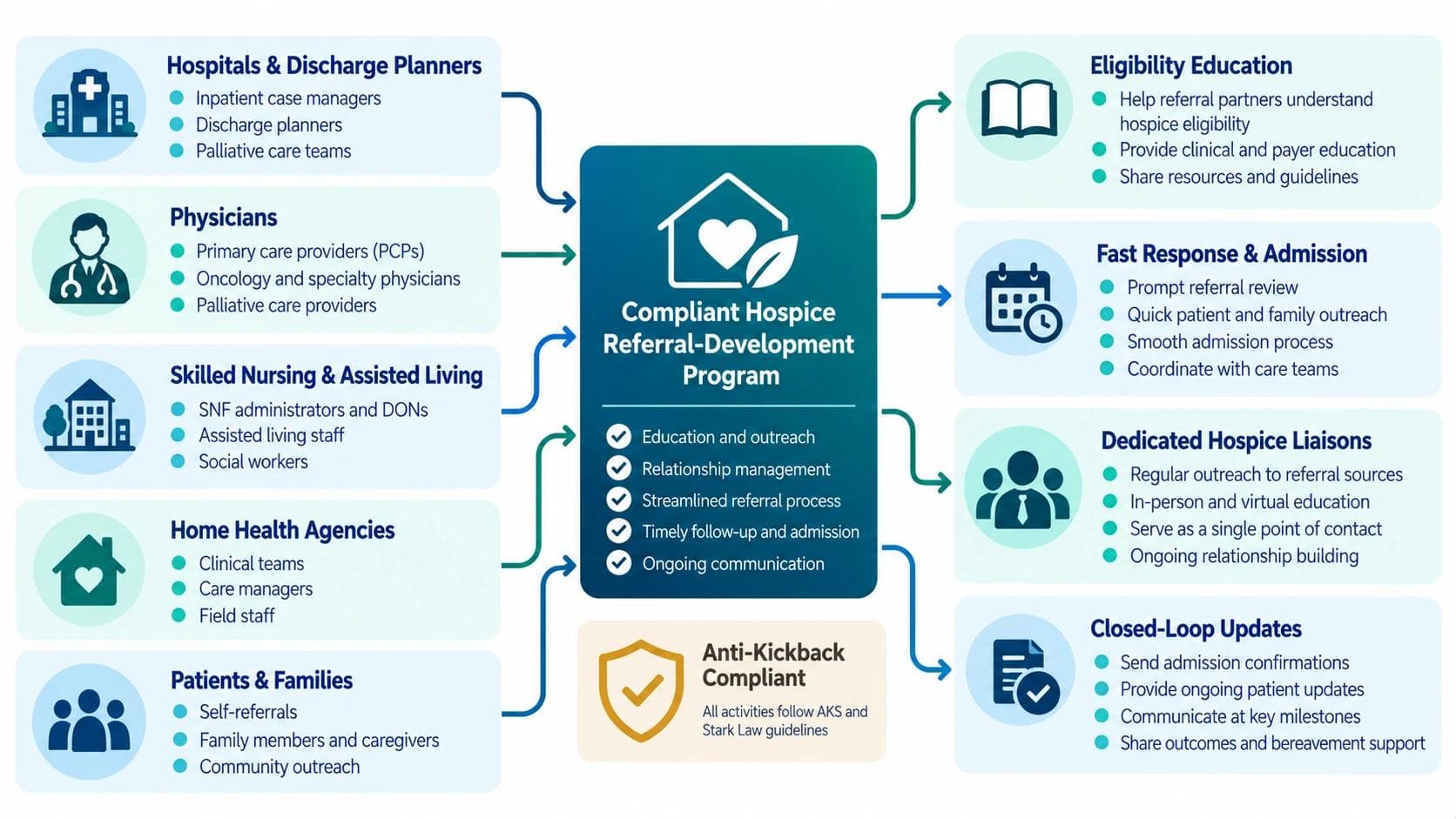
Hospice referrals flow from the full continuum of care:
- Hospitals and discharge planners - a major source for patients leaving acute care with a terminal prognosis, closely related to discharge-planner relationships.
- Physicians - oncologists, cardiologists, pulmonologists, and primary care physicians managing advanced illness.
- Skilled nursing facilities and assisted living - residents whose condition has progressed to hospice eligibility.
- Home health agencies - patients transitioning from skilled home care to end-of-life care.
- Patients and families - direct inquiries, increasingly informed by their own research.
As with any referral base, growth starts with knowing which sources send patients, which have gone quiet, and which should refer but do not - the discipline behind tracking referral sources.
The real problem: late referrals
The Medicare hospice benefit is available to patients with a terminal prognosis - generally a life expectancy of six months or less if the illness runs its normal course - and covers an interdisciplinary set of services; see Medicare hospice coverage and the CMS hospice benefit. Yet many eligible patients are referred only in their final days. The single biggest hospice referral-growth opportunity is not stealing share - it is helping referrers recognize eligibility earlier and refer at the right time. Education, not pressure, is the growth lever: referrers who understand the benefit and trust the hospice refer sooner and more often.
What referrers want from a hospice
- Fast response and admission. When a physician or discharge planner identifies a hospice-appropriate patient, they need same-day responsiveness - delays send the referral elsewhere or lose the window entirely.
- Eligibility clarity. Clear, compliant guidance on who qualifies and when, so referrers feel confident referring earlier.
- Closed-loop communication. Timely confirmation and updates back to the referring clinician, part of reducing referral leakage across the continuum.
- Seamless transitions. Smooth handoffs from hospital, SNF, or home health so the patient and family experience continuity, not a gap.
Mid-article CTA
Need help building your healthcare growth engine?
Medix helps healthcare startups, clinics, pharma companies, and provider-focused platforms build scalable commercial pipelines.
Book a Strategy CallBuild a compliant hospice referral-development program
Sustainable hospice referral growth is a repeatable, compliance-first system - the same structure Medix applies across post-acute settings such as home health and senior care:
- Map and segment referrers into grow, protect, and win-back groups across hospitals, physicians, SNFs, and home health.
- Educate on timely eligibility - the highest-leverage, most defensible growth activity.
- Deploy hospice liaisons to build relationships and surface friction - see the liaison program model.
- Guarantee fast response and admission - response time is the referrer's lived experience of your hospice.
- Measure and reallocate by referral source, timeliness, and length of stay.
Grow hospice referrals within Anti-Kickback rules
Compliance is not a footnote in hospice - it is central. Hospice has been one of the most active areas of federal enforcement, with repeated cases involving improper payments for referrals and improper arrangements with nursing facilities, assisted living, and physicians. The Anti-Kickback Statute prohibits offering anything of value to induce referrals of federally reimbursed services - see the OIG fraud and abuse laws. Grow strictly through genuine value - responsiveness, education, quality care, and smooth transitions - never inducements, and have counsel review every referral relationship, medical-director arrangement, and facility agreement. Quality is also increasingly transparent through the CMS Hospice Quality Reporting Program, which referrers and families consult.
Measure what grows the hospice
- Referral volume and trend by source (hospital, physician, SNF, home health, family).
- Referral-to-admission conversion and response time.
- Average length of stay - a proxy for how early patients are being referred.
- New referrers activated and lapsed referrers recovered.
Frequently asked questions
How do hospices get more referrals? By mapping referral sources, educating referrers on timely eligibility, responding and admitting fast, building relationships through liaisons, and closing the loop - all strictly within Anti-Kickback rules, which hospice regulators enforce aggressively.
Who refers patients to hospice? Hospitals and discharge planners, physicians managing advanced illness (oncology, cardiology, pulmonology, primary care), skilled nursing and assisted living facilities, home health agencies, and patients and families directly.
Why are hospice patients referred too late? Referrers often under-recognize eligibility or delay the conversation. The biggest growth opportunity is education that helps clinicians identify hospice-appropriate patients earlier, not pressure tactics.
What compliance rules apply to hospice referral growth? The Anti-Kickback Statute prohibits paying for referrals, and hospice is a top federal enforcement area for improper arrangements with facilities and physicians. Grow through genuine value and have counsel review every referral-related arrangement.
Becoming the hospice referrers trust
Hospice referral growth is won by earning referrer trust: educate on timely eligibility, respond and admit fast, communicate back, and operate with unimpeachable compliance. Hospices that build that system serve more patients earlier - and grow census the right way.
Medix Outreach builds compliant referral-development programs and provider networks for hospice and post-acute providers. To grow your hospice referral base, book a free strategy call or explore our Provider Network Development service.