

Referral leakage is one of the most expensive problems in healthcare that almost no one has a line item for. A patient is referred, and then - somewhere between the order and the completed visit - they land outside the network, never schedule, or disappear entirely. The downstream revenue, the continuity of care, and the relationship with the referring physician all leak away at once, quietly, case by case.
This guide defines referral leakage, explains why it happens, shows how to measure it, and lays out a practical framework to reduce it - all within the federal rules that govern physician referrals.
What referral leakage is
Referral leakage is the loss of referred patients from the intended care pathway or network. It happens when a referral is sent to an out-of-network provider, when a patient never schedules the referred visit, when they no-show, or when there is no confirmation that the visit ever happened. "Patient leakage" and "network leakage" describe the same phenomenon. The common thread is a broken or open referral loop: the referral starts but is never reliably closed.
Why referral leakage costs more than practices think
Leakage is not only lost volume. When referrals fall through, care fragments - a core patient-safety and coordination failure that the AHRQ work on care coordination identifies as a root cause of poor outcomes, especially when the loop between referring and receiving clinicians is never closed. The costs compound across three dimensions:
- Revenue. Every leaked referral is lost downstream volume - the specialist visit, the procedure, the imaging, the follow-up.
- Clinical continuity and safety. Open referral loops mean results and follow-up fall through the cracks; AHRQ's ambulatory patient-safety work treats failed follow-up on referrals and tests as a recognized source of harm.
- Relationships. A referring physician whose patient has a bad access experience stops sending - so leakage erodes the very referral base that feeds the practice.
Where leakage happens in the referral lifecycle
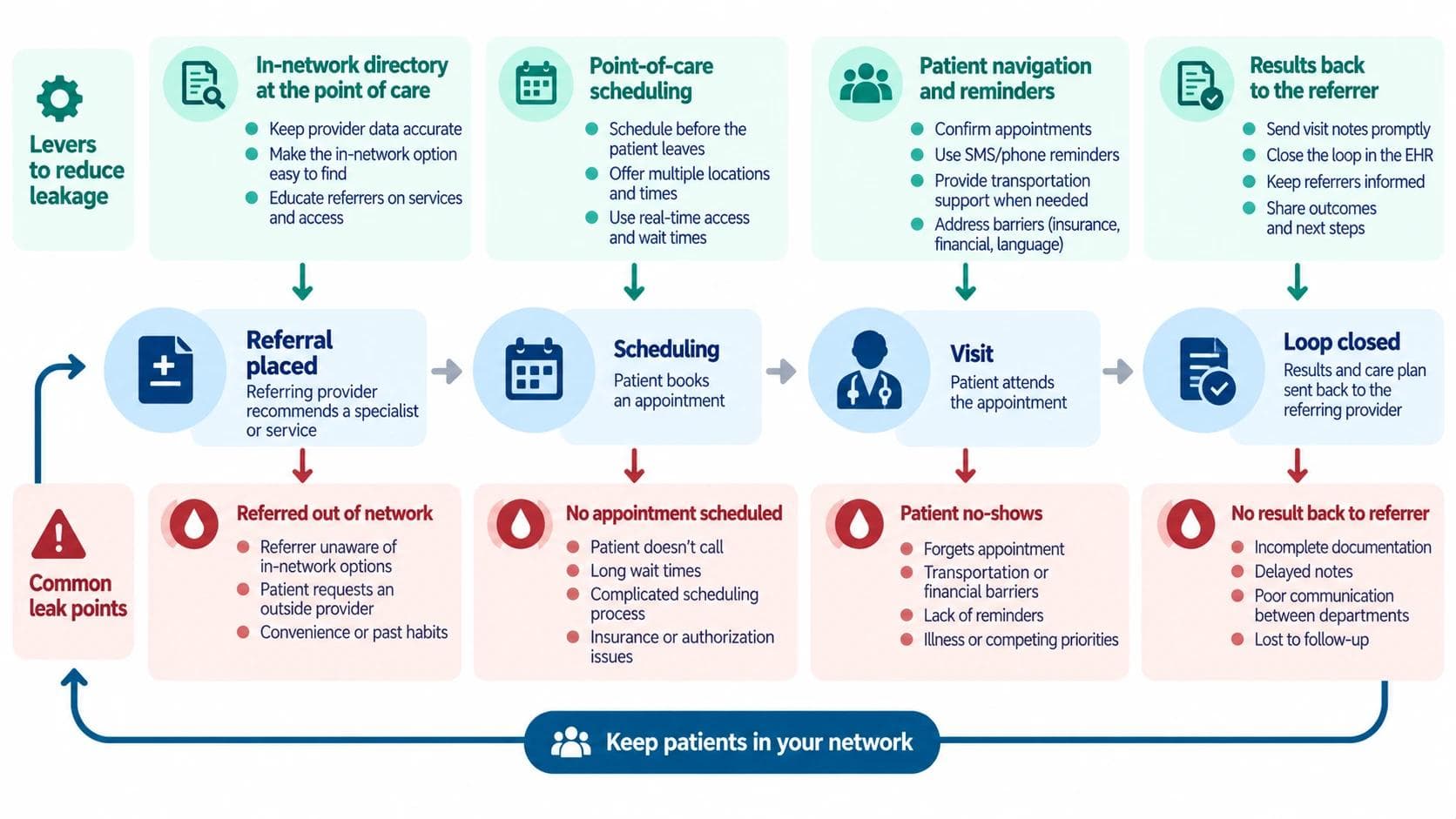
Leakage is not one event; it is several failure points along the referral journey:
- At the point of referral - the referral goes out-of-network by default, habit, or missing information about in-network options.
- At scheduling - the patient leaves without an appointment because same-day or point-of-care scheduling was not available.
- Between order and visit - no reminder, no navigation, and the patient never books or no-shows.
- At the loop - the receiving provider never confirms the visit or sends results back, so no one knows whether the referral completed.
How to measure referral leakage
You cannot reduce what you do not measure. The core metric is the leakage rate - the share of referrals that leave the intended network or never complete - segmented by referring source, specialty, and destination. Layer in referral-to-appointment conversion and time-to-appointment. This is the analytics discipline behind tracking referral sources, and it is what turns a vague sense of "we're losing patients" into a prioritized target list of where the leak is worst.
Mid-article CTA
Need help building your healthcare growth engine?
Medix helps healthcare startups, clinics, pharma companies, and provider-focused platforms build scalable commercial pipelines.
Book a Strategy CallHow to reduce referral leakage
Sustainable leakage reduction is a system, not a campaign:
- Make referring in-network effortless. Give referrers current directories of in-network specialists, services, and access, and make the in-network option the path of least resistance in the workflow.
- Close the loop. Confirm the appointment, confirm the visit, and send results and the plan back to the referring clinician - the single highest-leverage fix, supported by referral management software.
- Remove access friction. Fast scheduling (ideally at the point of referral), short waits, and patient navigation so referrals convert before they cool.
- Deploy physician liaisons. Use a physician-liaison program to surface why referrers send out, fix the friction, and rebuild relationships.
- Align the network. In ACO, CIN, and value-based arrangements, keeping appropriate referrals in-network also protects cost and quality performance - see clinically integrated network and ACO referral strategy.
- Measure and reallocate. Track leakage by source and destination and focus effort where the loss is largest.
Reduce leakage within Stark and Anti-Kickback rules
A critical caveat: you cannot simply pay physicians to keep referrals in-network. The Physician Self-Referral Law (Stark) restricts referrals where a financial relationship exists - see CMS on physician self-referral - and the Anti-Kickback Statute prohibits inducements for referrals of federally reimbursed services, per the OIG summary of the fraud and abuse laws. Reduce leakage by removing friction and delivering genuine value - access, communication, quality - not by paying for referrals, and have counsel review any referral program or alignment arrangement.
Frequently asked questions
What is referral leakage? Referral leakage is the loss of referred patients from the intended network or care pathway - when referrals go out-of-network, patients never schedule or no-show, or the loop is never closed with confirmation and results. It is also called patient leakage or network leakage.
Why does referral leakage matter? It drains downstream revenue, fragments care and creates patient-safety risk from open referral loops, and erodes relationships with referring physicians - which further shrinks referral volume over time.
How do you measure referral leakage? Calculate the leakage rate - the share of referrals that leave the network or never complete - segmented by referring source, specialty, and destination, alongside referral-to-appointment conversion and time-to-appointment.
How do you reduce referral leakage legally? Make in-network referral effortless, close the loop, remove access friction, use physician liaisons, and align the network - competing on genuine value rather than paying for referrals, which Stark and the Anti-Kickback Statute prohibit.
Turning a hidden leak into retained growth
Referral leakage is fixable, but only as a system: measure it honestly, close the loop, remove access friction, and rebuild referrer relationships - compliantly. Practices and systems that do this convert a quiet, recurring loss into retained volume, stronger continuity, and durable referral relationships.
Medix Outreach builds compliant referral-development programs and provider networks that close the loop and keep appropriate referrals in-system. To find and fix your leakage, book a free strategy call or explore our Provider Network Development service.