
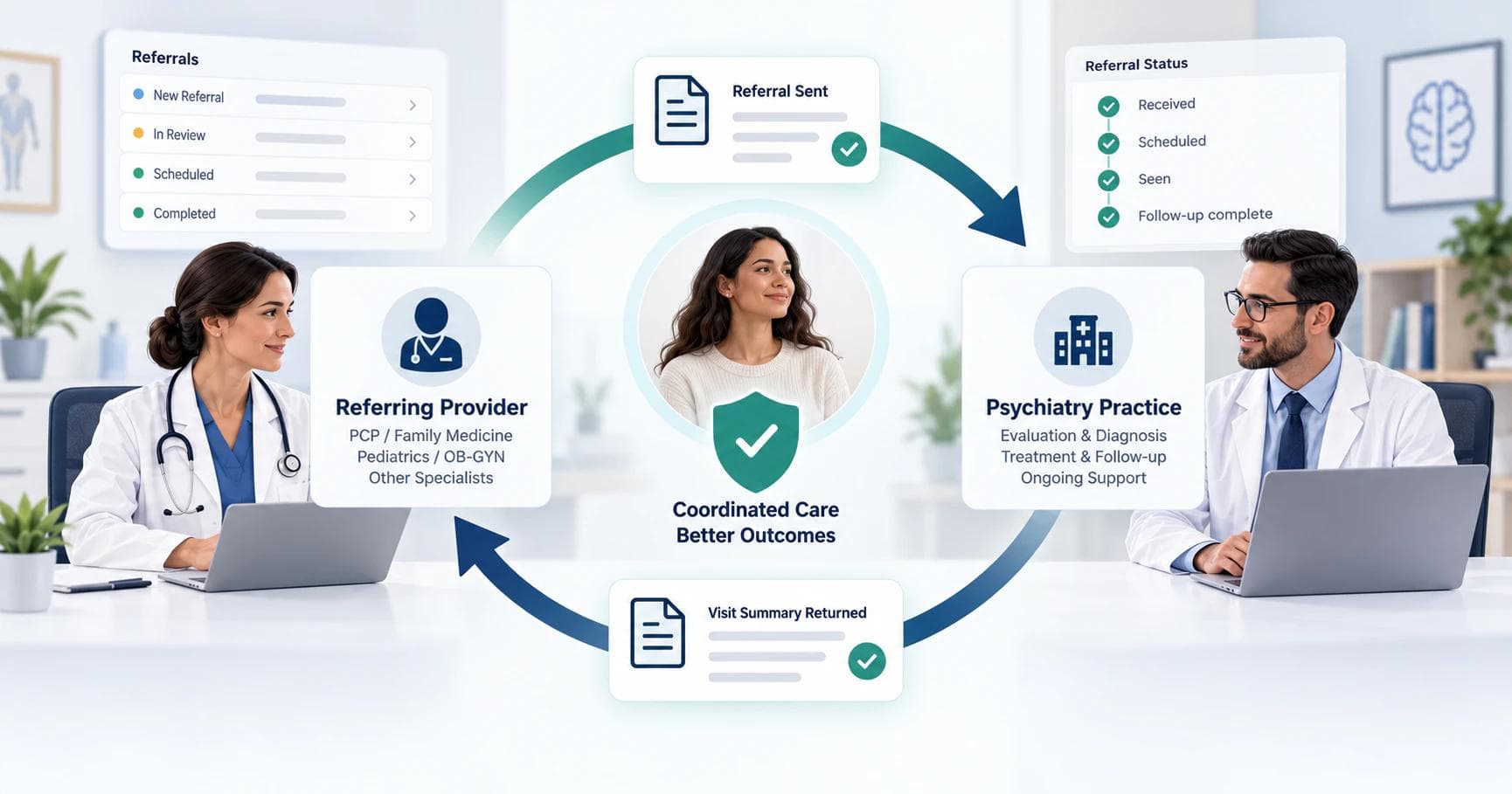
Referral management software captures, routes, tracks, and closes the loop on patient referrals - so fewer referrals leak and referring providers keep sending patients. The difference between a system that grows your practice and one that just digitizes a fax pile comes down to a handful of capabilities. This guide walks through what to require, what to ignore, and how to score vendors.
If your current 'system' is a fax machine, a shared inbox, and a spreadsheet, you are almost certainly losing referrals you never see. Before evaluating tools, it helps to understand how to measure referral leakage so you can quantify the problem the software is meant to solve.
What referral management software should do
Strip away the marketing and a referral system exists to do five jobs well:
- Capture referrals from every channel - fax, portal, phone, EHR, and web form - into one queue with structured data.
- Route each referral to the right provider or location based on specialty, insurance, urgency, and capacity.
- Track status end to end: received, scheduled, seen, and returned - so nothing sits in limbo.
- Close the loop by returning notes and outcomes to the referring provider automatically.
- Report on referral volume and conversion by source, so you know which relationships produce.
A tool that does the first two but not the last three is a queue, not a management system. The value is in tracking, closing, and reporting - exactly the parts a fax line cannot do.
Fax queue vs. real referral management
The gap between a manual process and true referral management is where growth leaks out. A one-way fax has no status, no automated follow-up, and no way to see which referrals were never scheduled. A closed-loop system makes every referral visible and every source measurable.
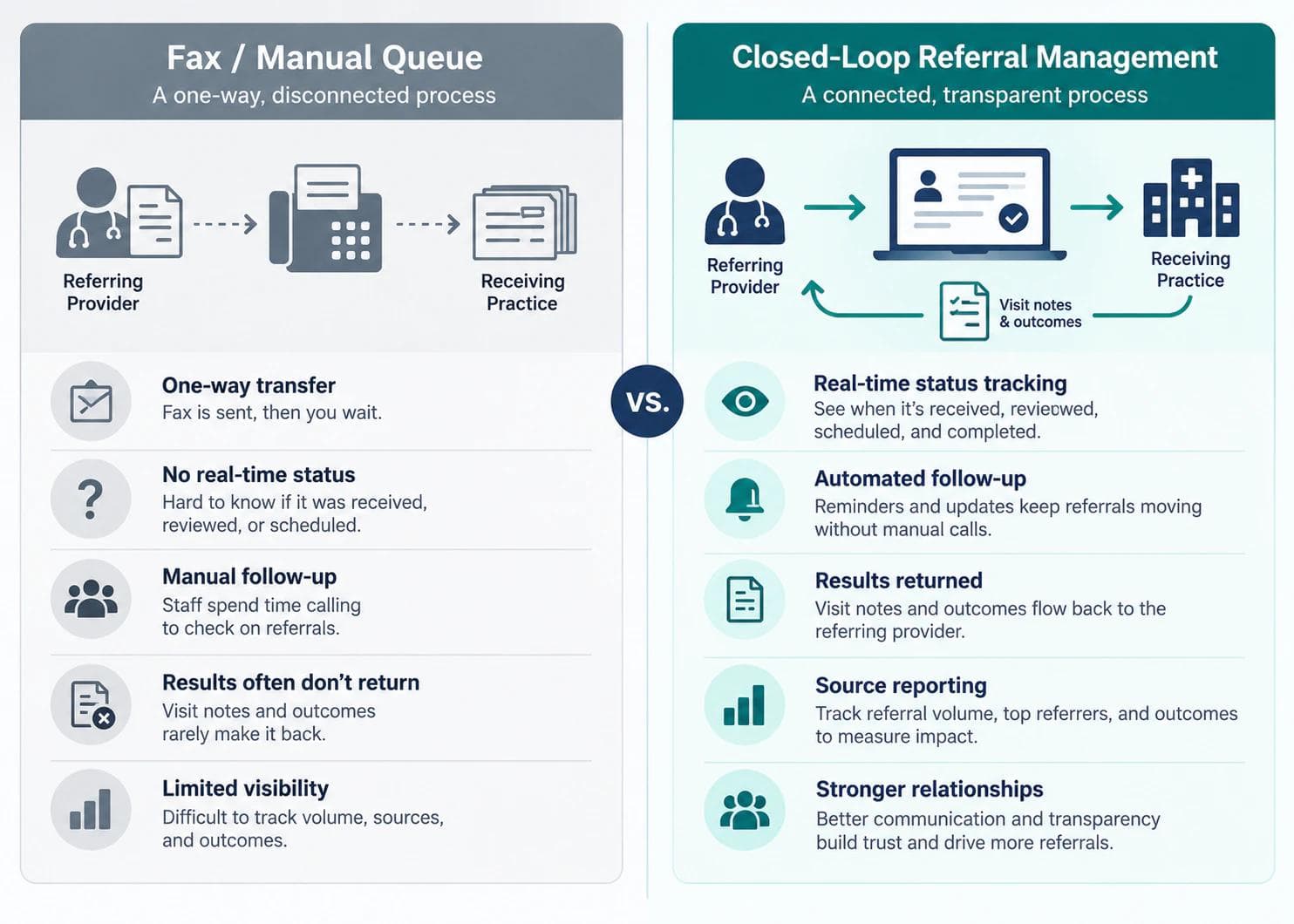
The clinical case for closing the loop is well established: coordinated transitions of care reduce duplicated work and improve outcomes, which is the core of care coordination. The commercial case is just as strong - referring providers keep sending patients to practices that communicate back.
Must-have features (and what they actually mean)
Closed-loop tracking
Every referral gets a status and an owner. You can see, at any moment, how many referrals are received but not scheduled, scheduled but not seen, and seen but not reported back. This single capability is what turns a closed-loop referral workflow from a slogan into an operating reality.
Interoperability and EHR integration
The system should exchange data with your EHR and with referring providers using current standards, not just fax. Ask how it handles EHR integration, electronic exchange, and the interoperability standards that make electronic referrals possible. Poor integration creates double entry, which staff quietly abandon.
Intelligent routing and capacity awareness
Referrals should route by specialty, payer, urgency, and real availability. A system that routes an urgent patient into a four-week queue is a liability. Routing quality depends on clean intake, which is why your intake and referral forms and your software have to be designed together.
Source-level analytics
You must be able to see referrals and conversion by referring provider and organization. This is the data that makes a physician referral engine accountable and tells your outreach team where to spend time.
Patient communication
Automated reminders and easy scheduling reduce the no-shows that make referrals look like leakage. A referral that is sent but never converts to a completed visit did not really happen.
Nice-to-have vs. deal-breaker
- Deal-breakers: closed-loop status tracking, HIPAA-appropriate security and a signed business associate agreement, source-level reporting, and workable EHR exchange.
- High value: intelligent routing, patient self-scheduling, automated referring-provider updates, and configurable intake by specialty.
- Nice-to-have: custom dashboards, mobile apps, and marketing integrations - useful, but do not let them outweigh the core loop.
Mid-article CTA
Need help building your healthcare growth engine?
Medix helps healthcare startups, clinics, pharma companies, and provider-focused platforms build scalable commercial pipelines.
Book a Strategy CallA vendor scoring checklist
Score each vendor 1-5 on these dimensions, weight them for your situation, and compare totals rather than trusting a demo impression:
- Closed-loop completeness - can it prove a referral was received, scheduled, seen, and reported back?
- Interoperability - EHR integration and standards-based exchange with outside providers.
- Routing intelligence - specialty, payer, urgency, and capacity logic.
- Analytics - source-level volume and conversion, exportable.
- Usability - will front-desk and referral staff actually use it daily?
- Security and compliance - HIPAA safeguards, BAA, access controls, audit logs.
- Implementation and support - realistic timeline, training, and a named point of contact.
- Total cost - licenses, integration, and the internal time to run it.
Software is necessary but not sufficient
Rolling it out without a staff revolt
The best-scored system fails if front-desk and referral staff quietly go back to the fax. A disciplined rollout protects your investment:
- Map the current workflow first - document exactly how referrals move today, including the informal workarounds, so you configure the tool to reality.
- Name an internal owner who is accountable for adoption, not just IT setup.
- Pilot with one specialty or location before an all-at-once launch; fix what breaks on a small footprint.
- Migrate the fax, don't fight it - route inbound faxes into the system so staff have one queue, not two.
- Train on the daily job, not the software - teach people how to work a referral, and let the tool be the means.
- Watch adoption metrics for the first 60 days - unworked queues are the early warning that the rollout is slipping.
The most common mistake is buying a system to fix a process nobody has designed. Software will faithfully automate a broken referral workflow. Before you buy, define who owns each referral status, what your follow-up cadence is, and how outreach connects to intake - the same discipline behind strong provider network development. If you want help aligning process and outreach before selecting a tool, Medix's Provider Network Development team can map it with you.
Frequently Asked Questions
What is referral management software?
Referral management software is a system that captures, routes, tracks, and closes the loop on patient referrals between providers. Unlike a fax line or a shared inbox, it gives every referral a status, automates follow-up, and reports on referral sources and conversion.
What does 'closed-loop referral' mean?
A closed-loop referral is one where the receiving provider confirms receipt, schedules the patient, and returns notes or outcomes to the referring provider - closing the communication loop. Open loops are where referrals leak and referring providers lose confidence.
Do I need referral management software or a CRM?
They solve different problems. A CRM manages your outreach and relationships with referral sources; referral management software manages the clinical referral transaction and its status. High-performing organizations often use both, integrated, so relationship activity and referral outcomes live together.
Does referral management software need to integrate with my EHR?
For most organizations, yes. EHR integration reduces double entry, keeps clinical context intact, and supports electronic, standards-based exchange. Ask vendors specifically how they handle EHR integration and current interoperability standards.