
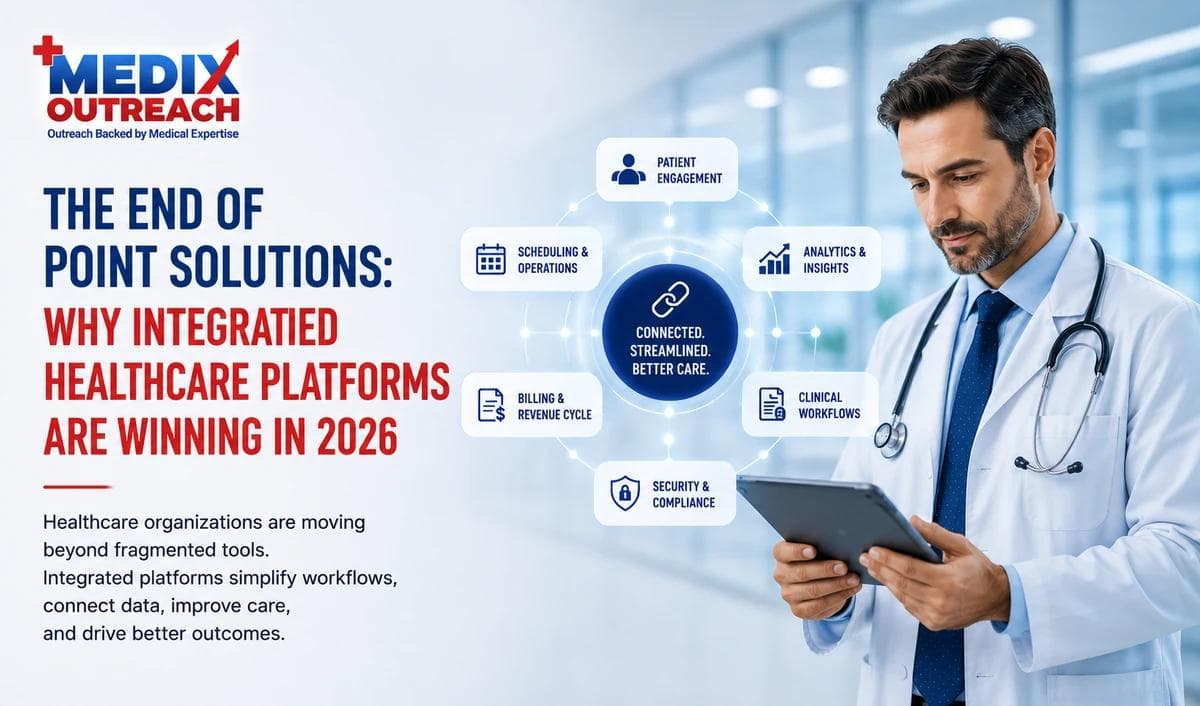
The healthcare technology market is entering a new phase.
For years, healthcare organizations invested in point solutions that addressed individual problems. One platform managed patient scheduling. Another handled remote patient monitoring. A third improved documentation. Others focused on billing, patient engagement, telehealth, analytics, or AI.
While these specialized tools solved specific challenges, they also created a new problem: complexity.
Healthcare providers now manage dozens of disconnected systems, creating fragmented workflows, duplicated data, higher administrative costs, and clinician frustration.
In 2026, healthcare buyers are changing how they evaluate technology.
Instead of purchasing more standalone software, they're prioritizing integrated healthcare platforms that simplify operations, improve interoperability, and deliver measurable business outcomes.
For healthcare companies, this shift is transforming commercialization, provider outreach, and healthcare go-to-market strategy.
Why Point Solutions Are Losing Momentum
Point solutions were designed to solve one problem exceptionally well.
Initially, this made perfect sense.
Healthcare organizations preferred best-of-breed software for each department.
Over time, however, those individual platforms created disconnected ecosystems.
Today, many providers struggle with:
- Multiple software logins
- Duplicate patient information
- Disconnected reporting
- Limited interoperability
- Workflow inefficiencies
- Higher training costs
- Increased administrative burden
Healthcare executives are no longer asking whether a product is the best in its category.
They're asking how well it works with everything else.
Integration Has Become a Buying Requirement
Healthcare buyers increasingly evaluate solutions based on operational fit rather than feature depth.
Questions now include:
- Does it integrate with our EHR?
- Can staff use it without changing workflows?
- Will it reduce administrative work?
- Can it replace multiple vendors?
- Does it improve communication across departments?
- Can it scale with our organization?
Technology that simplifies healthcare operations often wins over technology that simply adds new functionality.
This is why integrated healthcare platforms are gaining momentum across hospitals, health systems, physician groups, and specialty clinics.
Healthcare Providers Want Fewer Vendors
Vendor consolidation has become a strategic priority for many healthcare organizations.
Managing dozens of software providers creates challenges beyond technology.
Each additional vendor introduces:
- Contract negotiations
- Security reviews
- Compliance assessments
- User training
- Technical support
- Integration maintenance
Healthcare leaders increasingly prefer trusted partners capable of solving multiple business challenges through one connected platform.
For healthcare companies, this changes how products should be positioned in the market.
Commercialization Must Reflect the Shift
Healthcare companies often market products around individual capabilities.
Healthcare buyers increasingly purchase platforms based on ecosystem value.
Instead of saying:
"Our platform automates patient scheduling."
Leading organizations communicate:
"Our platform connects scheduling, patient engagement, analytics, workflow automation, and provider communication in one integrated environment."
The conversation shifts from features to operational transformation.
That's the foundation of modern healthcare commercialization.
Provider Outreach Must Focus on Business Outcomes
Integrated platforms solve broader organizational challenges.
Healthcare provider outreach should reflect that reality.
Rather than promoting individual features, outreach should focus on measurable improvements such as:
- Reduced clinician burnout
- Improved staff efficiency
- Better patient experience
- Lower operational costs
- Simplified workflows
- Faster decision-making
- Improved data visibility
Healthcare providers respond to solutions that reduce complexity rather than create additional work.
Mid-article CTA
Need help building your healthcare growth engine?
Medix helps healthcare startups, clinics, pharma companies, and provider-focused platforms build scalable commercial pipelines.
Book a Strategy CallHealthcare Go-to-Market Strategy Must Evolve
The move toward integrated platforms requires healthcare companies to rethink their healthcare go-to-market strategy.
Successful organizations now position themselves around business transformation instead of software functionality.
That includes:
- Clear commercial positioning
- Healthcare business development aligned with executive priorities
- Provider outreach centered on workflow improvement
- Educational content demonstrating operational value
- Strategic partnerships that strengthen ecosystem integration
Healthcare buyers increasingly expect vendors to solve organizational problems, not isolated technical issues. This is also why so many promising products stall in pilot purgatory when they cannot show how they fit the larger operational picture.
Strategic Partnerships Are Becoming More Valuable
Integration rarely happens alone.
Healthcare companies increasingly partner with:
- Electronic Health Record vendors
- Clinical technology providers
- Healthcare SaaS platforms
- Medical device manufacturers
- Revenue cycle management companies
- Digital health organizations
- Pharmaceutical companies
These strategic partnerships expand functionality while increasing commercial credibility.
Organizations that build connected ecosystems often reach healthcare buyers faster than companies operating independently.
Commercial Success Depends on Simplicity
Healthcare organizations don't want more dashboards.
They want fewer.
They don't want more software.
They want better-connected systems.
Commercial teams that understand this shift position their products differently.
Instead of competing feature by feature, they communicate long-term operational value.
That creates stronger provider engagement and healthier healthcare sales pipelines.
Why Healthcare Commercialization Is More Important Than Ever
As healthcare buying becomes more complex, commercialization becomes a competitive advantage.
Healthcare commercialization aligns:
- Healthcare business development
- Provider outreach
- Healthcare demand generation
- Strategic partnerships
- Healthcare sales outsourcing
- Revenue pipeline management
Rather than focusing only on lead generation, commercialization creates a repeatable system for long-term growth. The same pattern shows up when selling AI into healthcare: the technology opens the door, but commercial execution wins the deal.
Organizations with integrated commercial strategies are better positioned to compete in a market increasingly driven by trust, interoperability, and operational efficiency.
How Medix Outreach Helps Healthcare Companies Position for the Future
At Medix Outreach, we help healthcare companies commercialize solutions that solve meaningful healthcare challenges.
As a Healthcare Commercialization and Business Development Partner, we combine pharmacist-led expertise with healthcare go-to-market strategy and commercial growth, provider outreach, healthcare business development, strategic partnerships, healthcare sales outsourcing, and end-to-end revenue pipeline development.
Whether you're launching a healthcare SaaS platform, AI solution, medical device, pharmaceutical product, clinical diagnostics technology, or digital health innovation, we help position your organization around the outcomes healthcare buyers value most. Our work refining provider positioning to accelerate clinic adoption is one example of that approach.
Because in today's healthcare market, companies don't win by offering another point solution.
They win by becoming part of a connected healthcare ecosystem.
Conclusion
Healthcare technology is moving beyond isolated products.
Healthcare organizations are investing in integrated platforms that simplify operations, improve collaboration, and support long-term clinical and business outcomes.
Companies that continue positioning themselves as standalone solutions will face increasing competition.
Organizations that align their healthcare go-to-market strategy, provider outreach, business development, and commercialization around integration will build stronger provider relationships, healthier sales pipelines, and sustainable commercial growth.
In 2026, healthcare buyers aren't looking for more software.
They're looking for connected solutions delivered by trusted partners.
Frequently Asked Questions
What are integrated healthcare platforms?
Integrated healthcare platforms are connected systems that combine multiple functions, such as scheduling, documentation, analytics, patient engagement, and communication, into one environment that shares data and workflows. They contrast with point solutions, which each solve a single problem in isolation. Healthcare buyers favor integrated platforms because they reduce complexity, improve interoperability, and lower the administrative burden of managing many disconnected vendors.
Why are healthcare buyers moving away from point solutions?
Point solutions each solve one problem well, but using many of them creates fragmented workflows, duplicated data, higher training and support costs, and clinician frustration. Healthcare executives increasingly evaluate technology on operational fit and how well it works with everything else, not just feature depth. As a result, they are consolidating vendors and prioritizing platforms that simplify operations.
How should healthcare companies change their commercialization for this shift?
Companies should position around operational outcomes and ecosystem value rather than individual features. That means communicating how a product reduces burden, improves workflows, and connects with existing systems, and aligning business development, provider outreach, and partnerships around integration. Commercialization becomes a repeatable growth system rather than a series of feature-led campaigns.
Does this shift only affect large health systems?
No. The move toward integration affects hospitals, health systems, physician groups, and specialty clinics alike. Smaller organizations often feel vendor sprawl acutely because they have less staff to manage multiple systems, which makes a connected platform and fewer trusted vendors especially attractive.
How do strategic partnerships support platform positioning?
Integration rarely happens alone, so partnerships with EHR vendors, clinical technology providers, and other platforms expand functionality and increase commercial credibility. Organizations that build connected ecosystems tend to reach and win healthcare buyers faster than companies that operate independently, because buyers trust solutions that already fit their environment.
<!-- EXTERNAL REFERENCES -->
- No external regulatory citation required; this is a market and commercialization analysis. Interoperability context aligns with the ONC health IT interoperability program at https://www.healthit.gov (optional supporting reference).