
Med spa lead generation is, in practice, a consultation engine. Aesthetic patients search with high intent ("Botox near me," "lip filler cost"), decide quickly, and choose on trust and responsiveness. So the job is not "more leads" — it is capturing high-intent local demand, converting it with credible visual proof, and getting to the patient before a competitor does. Do those three things inside the rules that govern aesthetic medicine, and the calendar fills itself.
The aesthetic vertical rewards this system especially well because the treatments repeat: a first Botox appointment becomes a standing quarterly booking, a membership, or a package. That makes each acquired patient worth far more than one visit, which is why lead generation and retention have to be built together. For the wider growth picture, pair this with our aesthetic and med spa practice growth guide; this piece focuses on the pipeline.
Why med spa lead generation is its own game
Three things make aesthetics different from general practice marketing:
- The searches are high-intent and hyper-local. People searching for a specific treatment plus a location are ready to book. Winning the local search moment matters more than broad awareness.
- Trust is visual and personal. Patients want to see real results and know exactly who is treating them. Before/after proof and provider credentials do the persuading.
- Injectables and energy devices are medical. Neurotoxins and dermal fillers are regulated medical products, and treatments that carry clinical risk require physician oversight. Marketing has to reflect medical reality, not just spa aesthetics.
Get found: local search and Google Business Profile
Own the "near me" treatment moment.
- Google Business Profile. Claim and fully complete it — treatments offered, hours, photos, and reviews — per Google's guidelines. For most med spas this is the single highest-return local asset.
- Treatment-and-location pages. Build clear pages for each core treatment optimized for local search, with honest pricing guidance, what to expect, and provider information. The broader framework — including ranking in AI-generated answers — is in our healthcare SEO strategy pillar.
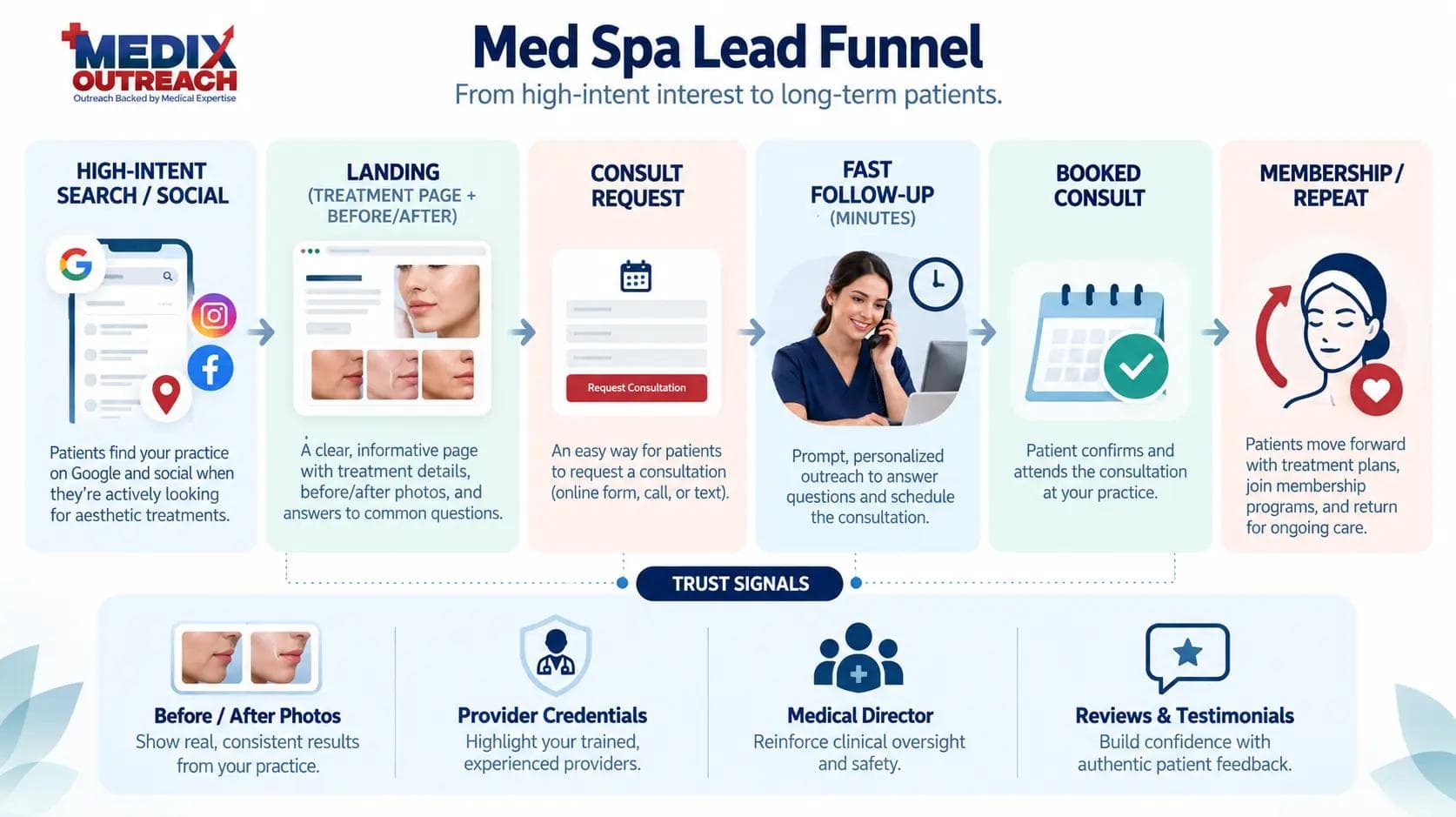
Convert with trust
High-intent traffic converts on credibility. The essentials:
- Before/after galleries of real, consented results — your most persuasive asset. (Consent and claims rules apply; see compliance below.)
- Provider bios and credentials, and a visible medical director or supervising physician. This is both a trust signal and, in most states, a legal requirement.
- Reviews and social proof, requested compliantly and answered without revealing anyone's patient status.
- A frictionless path to book a consultation — online scheduling and one-tap contact on mobile.
Paid social and search
Aesthetics is one of the few healthcare categories where paid social genuinely shines, because the results are visual.
- Instagram, Facebook, and TikTok showcase transformations, education, and offers — strong for awareness and retargeting.
- Search ads capture bottom-of-funnel intent ("laser hair removal near me").
- Offers (first-treatment pricing, events, memberships) convert interest into a booked consult — kept honest and compliant.
Retarget people who engaged but did not book; the second touch converts a large share of aesthetic leads.
Mid-article CTA
Getting clicks but not consults?
Medix helps med spas convert high-intent local demand into booked, repeat consultations.
Book an Aesthetic Growth CallSpeed to lead and booking
In aesthetics, response time is a conversion lever. A lead that gets a reply in minutes books at a far higher rate than one that waits hours. Put online booking on every page, and make sure inbound calls, forms, and DMs are answered fast. A slow follow-up hands the patient to the med spa that replied first.
Retention and lifetime value
The real economics of aesthetics are in repeat revenue. Build retention into the funnel from day one: memberships and treatment packages, recall for maintenance treatments (Botox every ~3–4 months), and permission-based email/SMS with genuinely useful content and timely offers. Many med spas also run adjacent programs — GLP-1 weight-loss programs, for example — that deepen patient value. The retention and revenue mechanics are covered in growing the practice's business.
Compliance for aesthetics
Aesthetic marketing sits on top of medical regulation. Non-negotiables:
- Medical oversight and scope of practice. Per the American Med Spa Association, treatments with clinical risk require a medical director, and who may perform which procedure is set by state law — estheticians cannot inject. Marketing must not imply otherwise.
- FDA-regulated products. Neurotoxins and fillers are prescription medical products; the FDA advises using licensed, qualified providers. Avoid claims that trivialize medical risk.
- FTC. Before/after images and results claims must be truthful and substantiated, and testimonials count as your own claims under the Health Products Compliance Guidance.
- HIPAA. Patient images, testimonials, and data require proper authorization.
This is the wider medical practice marketing playbook applied to a medical, high-trust, image-driven category.
Frequently asked questions
What is the best lead source for a med spa?
Local search plus Google Business Profile for high-intent capture, and Instagram/TikTok for awareness and retargeting. The mix depends on your treatments and market, but "get found locally, convert with visual proof, respond fast" holds everywhere.
How fast should we follow up with a med spa lead?
As close to immediately as possible. Aesthetic leads convert far better with a response in minutes; a multi-hour delay loses many of them to a faster competitor.
Do med spa marketing rules really apply to social media?
Yes. FTC substantiation and testimonial rules, HIPAA authorization for patient images, and state scope-of-practice rules all apply to social content — the platform does not change the law.
How do we make each new patient worth more?
Build retention in: memberships, packages, and maintenance recall. Because aesthetic treatments repeat, retention often drives more revenue than acquisition.