

Men's health has become one of the fastest-growing cash-pay categories in American healthcare - testosterone therapy, erectile-dysfunction treatment, weight management, and general vitality care, largely paid out of pocket and marketed directly to consumers. It is also one of the most crowded and most scrutinized. The clinics that grow sustainably are not the ones making the boldest promises; they are the ones that win on clinical credibility and keep their marketing claims defensible.
This guide covers the men's health opportunity and its trust problem, who the patient is, the channels that work, the compliant-claims rules that protect your practice, and how to build a durable growth engine.
The opportunity - and the trust problem
Demand is real and rising, but the category carries reputational baggage. Direct-to-consumer men's clinics have drawn criticism and regulatory attention for aggressive marketing and inconsistent clinical oversight. That is precisely where a credible clinic wins. Testosterone products, for example, are FDA-approved only for men with low testosterone caused by an associated medical condition - not simply for low levels that come with aging - as the FDA testosterone information explains, and professional guidance such as the AUA testosterone deficiency guideline sets standards for diagnosis and management. A clinic that markets on proper diagnosis, appropriate indications, and real clinical oversight differentiates itself from the hype - the same clinical-credibility advantage that wins across healthcare marketing.
Who the patient is - and how they decide
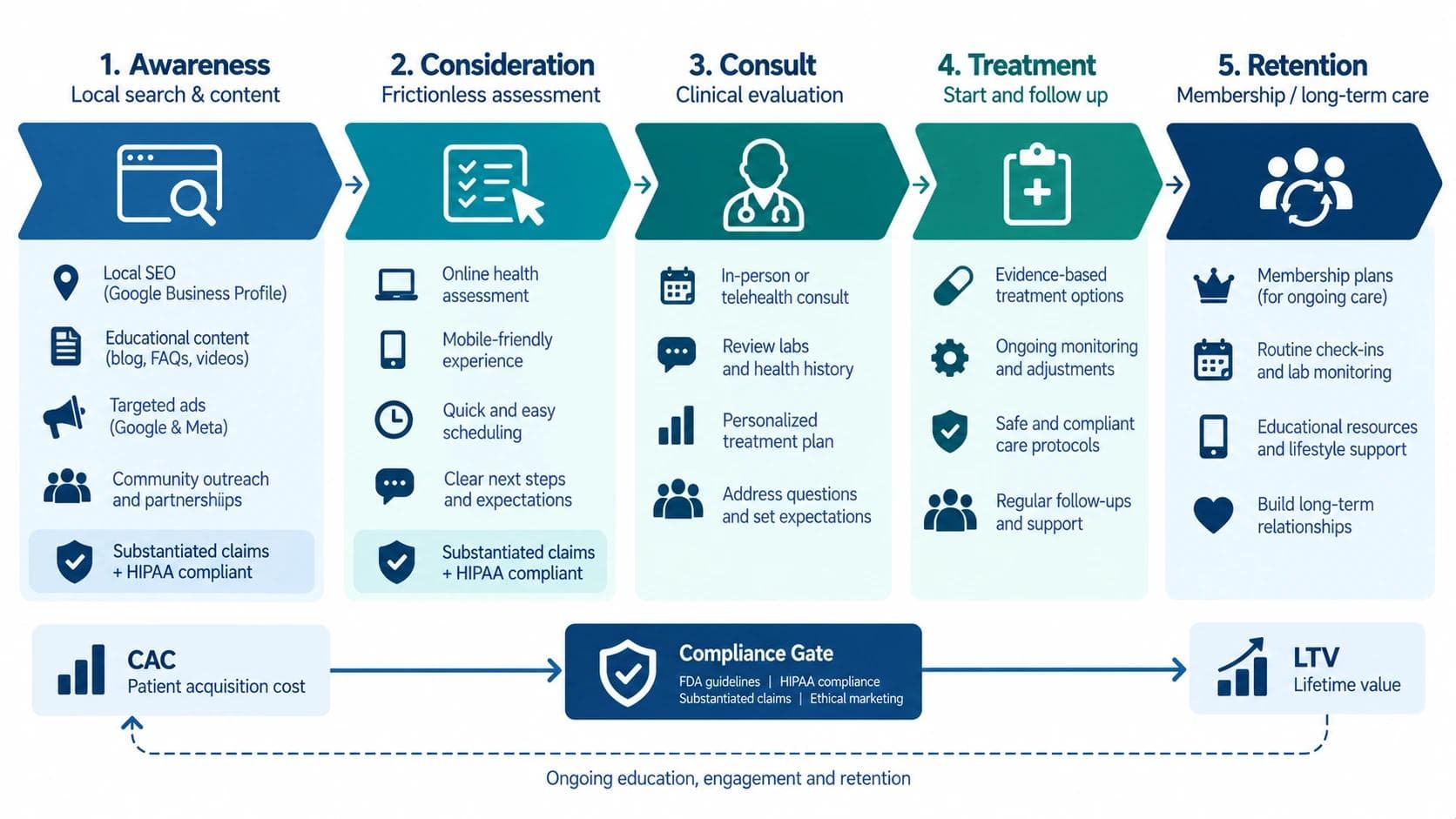
The men's health patient is typically researching privately, comparing options online, and deciding quickly once he trusts a provider. The journey is digital-first: a symptom search (fatigue, low libido, weight, ED), a comparison of local clinics, a review-and-reputation check, then a low-friction first step (an assessment or consult). Because most of this is self-pay, price transparency and a frictionless booking path matter as much as clinical reputation - the broader pattern in the healthcare patient-acquisition digital journey. Many men's health clinics also offer weight management, so the funnel frequently overlaps with GLP-1 weight-loss program growth and adjacent cash-pay models such as functional medicine.
Marketing channels that actually work
- Local SEO and Google Business Profile. Most men's health demand is local and high-intent; owning local search is the highest-leverage channel.
- Educational content. Honest, accurate content on symptoms, diagnosis, and what treatment does and does not do builds trust and ranks - and feeds AI answer engines.
- Paid search, done compliantly. High-intent terms convert, but ad claims must be substantiated (see below).
- Reputation and reviews. In a trust-sensitive category, reviews and outcomes stories are decisive.
- Retention and referral. Membership and recurring-care models turn one visit into lifetime value and word-of-mouth.
Compliant claims: the non-negotiable
In men's health, careless marketing is a legal and reputational risk, not just a conversion problem. Three rules govern everything:
- Advertising substantiation. The FTC requires that health and efficacy claims be truthful and backed by appropriate scientific evidence - "companies must have appropriate substantiation to back up claims for health-related products," per the FTC health-claims guidance. Avoid overstated promises about testosterone, HGH, or peptide add-ons.
- Accurate indications. Market within approved indications and sound clinical standards, not around them.
- Patient-privacy rules. Protected health information cannot be used for marketing without the patient's authorization under HIPAA marketing rules; design reviews, testimonials, and retargeting accordingly - the discipline in HIPAA-compliant sales and marketing.
Mid-article CTA
Need help building your healthcare growth engine?
Medix helps healthcare startups, clinics, pharma companies, and provider-focused platforms build scalable commercial pipelines.
Book a Strategy CallBuild the growth engine
- Position on credibility. Lead with proper diagnosis, qualified clinicians, and oversight - your durable differentiator.
- Engineer the funnel. Local search → educational content → frictionless assessment → consult → treatment, with transparent pricing.
- Build recurring revenue. Membership and follow-up care models raise lifetime value and retention.
- Measure CAC and LTV. Track cost per acquired patient against lifetime value by channel, and reallocate to what performs.
Frequently asked questions
How do you market a men's health or TRT clinic? Win local high-intent search, publish accurate educational content, run compliant paid search, build reviews and reputation, and retain patients with membership models - all positioned on clinical credibility rather than hype.
What are the compliance risks in men's health marketing? Unsubstantiated efficacy claims (an FTC issue), marketing outside approved indications, and using patient information for marketing without HIPAA authorization. Credible clinics treat compliance as a competitive advantage.
Which channel works best for men's health clinics? Local SEO and Google Business Profile usually deliver the highest-intent, lowest-cost patients, supported by educational content and reputation management.
How do men's health clinics grow lifetime value? Through recurring-care and membership models, strong follow-up, and referral programs that turn a single episode into ongoing, compliant care relationships.
Growing a men's health practice the right way
Men's health marketing rewards the clinics that pair genuine demand with genuine credibility: accurate claims, proper diagnosis, a frictionless digital journey, and retention that compounds. That is how you grow in a crowded category without inviting the scrutiny that follows the hype.
Medix Outreach builds compliant, credibility-first patient-acquisition engines for men's health and other cash-pay clinics. To grow your practice, book a free strategy call or explore our Patient Acquisition & Practice Growth service.