
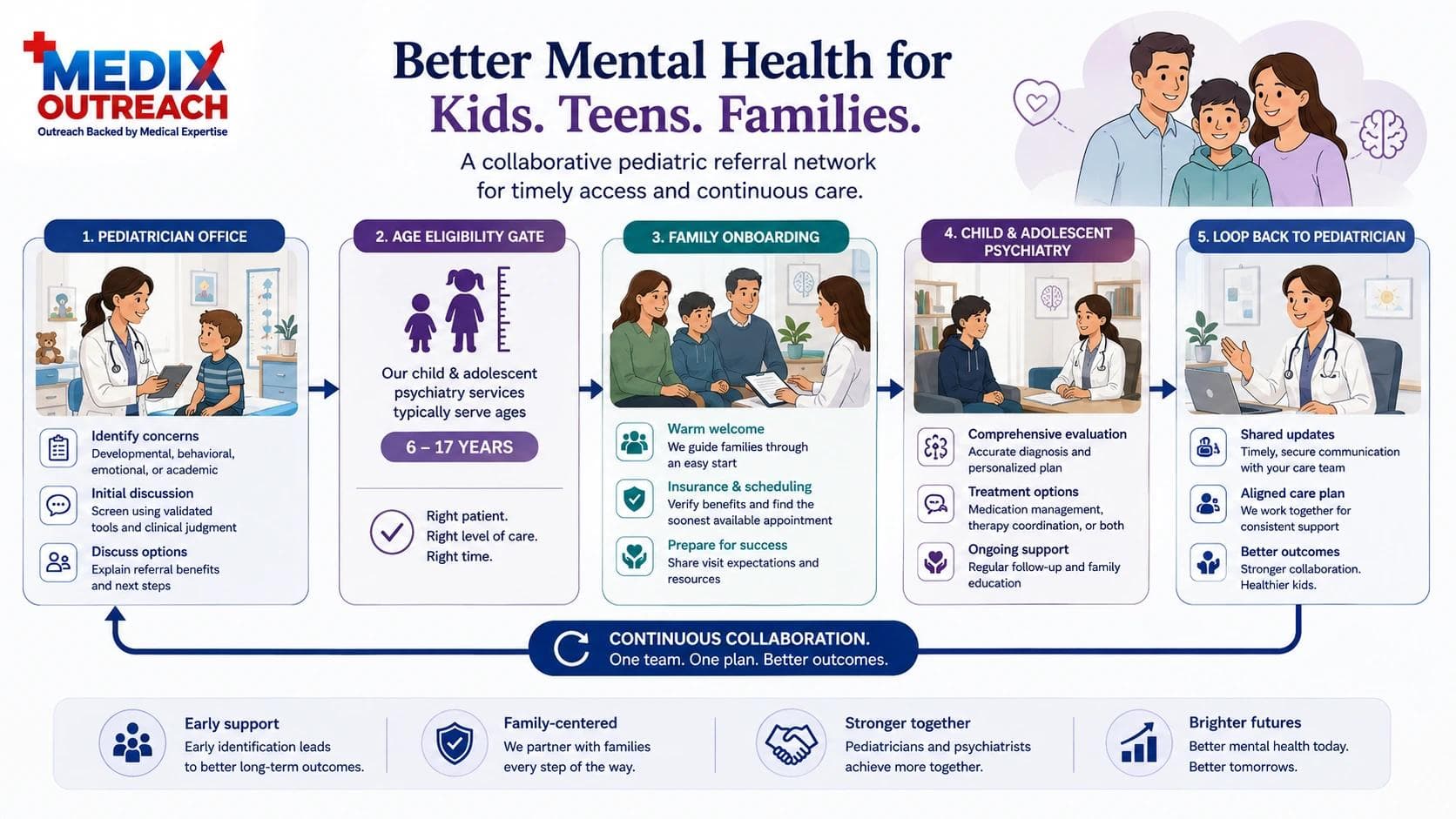
A pediatrician-to-psychiatry referral is a referral from a pediatric primary care practice to child and adolescent psychiatry, and it sits at the center of one of the hardest access problems in American healthcare. Pediatricians identify far more child and adolescent mental health needs than the specialty workforce can absorb, so the practices that build a real pediatric mental health referral network — age-appropriate expertise, honest capacity, family-friendly intake, and clean coordination back to the pediatrician — become indispensable to the pediatricians they serve. This article covers why pediatricians need child/adolescent psychiatry partners and how a psychiatry practice can build a referral network that actually improves access for kids and families.
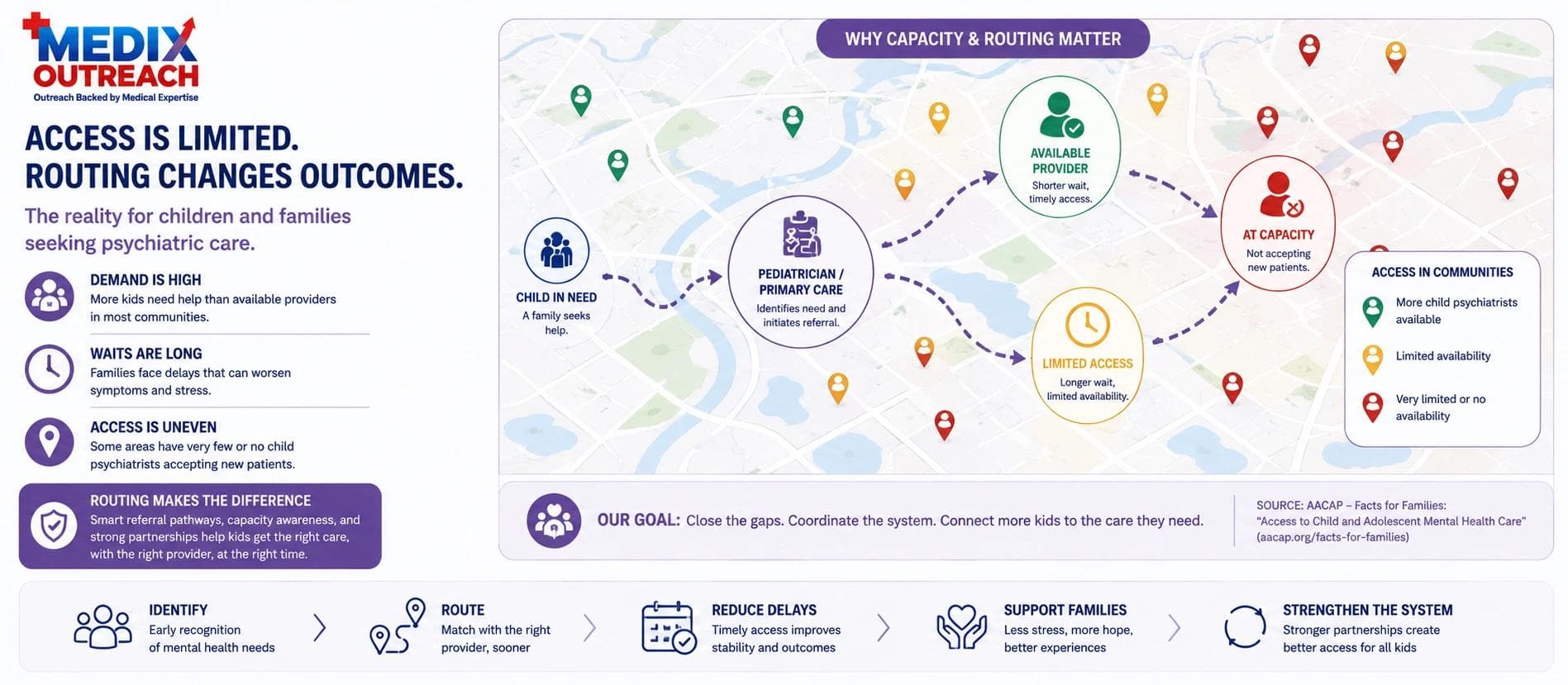
The context is a documented workforce shortage. The American Academy of Child and Adolescent Psychiatry's workforce maps show a severe national shortage of child and adolescent psychiatrists, with the great majority of U.S. counties lacking a single practicing child and adolescent psychiatrist. That scarcity is precisely why access, capacity, and routing — not marketing volume — determine which practice a pediatrician learns to rely on.
Why do pediatricians need child and adolescent psychiatry partners?
Pediatricians are frequently the first and only clinician a child with a mental health concern sees, and they manage a great deal of it in primary care. They refer to child/adolescent psychiatry for needs beyond that scope:
- Diagnostic complexity in a developing child or adolescent
- Medication management requiring child/adolescent psychiatric expertise
- Moderate-to-severe or treatment-resistant presentations
- Safety concerns needing specialist involvement
National programs exist specifically to extend this scarce expertise into pediatric primary care — the AAP-supported Pediatric Mental Health Care Access programs provide pediatricians with provider-to-provider psychiatric teleconsultation. A psychiatry practice that understands both direct referral and this consultation ecosystem can meet pediatricians where they are.
Age-specific eligibility and expertise
Child and adolescent psychiatry is not adult psychiatry with a lower age cutoff. It carries distinct diagnostic, developmental, medication, and family-system considerations. That makes two things load-bearing for a pediatric referral network:
- Age-specific eligibility — the pediatrician needs to know the exact age range the practice serves, so referrals land in scope.
- Child/adolescent expertise — credibility with pediatricians depends on genuine pediatric psychiatric competence, not a general practice that occasionally sees teens.
Mid-article CTA
Need help building your healthcare growth engine?
Medix helps healthcare startups, clinics, pharma companies, and provider-focused platforms build scalable commercial pipelines.
Book a Strategy CallCapacity, waitlists, and honest access
Given the workforce shortage, capacity is the defining constraint of pediatric psychiatry access — and honesty about it is part of the product. Pediatricians would rather have a truthful waitlist and a clear routing plan than an optimistic promise that collapses. A pediatric referral network should make waitlist status transparent, reserve pathways for higher-acuity referrals, and tell the pediatrician where a child was routed when the practice cannot take them. Capacity you can sustain beats capacity you advertise — the same operational-readiness discipline that governs a psychiatry referral network.
Family onboarding and intake friction
Pediatric intake has an extra layer: the family. A child's referral runs through parents or guardians, consent, school context, and scheduling around a caregiver's availability. Intake friction that an adult patient might push through will stop a busy parent cold, and the child leaks out of the pathway. A pediatric-appropriate intake keeps required fields minimal, communicates clearly with caregivers, and makes the first appointment easy to book — the pediatric version of the low-friction intake covered in what primary care practices need from a psychiatry partner.
Clinical triage, level of care, and out-of-scope routing
Pediatric referrals arrive at varied acuity, so clinical triage is essential and, as always, clinician-owned. A triage clinician determines whether a child needs routine outpatient care, an urgent pathway, or a higher level of care than the practice provides, and whether the referral is within age and scope. Out-of-scope referrals — a child younger than the practice serves, or a need requiring a different level of care — should be routed appropriately, with the pediatrician told where the child went. Routing a child out of scope is not a dead end; it is a coordination duty.
Communication back to pediatricians and referral completion
Closing the loop matters even more in pediatrics, because the pediatrician remains the child's medical home and continues to see the family. They need to know the child was contacted and scheduled, what the plan is, and what to reinforce with the family. Closed-loop communication and referral completion — confirming the child actually reached and attended care — are what turn a one-time pediatric referral into a standing relationship. In a workforce-constrained specialty, the practice that closes loops reliably becomes the one pediatricians route to first.
Frequently asked questions
What is a pediatrician-to-psychiatry referral?
A referral from a pediatric primary care practice to child and adolescent psychiatry for a child or adolescent whose mental health needs exceed what primary care can manage — diagnostic complexity, medication management, or higher acuity.
Why is child and adolescent psychiatry access so difficult?
Because of a documented workforce shortage: AACAP's workforce maps show most U.S. counties lack a practicing child and adolescent psychiatrist, so capacity and routing largely determine access.
What makes a psychiatry practice a good pediatric referral partner?
Genuine child/adolescent expertise, clear age eligibility, honest capacity and waitlist transparency, family-friendly intake, clinician-owned triage, out-of-scope routing, and closed-loop communication back to the pediatrician.