

Pharma business development is the discipline of creating value a company cannot create alone. A biotech with a promising molecule but no commercial infrastructure, a mid-cap that needs to fill a pipeline gap, a manufacturer that wants to enter a new region — each closes that gap through a partnership rather than by building everything itself. BD is how those partnerships get found, structured, and managed, and in modern pharma it is not a support function. It is often the primary engine of both pipeline and revenue.
Its importance is visible in the numbers: licensing and partnering reached record activity in 2025, with more than 500 licensing deals and a strong shift toward shared-development structures, per Nature's Biopharma Dealmakers. This guide covers the models, how deals are actually structured, how to select a partner, and the alliance management that decides whether a signed deal becomes real value. It is the strategic parent to our pharma lead generation piece, which covers building the pipeline of potential partners.
What pharma business development actually covers
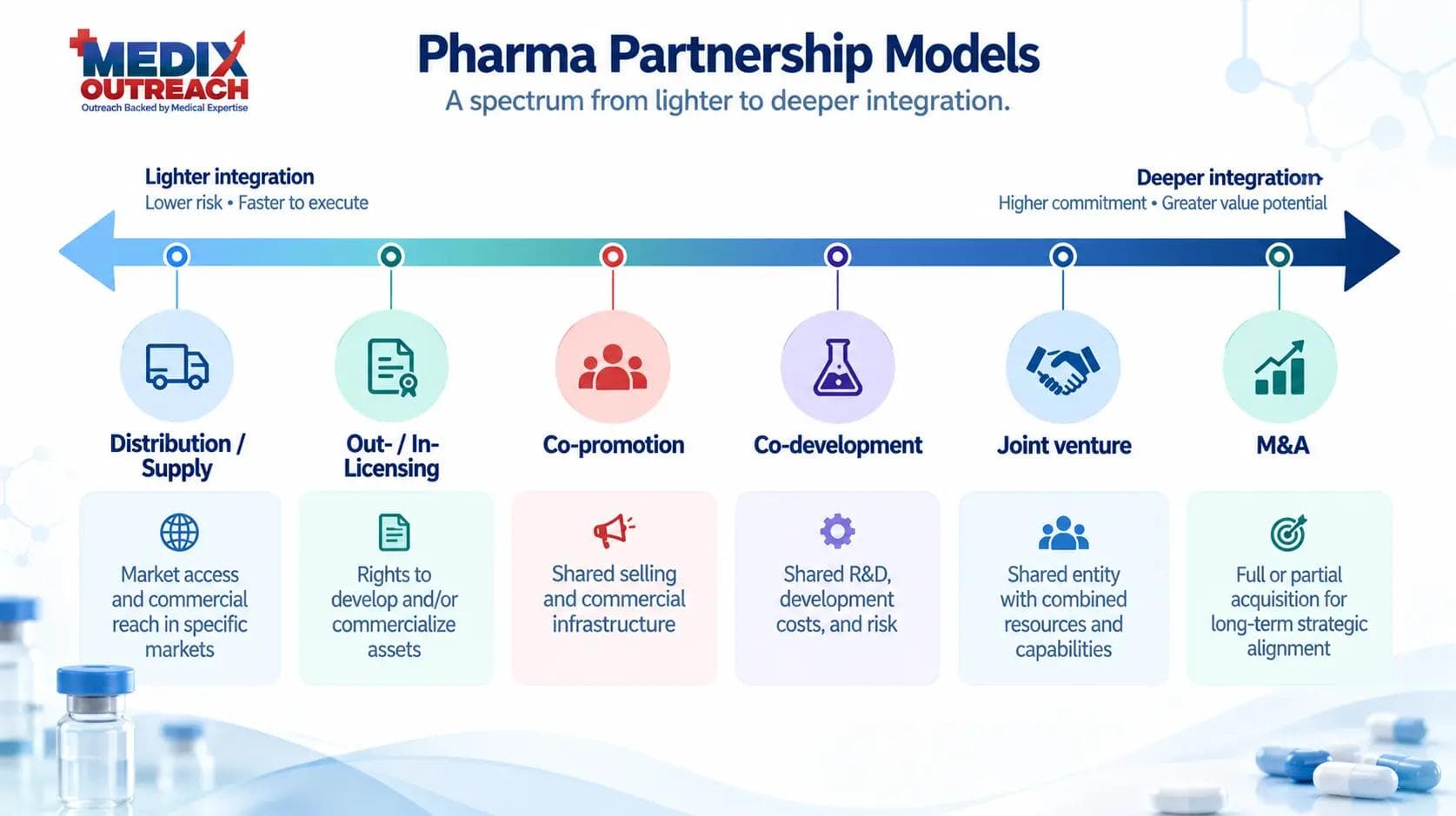
BD spans a spectrum of arrangements, from light to deeply integrated:
- In-licensing — acquiring rights to another company's asset or technology to strengthen your pipeline.
- Out-licensing — granting rights to your asset to a partner better able to develop or commercialize it, in exchange for upfronts, milestones, and royalties. Often the only path to market for a small biotech; see how to find pharma licensing partners.
- Co-development — jointly developing an asset, sharing cost, risk, and decision-making. Now the dominant structure in new deals.
- Co-promotion / co-commercialization — jointly marketing a product, combining one partner's asset with another's commercial reach.
- Joint ventures — a shared entity, common in oncology, rare disease, and regional plays.
- Distribution and supply agreements — commercializing through a partner's channel in a market or segment; see healthcare distribution partnerships.
- Manufacturing/CDMO partnerships — securing development and supply capacity as an asset advances.
The right model depends on what you lack — capital, capabilities, capacity, or market access — and what you are willing to share.
The deal is mostly milestones and royalties
Understanding deal structure is half of BD literacy. Modern biopharma deals are typically milestone-heavy: a relatively modest upfront payment, a schedule of development, regulatory, and commercial milestone payments, and tiered royalties on future sales. This structure shares risk — the partner pays more as the asset de-risks — and is why headline "deal values" (upfront plus all possible milestones) rarely equal cash received. Increasingly, deals also distribute development responsibilities and risk more equally between partners, per Nature's 2025 analysis. For BD teams, the implication is clear: the negotiation is as much about milestone definitions, royalty tiers, and governance as about the upfront.
Find and select the right partner
The best deals pair complementary strengths — one side brings the innovation, the other brings capital, capabilities, or commercial reach. A disciplined partner search evaluates:
- Strategic fit — does the asset fill a real pipeline or portfolio gap for the partner?
- Capability fit — can the partner actually develop, manufacture, or commercialize it?
- Therapeutic and modality alignment — track record in the relevant area.
- Cultural and governance fit — the softest and most underrated factor, and a frequent cause of failed alliances.
Selection is upstream of everything; a structurally perfect deal with the wrong partner still fails.
Mid-article CTA
Need the right partner, not just a list?
Medix helps pharma and biotech companies find, reach, and advance the partnerships that create value.
Book a Partnerships Strategy CallThe BD process
A repeatable BD process runs roughly: target identification (mapping who has the asset or the capability you need) → outreach and initial discussions → evaluation and due diligence (scientific, clinical, regulatory, commercial, IP, and manufacturing) → term sheet and negotiation → definitive agreement → alliance management. The front of that funnel — building a qualified pipeline of potential partners and knowing when they are in-market — is a demand discipline in itself, covered in pharma lead generation.
Alliance management: where value is won or lost
Signing is the beginning, not the end. Many deals underdeliver not because the science failed but because the alliance was poorly managed — misaligned incentives, unclear governance, or breakdowns in joint decision-making. Strong alliance management establishes clear governance, decision rights, shared metrics, and communication cadences, and actively manages the relationship over years. Treat it as a core BD capability, not administrative overhead.
Regulatory, antitrust, and compliance considerations
Partnerships operate inside legal constraints. Collaborations and co-promotion arrangements between actual or potential competitors carry antitrust considerations and must be structured to comply with current FTC competition guidance. Deals also implicate IP, regulatory strategy (development phase and approval milestones shape timing and value, per the FDA drug development process), and, for cross-border deals, foreign regulatory and market-access requirements — the terrain behind US-to-MENA market expansion.
For emerging biotech, BD is a survival strategy
For a small or clinical-stage biotech, BD is often existential: out-licensing or partnering can fund development, provide commercial capabilities the company will never build, and validate the science. The lesson from the peptide partnership work applies broadly — start BD conversations early, build relationships before you need the deal, and treat partnering as a core strategy rather than a fallback.
Frequently asked questions
What is the difference between pharma business development and licensing?
Licensing is one instrument within BD. Business development is the broader function of creating value through partnerships — licensing, co-development, co-promotion, JVs, distribution, and more.
How are pharma partnership deals usually structured?
Most are milestone-and-royalty structures: a modest upfront, development/regulatory/commercial milestone payments, and tiered royalties. Headline deal value reflects the maximum if all milestones are hit, not guaranteed cash.
When should a biotech start business development?
Earlier than most do. Building partner relationships before you urgently need a deal produces better terms and more options; BD is a long-cycle, relationship-driven discipline.
What most often makes a pharma partnership fail?
Poor partner fit and weak alliance management more often than bad science. Governance, aligned incentives, and active relationship management determine whether a signed deal creates value.