
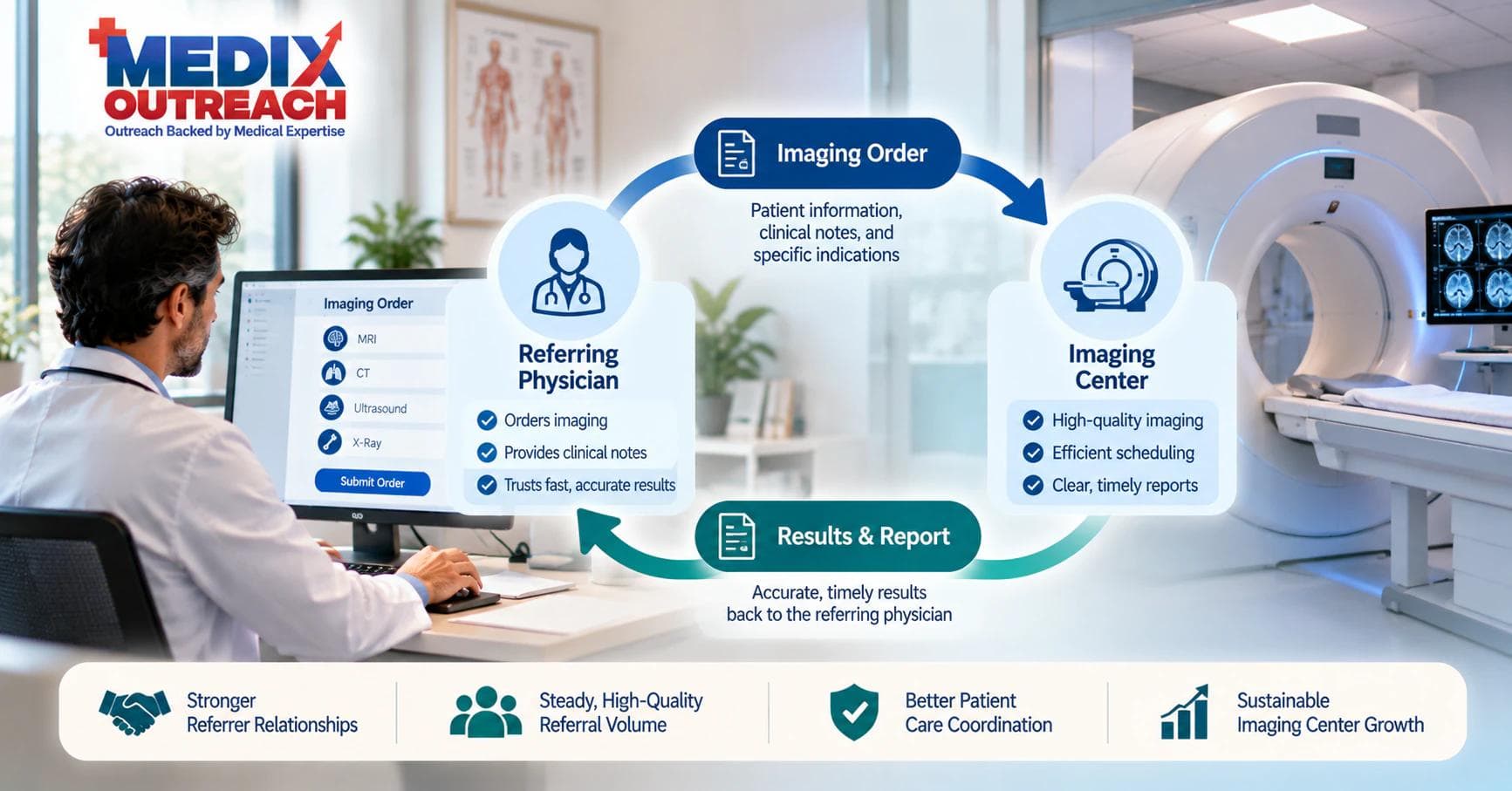
An imaging center's growth is decided almost entirely by other physicians. Patients rarely choose their own imaging site; a referring doctor chooses it for them. That means imaging "marketing" is really referral development — the work of becoming the center referring physicians trust, prefer, and find easy to use. Billboards and consumer ads do little when the decision belongs to a primary care physician, orthopedist, or oncologist filling out an order.
This guide covers how radiology practices and imaging centers grow referral volume the way it is actually won: through access, workflow, and relationships — and how to do it inside the strict rules that govern physician referrals for imaging.
Understand who really sends the referral
Referral volume concentrates in a relatively small number of referring physicians and practices. A disproportionate share of your scans comes from a disproportionately small group of referrers. Growth starts by knowing that map:
- Who your top referrers are and whether their volume is rising or falling.
- Who refers to you occasionally but sends most of their imaging elsewhere — your biggest growth opportunity.
- Who should refer to you but does not — the right specialty, the right geography, and currently invisible to your center.
You cannot grow what you cannot see. The same referral-analytics discipline Medix applies across specialties — tracking referral sources and conversion — is the foundation here.
What referring physicians actually want from an imaging center
Referrers do not choose an imaging center on brand. They choose on whether it makes their job and their patient's experience easier. The levers that move referrals:
- Access. Fast scheduling, short wait times, and convenient locations and hours. If a patient can be seen sooner at your center, the referral follows.
- Report quality and speed. Clear, timely reports from accessible radiologists. A referring physician who can call a radiologist and get a straight answer refers again.
- Workflow simplicity. Easy order submission, results delivered into the referrer's EHR, and no administrative friction. The referral-management workflow often matters more than any single clinical feature.
- Appropriate, defensible imaging. Referrers value a center that helps them order the right study. Supporting appropriate-use decisions, consistent with the ACR Appropriateness Criteria, builds clinical trust.
In short: be the easiest, fastest, most reliable option for the referring physician and their patient.
Referral development inside the rules: Stark and Anti-Kickback
Imaging is one of the most heavily regulated referral categories, because advanced imaging is a "designated health service" under the physician self-referral law. This shapes what you can and cannot do.
- The Physician Self-Referral Law (Stark) restricts referrals for designated health services, including many imaging services, when the referring physician (or an immediate family member) has a financial relationship with the entity, unless an exception applies. Review the CMS physician self-referral resources.
- The Anti-Kickback Statute prohibits offering anything of value to induce referrals of items or services payable by federal health programs. See the OIG overview of the fraud and abuse laws.
The practical takeaway: grow referrals by being better and easier to use — access, quality, service, and workflow — not by offering inducements. Every liaison program, co-marketing arrangement, or physician relationship should be reviewed by healthcare counsel. Done right, compliant referral development is also more durable, because it is built on genuine clinical value rather than a relationship that can disappear the moment an inducement does.
Mid-article CTA
Need help building your healthcare growth engine?
Medix helps healthcare startups, clinics, pharma companies, and provider-focused platforms build scalable commercial pipelines.
Book a Strategy CallBuild a referral-development program, not a campaign
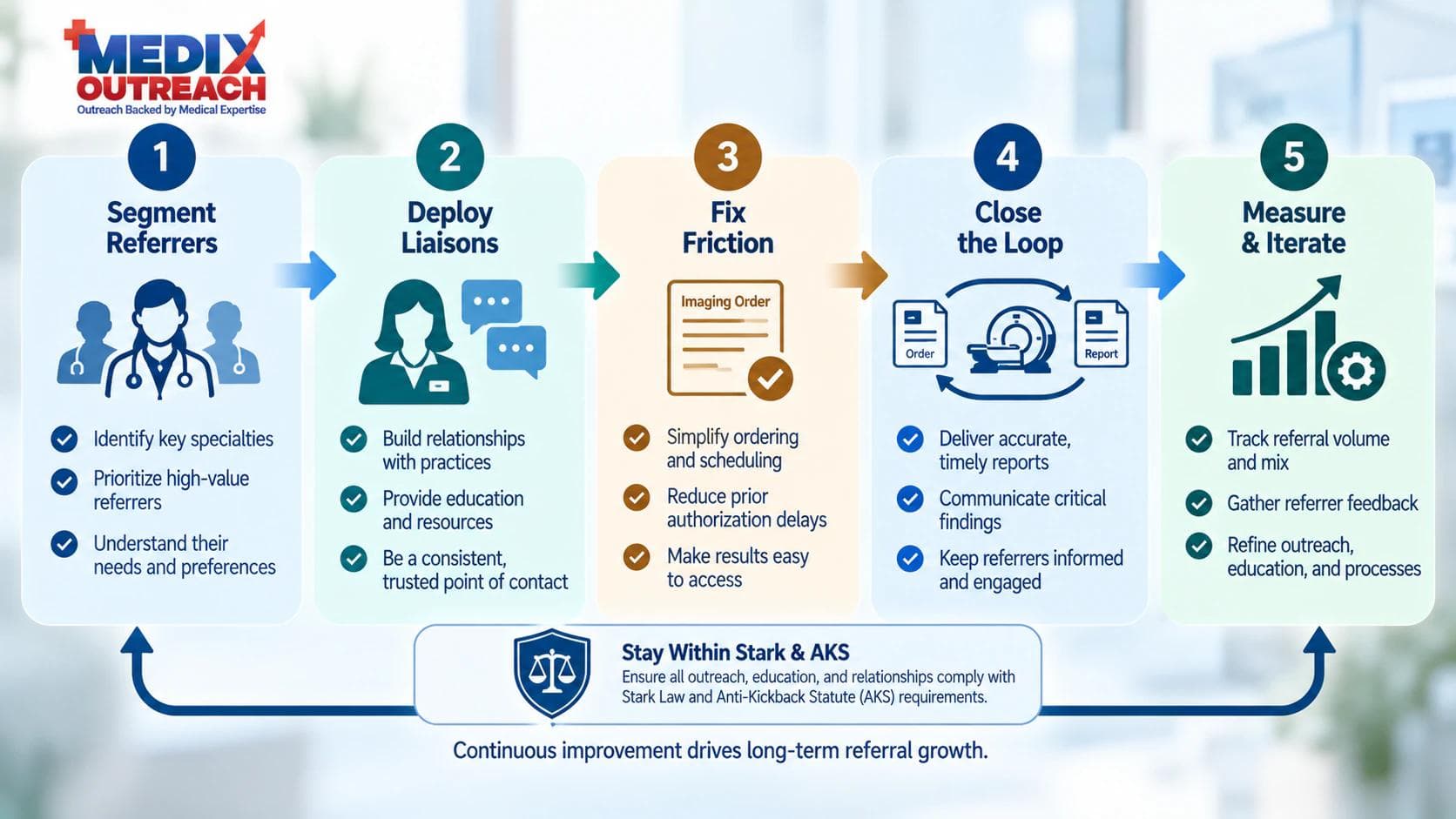
Sustainable imaging referral growth looks like a system, modeled on the same approach Medix uses across specialties such as orthopedic referral growth.
- Segment referrers into grow, protect, and win-back groups based on current and potential volume.
- Deploy physician liaisons to carry a consistent message, gather feedback, and resolve friction — the field motion detailed in the Medix physician-liaison program guide.
- Fix the friction liaisons surface — scheduling delays, report turnaround, EHR integration — because solving an operational problem wins more referrals than any pitch.
- Close the loop with every referrer: confirm receipt, deliver results promptly, and keep them informed.
- Measure and iterate on referral volume by source, so effort flows to the relationships that respond.
Measure referral growth, not activity
- Referral volume by referring physician and practice — and the trend for each.
- Share of a referrer's imaging you capture vs. competitors (where estimable).
- New referrers activated and lapsed referrers won back.
- Scheduling lead time and report turnaround — the operational metrics that drive referral loyalty.
Frequently asked questions
How do imaging centers get more referrals? By becoming the easiest, fastest, most reliable option for referring physicians: fast scheduling, strong and timely reports, simple ordering and EHR-integrated results, and consistent relationship management through liaisons — all within Stark and Anti-Kickback limits.
Is radiology marketing really about patients? Mostly no. Patients rarely choose their imaging site; referring physicians do. So imaging growth is primarily referral development aimed at referring physicians and their staff, supported by a solid consumer presence for the share of patients who do choose.
What are the legal limits on growing imaging referrals? Advanced imaging is a designated health service under the Stark Law, and the Anti-Kickback Statute prohibits inducements for referrals of federally reimbursed services. Grow through genuine value — access, quality, and service — and have counsel review any program involving physician relationships.
What is the single biggest lever for imaging referral growth? Access and workflow. If a referring physician's patient can be seen sooner and the results flow cleanly back into their EHR, that center usually wins the referral.
Becoming the imaging center referrers prefer
Imaging referral growth is won by being genuinely easier and better to work with, measured rigorously, and developed through compliant relationships. Centers that treat it as a system — know the referrer map, remove friction, close the loop, and stay within the rules — grow referral volume predictably while competitors run ads that the real decision-maker never sees.
Medix Outreach builds compliant referral-development programs and provider networks for imaging, specialty, and diagnostic practices. To grow your imaging referral base, book a free strategy call or explore our Provider Network Development service.