
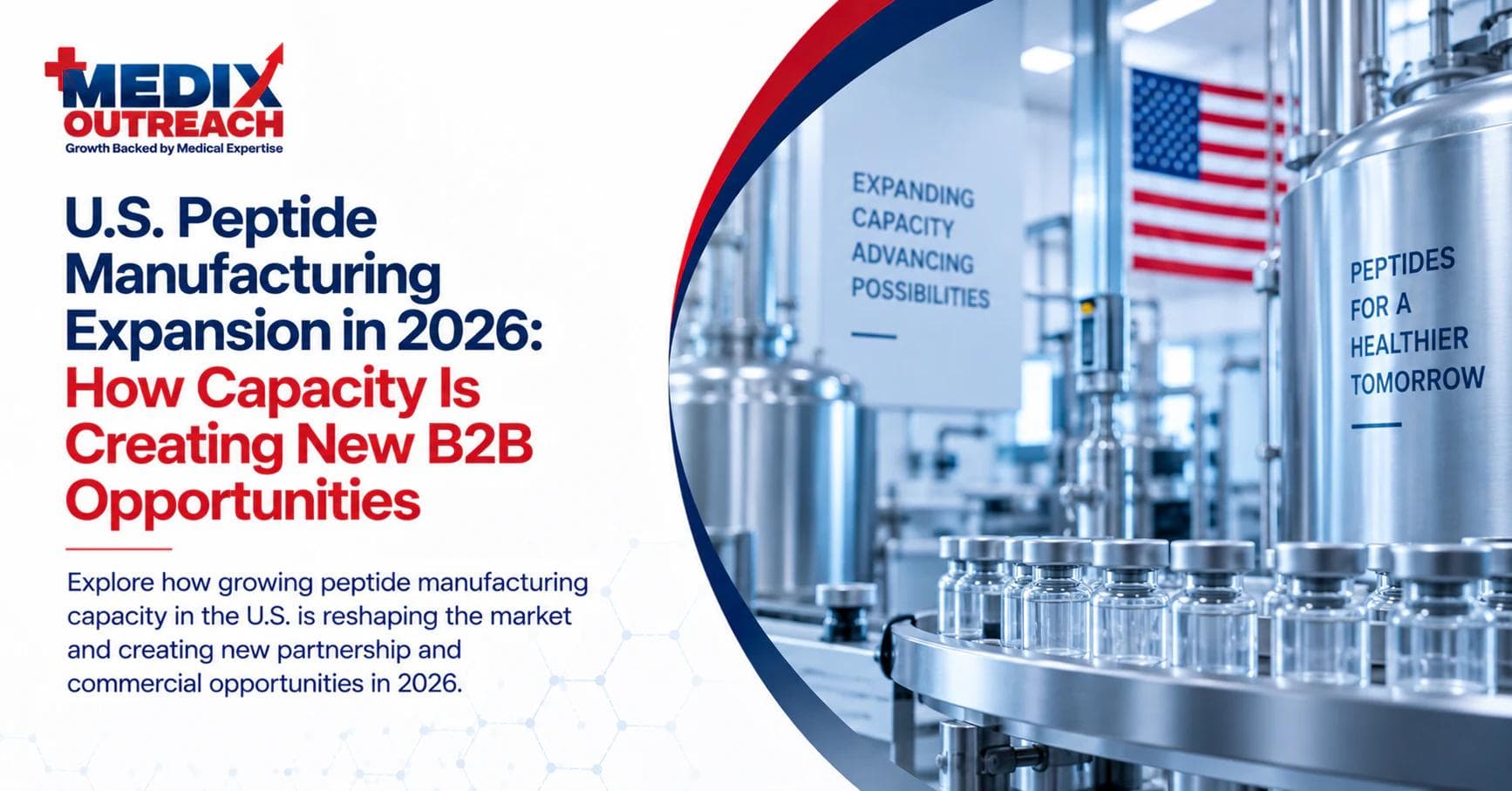
Peptide manufacturing is becoming a strategic commercial issue.
The rapid growth of peptide therapeutics, particularly GLP-1-related medicines, has increased attention on manufacturing capacity, geographic footprint, supply resilience, and long-term production requirements.
In 2026, CDMO activity illustrates how significant this shift has become.
DCAT reported multiple peptide-focused investments and transactions during 2026, including Samsung Biologics' planned acquisition of PolyPeptide Group, CordenPharma's acquisition of AmbioPharm, and Bachem's planned large-scale peptide production facility in Switzerland.
These developments point to a larger commercial trend.
Manufacturing capacity is becoming part of the value proposition
Historically, pharmaceutical buyers could evaluate manufacturing partners largely around quality, technical capability, cost, and capacity.
As peptide demand increases, the question becomes broader:
Can the partner support the program as demand grows?
That brings several factors into the conversation:
- Development capabilities
- Manufacturing scale
- Geographic footprint
- Supply continuity
- Quality infrastructure
- Technology transfer
- Commercial production readiness
For peptide companies, these factors can become central to B2B positioning.
Why U.S. capacity matters
Manufacturing location can influence commercial decisions.
Pharmaceutical companies may evaluate suppliers based on geographic strategy, supply-chain requirements, customer expectations, and the broader operating model surrounding a product.
This creates opportunities for manufacturers that can communicate not just what they produce, but how their infrastructure supports pharmaceutical programs.
From capacity to commercial narrative
A common mistake is to communicate manufacturing capacity as a standalone number.
Capacity becomes more commercially meaningful when it is connected to a customer's potential requirement.
Instead of:
"We have expanded our manufacturing capacity."
A stronger commercial narrative might explain:
"Our expanded capabilities are designed to support peptide programs as they progress from development toward larger-scale production."
The second message connects infrastructure to the buyer's journey.
What this means for pharma business development
Manufacturing companies can use market intelligence to identify pharmaceutical companies that may be entering new development stages.
Potential signals include:
- New clinical programs
- Pipeline expansion
- Licensing activity
- New therapeutic programs
- Manufacturing announcements
- Geographic expansion
- New strategic partnerships
These signals can help identify accounts before they enter a formal procurement process.
Mid-article CTA
Need help building your healthcare growth engine?
Medix helps healthcare startups, clinics, pharma companies, and provider-focused platforms build scalable commercial pipelines.
Book a Strategy CallBuilding a peptide marketing outreach strategy around capacity
A modern outreach strategy can combine:
Market intelligence
- Manufacturing intelligence
- Account research
- Stakeholder mapping
- Targeted messaging
For example, a manufacturer may identify a biotech company advancing a peptide candidate toward clinical development.
The outreach can then focus on the manufacturing challenges that may become relevant at that stage.
That is much more useful than sending a generic capabilities deck.
Manufacturing and commercialization are increasingly connected
The manufacturing decision can influence the broader commercialization pathway.
If a company cannot reliably scale production, commercial plans may be affected.
If technology transfer is difficult, timelines may be affected.
If the manufacturing model does not align with the target market, expansion can become more complex.
That means manufacturing capabilities can influence commercial strategy long before a product reaches the market.
Why B2B relationships matter
Peptide manufacturing partnerships are rarely simple transactions.
They may involve:
- Technical teams
- Procurement
- Quality
- Regulatory
- Business development
- Operations
- Executive leadership
A supplier that understands this complexity can build relationships across the organization rather than relying on a single contact.
Final takeaway
The expansion of peptide manufacturing capacity in 2026 reflects a broader change in the market.
Capacity is no longer just an operational consideration. It can become part of a company's commercial positioning.
For peptide manufacturers and pharmaceutical suppliers, the opportunity is to translate manufacturing capabilities into business outcomes and build B2B relationships before commercial demand becomes an urgent procurement requirement.
That is where targeted peptide marketing outreach can create value.