
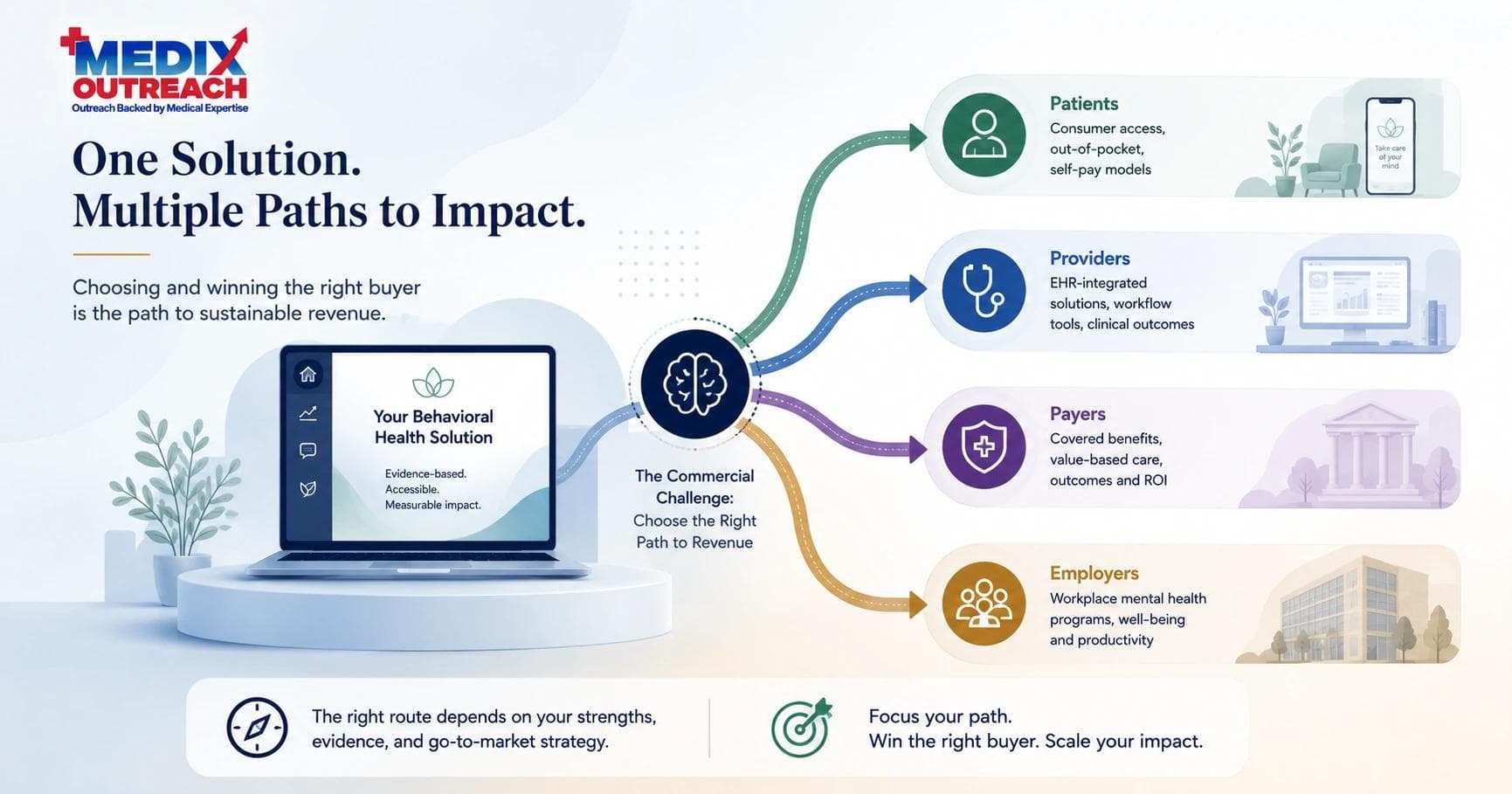
Few categories illustrate the gap between clinical need and commercial success as starkly as behavioral health and digital therapeutics. The need is undeniable and enormous, the products are often genuinely effective, and the funding has been substantial. And yet the space is littered with well-built, well-funded companies that ran out of money before they found a buyer who would pay sustainably. Some of the most prominent prescription digital therapeutics companies proved their products worked clinically and still could not build a viable business, because clinical validation and a commercial model are not the same thing.
The lesson from those failures is not that the category is bad. It is that in behavioral health and digital therapeutics, the hard problem is almost never the product - it is the commercialization. Who pays, why they pay, and what makes them keep paying are the questions that decide survival, and they have to be answered before the product is finished, not after.
Short version: behavioral health and DTx succeed commercially when they pick a buyer who has a real budget and a real incentive to pay, build the specific evidence that buyer requires, prove sustained patient engagement, and reach that buyer through a channel that fits. The companies that fail usually built a great product and assumed the buyer would follow.
The Buyer Problem Comes First
The defining strategic decision in behavioral health and digital therapeutics is who your buyer is, because unlike a consumer app, a clinically serious solution needs someone with a budget and a reason to fund it. Each candidate buyer has a different bar, a different sales cycle, and a different durability of revenue.
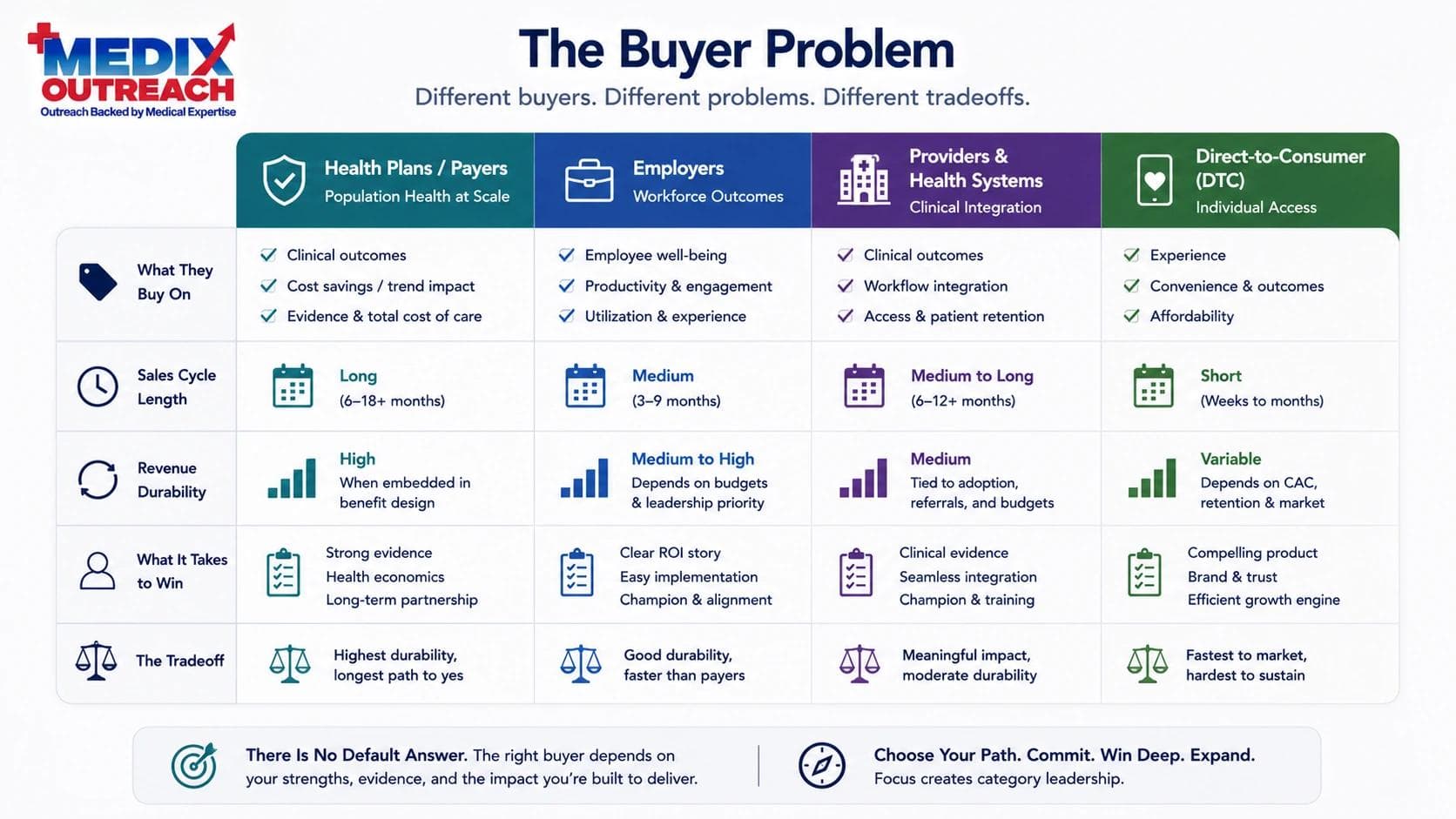
- Health plans and payers can fund solutions at scale and for the long term, but they buy on evidence of outcomes and cost savings, move slowly, and require a reimbursement or contracting mechanism. Winning here is the highest-value and hardest path, and it follows the discipline in our guide to selling to payers and health plans.
- Employers and benefits buyers have been the pragmatic entry point for much of digital mental health, buying to improve employee wellbeing and productivity. The cycle is faster than payers, but the revenue can be less durable and subject to annual benefits decisions and crowded point-solution fatigue.
- Providers and health systems adopt solutions that fit clinical workflows and improve their outcomes or capacity, but they rarely have budget to pay much directly, so the model often depends on reimbursement or on making the provider more efficient. This mirrors a healthcare SaaS enterprise sale.
- Direct-to-consumer can generate revenue fast but is expensive to sustain, has high churn, and does not fit clinically serious, higher-cost interventions well.
The failures in the category frequently trace to choosing a buyer whose willingness to pay never materialized, or to trying to sell to everyone at once. The first commercialization task is to choose the buyer whose incentives genuinely align with paying for your solution, and to build the whole strategy around that buyer.
Reimbursement Is a Strategy, Not a Hope
The prescription digital therapeutics companies that struggled most often did so because they built products that required reimbursement that did not reliably exist. A regulatory authorization from the U.S. Food and Drug Administration for a software-based treatment confirms it is safe and effective; it does not create a payment pathway. Payers decide separately whether and how to cover it, and for novel digital treatments those pathways have been slow, inconsistent, and hard-won.
This is the single most important lesson from the category's history: do not assume that clinical efficacy or even FDA authorization translates into someone paying. Reimbursement and buyer willingness-to-pay must be validated as rigorously as the clinical model, and early. Our guide to market access and reimbursement strategy covers the mechanics, and for behavioral health and DTx the imperative is to answer "who pays, through what mechanism, and is that mechanism real today" before you scale spending. A company that nails the clinical product and guesses on reimbursement is building on the same fault line that sank its predecessors.
Evidence and Engagement Are the Product
Buyers in this space - especially payers and employers - do not pay for features. They pay for outcomes, and outcomes in behavioral health depend on two things: clinical evidence and sustained patient engagement.
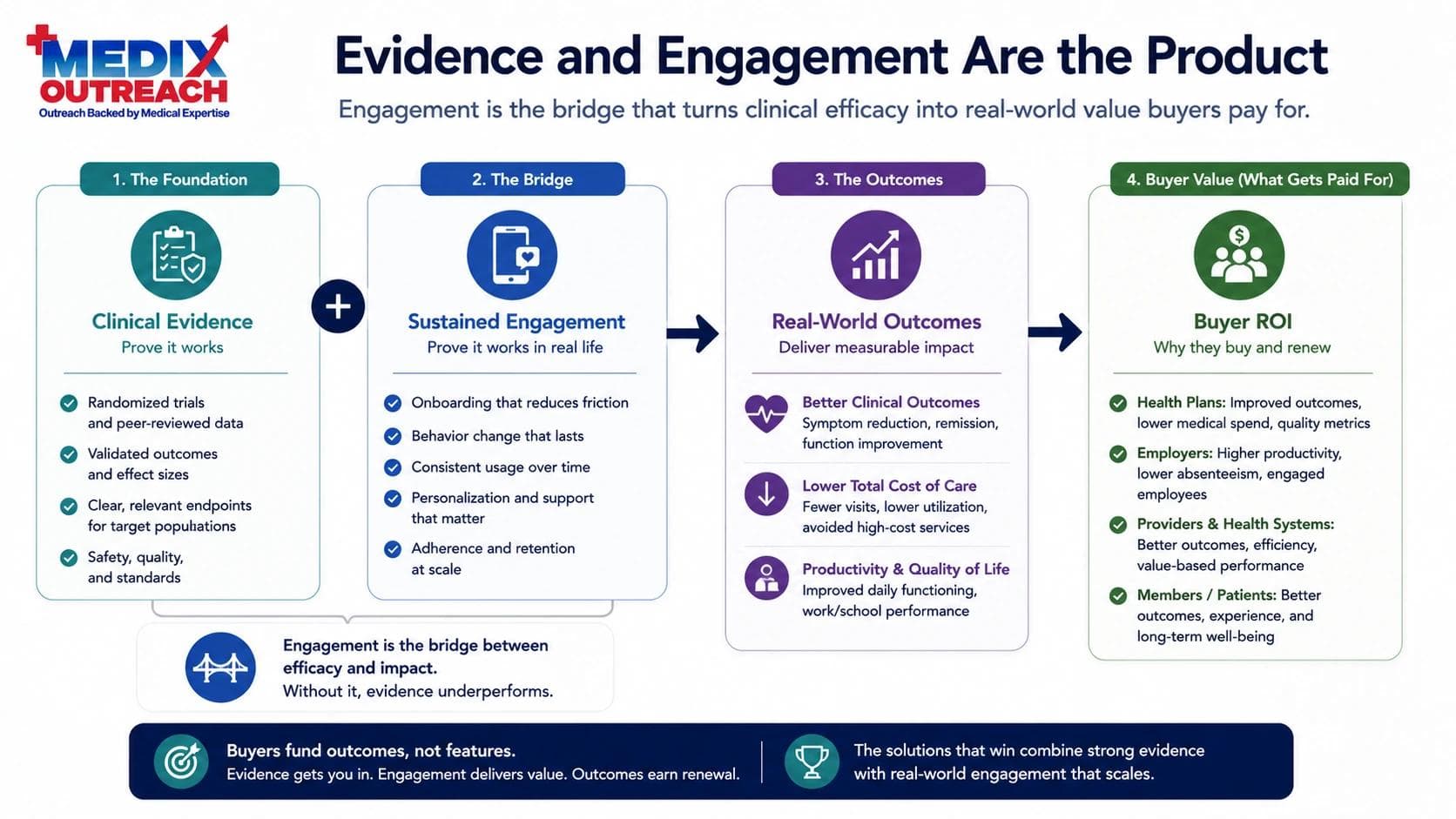
- Evidence must speak to what the buyer actually underwrites: improved clinical outcomes, reduced total cost of care, lower acuity, better productivity. Generic "our users like it" data does not move a payer. Studies designed around the buyer's economic and clinical questions do.
- Engagement is the bridge between a validated product and real-world value. A behavioral health solution that patients start and abandon produces no outcomes and no ROI, and engagement is notoriously hard in mental health. Demonstrable, sustained engagement is often what separates the solutions payers renew from the ones they drop.
Framing evidence and engagement as the product, rather than the app, is what makes a behavioral health company credible to a serious buyer. This is the same reality behind healthcare AI adoption: the buyer adopts proven, integrated value, not technology for its own sake.
Mid-article CTA
Need help building your healthcare growth engine?
Medix helps healthcare startups, clinics, pharma companies, and provider-focused platforms build scalable commercial pipelines.
Book a Strategy CallEscape Pilot Purgatory
Behavioral health and digital therapeutics companies are especially prone to a trap: the endless pilot. A health system or employer runs a small pilot, it goes fine, and then nothing scales, because no one built the path from pilot to durable contract. Pilots feel like progress and consume years of runway while producing little revenue.
The way out is to treat pilots as a means to a contract, not an end in themselves: define upfront what success looks like and what happens if it is met, secure the economic buyer and the expansion path before the pilot starts, and design the pilot to prove the specific outcome that unlocks the budget. We cover this in depth in escaping pilot purgatory, and it is arguably the most important operational discipline in the category, because a pipeline full of pilots that never convert is how funded companies quietly die.
Channel and Message Fit
Once you know your buyer, the channel and message have to fit them, and behavioral health carries an extra layer: sensitivity. This is a category where trust, privacy, and clinical seriousness matter enormously, and where stigma and skepticism are real. The message that wins an employer is different from the one that wins a payer or a health system, and all of them must be handled with clinical credibility and care.
For provider-facing channels, adoption follows the same relationship and referral dynamics as the rest of healthcare. Our work building a local provider referral engine for a psychiatry practice is an example of growing behavioral health services through trusted provider relationships rather than broadcast marketing - a reminder that even in a digital category, the human channels of trust and referral still drive adoption.
Where Medix Fits
Medix Outreach helps behavioral health and digital therapeutics companies solve the commercialization problem that sinks so many of them. Our healthcare commercial growth and go-to-market work pressure-tests which buyer will actually pay, builds the evidence-and-reimbursement narrative that buyer requires, and reaches the right payers, employers, and providers through channels that fit - so a clinically strong product finds a commercially viable path. We focus on the question that decides survival in this category: who pays, and why.
Frequently Asked Questions
Why do so many behavioral health and digital therapeutics companies fail commercially?
Usually not because of the product, but because of commercialization. Many built clinically effective solutions - some even FDA-authorized - that required reimbursement or buyer willingness-to-pay that did not reliably exist. They chose a buyer whose incentive to pay never materialized, assumed clinical efficacy would translate into payment, or got stuck in endless pilots. The hard problem in this category is finding a buyer with a real budget and reason to pay, not building the technology.
Who is the buyer for a digital therapeutic or behavioral health solution?
The main candidates are health plans and payers (highest value and durability but slow and evidence-driven), employers and benefits buyers (faster but less durable and subject to annual decisions), providers and health systems (workflow-driven but with little direct budget), and direct-to-consumer (fast revenue but high churn and poor fit for serious clinical interventions). Choosing the buyer whose incentives genuinely align with paying for your solution is the first and most important commercialization decision.
Does FDA authorization for a digital therapeutic guarantee reimbursement?
No. FDA authorization confirms a software-based treatment is safe and effective, but it does not create a payment pathway. Payers decide separately whether and how to cover it, and for novel digital treatments those pathways have often been slow and inconsistent. Reimbursement and buyer willingness-to-pay must be validated as rigorously and as early as the clinical model, because assuming efficacy equals payment is a common and fatal mistake in the category.
What makes payers and employers actually pay for behavioral health solutions?
They pay for outcomes, not features - improved clinical results, reduced total cost of care, lower acuity, and better productivity - backed by evidence designed around their specific economic and clinical questions. They also require proof of sustained patient engagement, because a solution people abandon produces no outcomes or ROI. Evidence and engagement, framed as the real product, are what make a behavioral health company credible to a serious buyer.
How do behavioral health companies avoid getting stuck in pilots?
Treat pilots as a means to a contract, not an end. Define upfront what success looks like and what happens if it is met, secure the economic buyer and the expansion path before the pilot starts, and design the pilot to prove the specific outcome that unlocks budget. A pipeline full of pilots that never convert consumes runway while producing little revenue, so converting pilots to durable contracts is one of the most important disciplines in the category.