
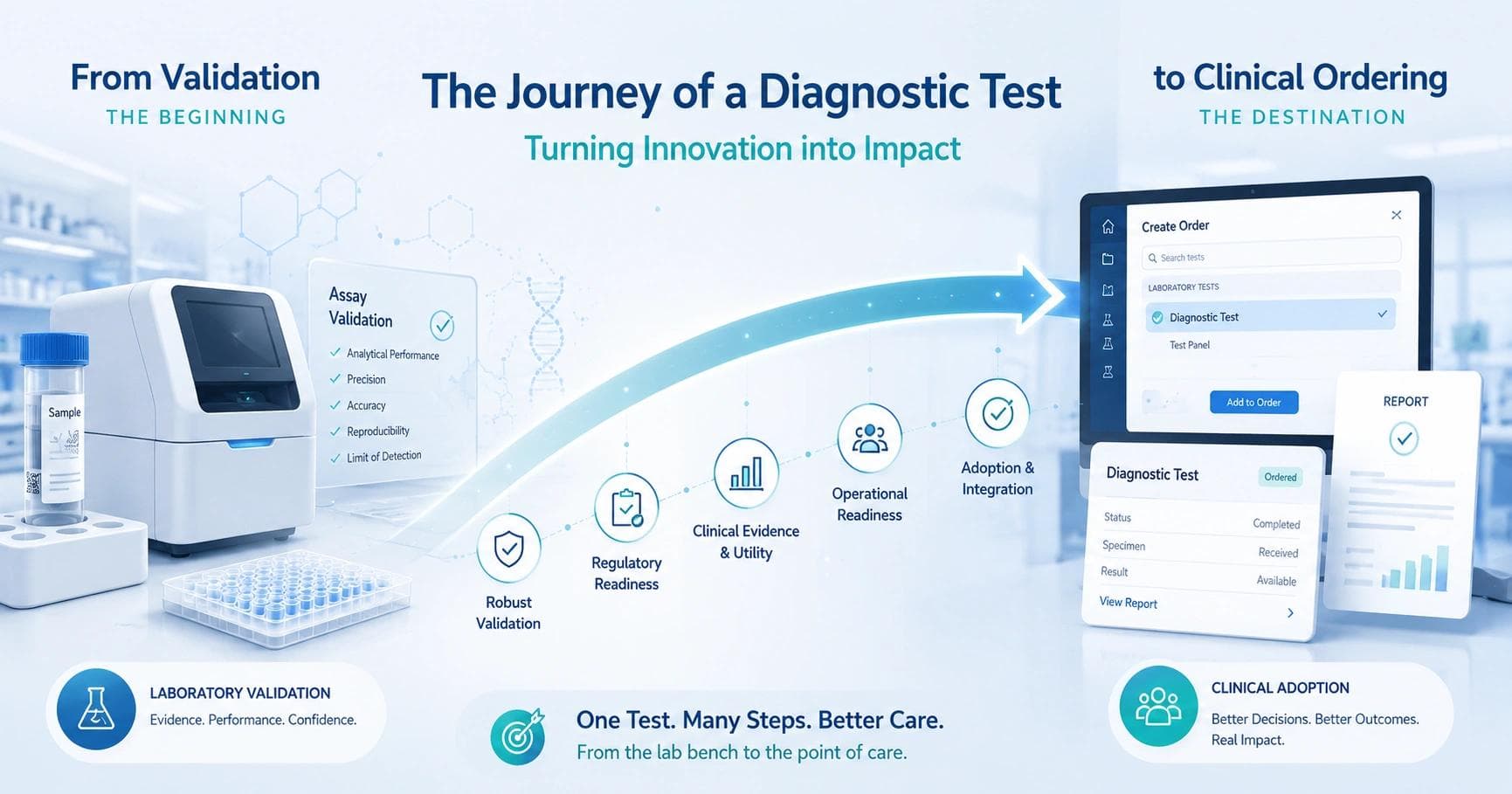
Diagnostics is one of the few categories in healthcare where the science can be finished and the commercial work has barely started. You can have a test with excellent analytical and clinical validation, published data, and a CLIA-certified lab ready to run it, and still watch order volume flatline. The reason is almost always the same: no code, no coverage, or no clinician trust. Sometimes all three.
Commercializing a diagnostic test is different from commercializing a device or a drug because the buyer, the payer, and the user are often three different parties with three different questions. The ordering clinician asks whether the result will change what they do. The payer asks whether it is medically necessary and worth paying for. The lab or health system asks whether it fits the workflow and the economics. A commercialization strategy that answers only one of those questions stalls.
Short version: diagnostics commercialization is won on three fronts at once - a clear regulatory and lab path, a coverage-coding-payment strategy that gets you reimbursed, and an evidence-and-adoption engine that gets clinicians to order. Skip any one and the test does not scale.
Start With the Regulatory and Lab Path
The first fork is how your test reaches the market. In the United States, most diagnostics take one of two broad paths, and the choice shapes your timeline, your claims, and your commercial story.
- An FDA-cleared or FDA-approved in vitro diagnostic (IVD) is authorized by the U.S. Food and Drug Administration and can be marketed with specific intended-use claims and, often, distributed as a kit. This path is more demanding but produces stronger, defensible claims.
- A laboratory developed test (LDT) is designed, manufactured, and run within a single CLIA-certified high-complexity laboratory. Historically this route reached the market faster, though the regulatory landscape around LDTs has been shifting and warrants current legal and regulatory input.
Either way, running clinical testing requires the lab to hold CLIA certification, and many labs also pursue accreditation from bodies like CAP. The point for a commercial leader is that the regulatory and lab path is not a compliance footnote - it determines what you can claim, how fast you can launch, and how a sophisticated buyer will judge your credibility. Get current, specific regulatory counsel before you build the commercial plan on top of an assumption.
Coverage, Coding, and Payment: The Real Gate
Here is where diagnostics diverges most sharply from other healthcare products. Getting paid for a test requires three separate things to be true, and having one does not give you the others.
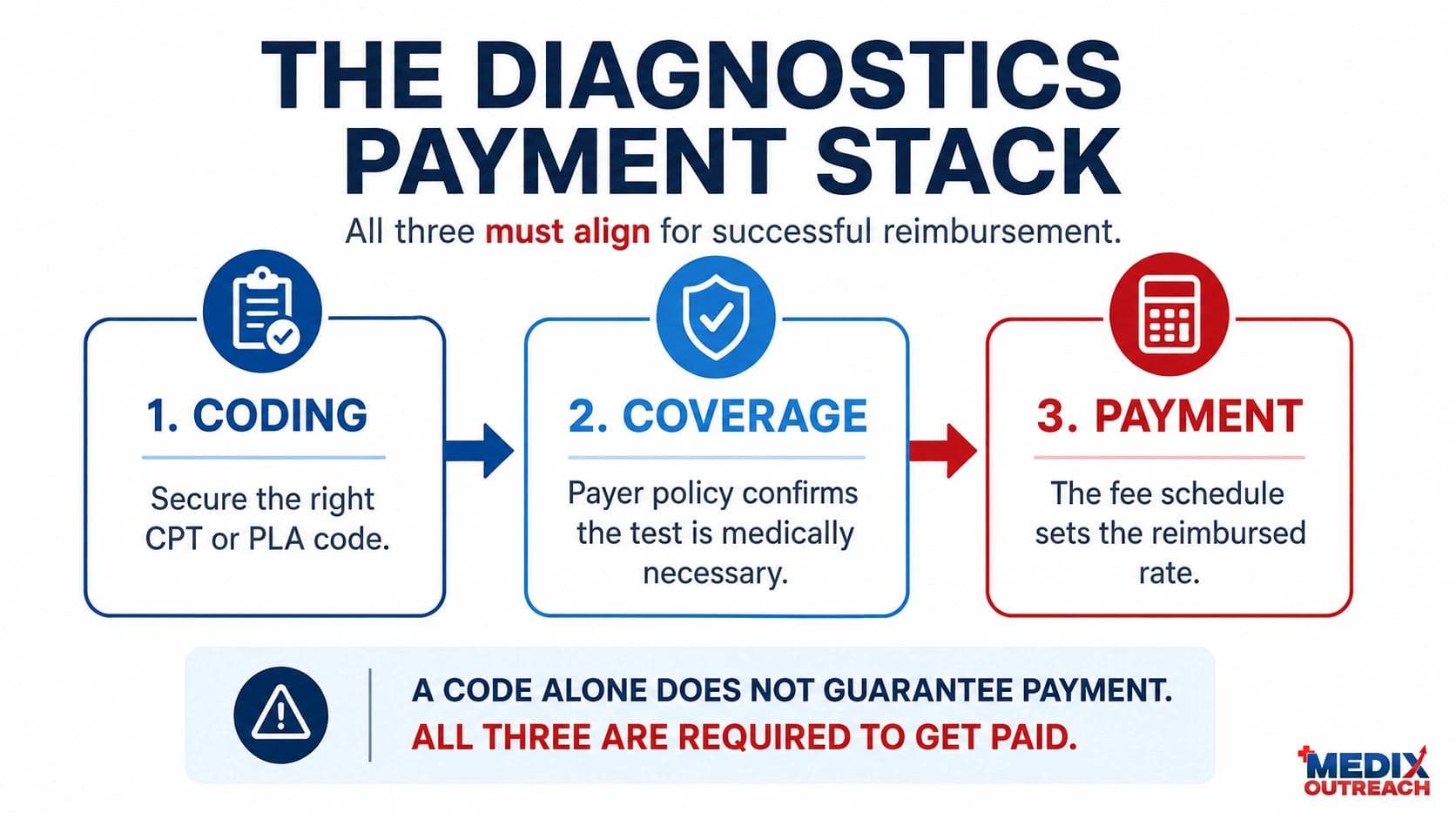
- Coding is having a way to bill for the test - typically a CPT code, or for proprietary tests a PLA (Proprietary Laboratory Analyses) code from the AMA. A code is an identifier, not a promise of payment.
- Coverage is a payer's policy decision that the test is medically necessary for a defined population. Without a favorable coverage policy, a claim gets denied even with a valid code. Medicare coverage may come through local or national determinations, and each commercial payer sets its own policy.
- Payment is the actual rate. For many lab tests, Medicare pays on the Clinical Laboratory Fee Schedule, and commercial rates are negotiated or benchmarked against it.
The practical consequence is that reimbursement strategy is not a post-launch task; it belongs in the plan from the start, because generating the clinical-utility evidence payers require can take years. Our guide to market access and reimbursement strategy covers the broader mechanics, and for diagnostics the headline is this: a test without a coverage-coding-payment plan is a test that will be ordered and then not paid for, which is worse than not being ordered at all, because it burns clinician goodwill.
Evidence Is the Product
Payers and guideline committees do not reward accuracy alone. They reward clinical utility - proof that using the test changes management and improves outcomes or reduces cost. Analytical validity (does the test measure what it claims) and clinical validity (does the measurement correlate with the condition) are table stakes. Clinical utility (does using it lead to better decisions) is what unlocks coverage and adoption.
That reframes the R&D and evidence roadmap as a commercial asset, not a scientific afterthought. The studies you run, the endpoints you choose, and the populations you study should be designed with the coverage decision and the clinician's ordering decision in mind. Diagnostics companies that treat evidence generation as a marketing input, not just a regulatory one, build a moat that a competitor with a similar assay cannot easily cross.
Mid-article CTA
Need help building your healthcare growth engine?
Medix helps healthcare startups, clinics, pharma companies, and provider-focused platforms build scalable commercial pipelines.
Book a Strategy CallThe Adoption Engine: Getting Clinicians to Order
Even with a code, coverage, and evidence, a test only succeeds if clinicians order it, and ordering is a behavior change. A physician has to remember the test exists, believe the result will change management, trust that the patient will not get a surprise bill, and be able to order it without friction in the EHR.
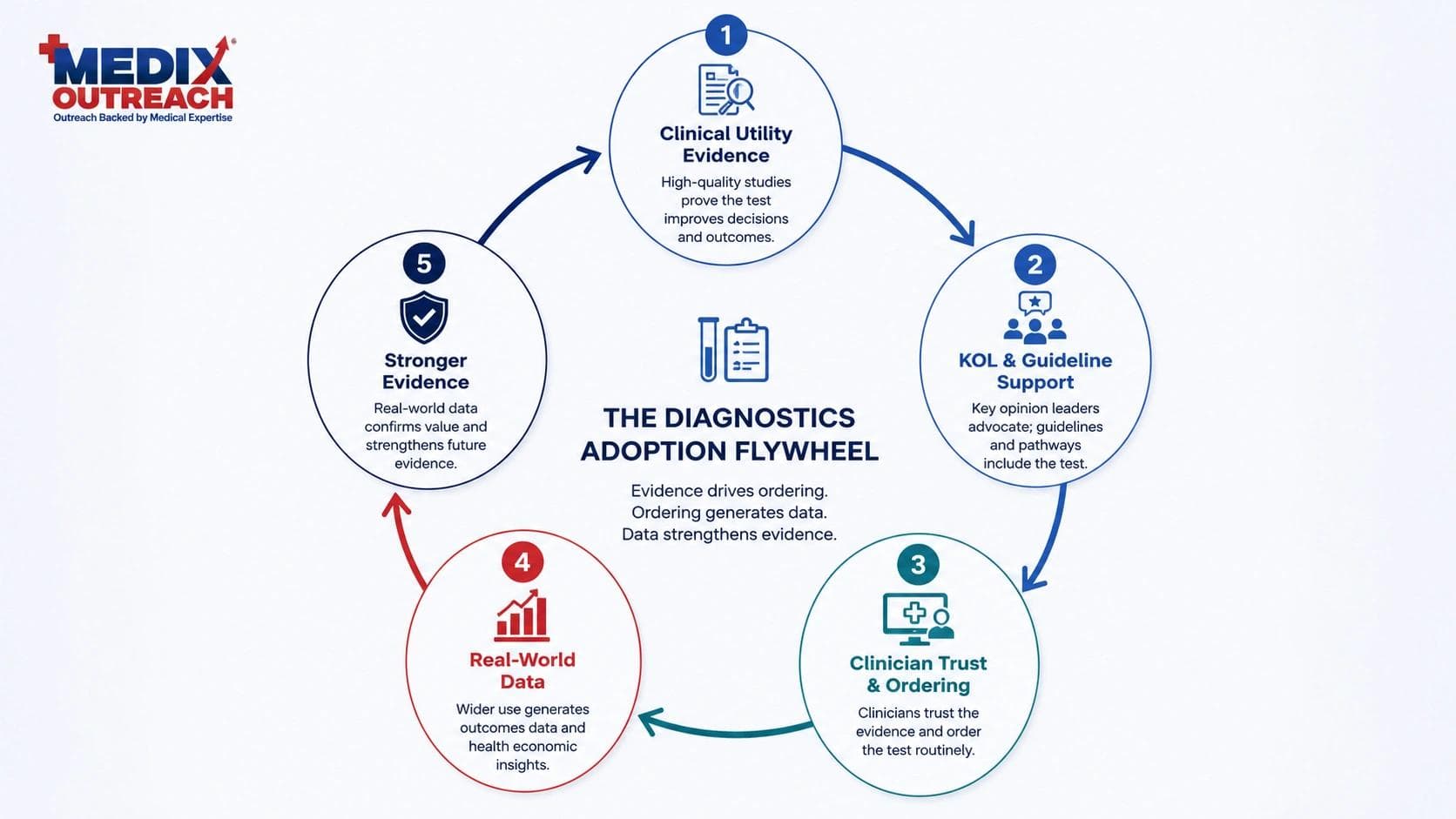
The levers that drive ordering compound on each other:
- Clinical utility evidence that speaks to the specific decision the clinician faces.
- Key opinion leaders and guideline inclusion. When respected specialists and clinical guidelines endorse a test, ordering follows. Building that credibility is deliberate work, which we cover in KOL and medical advisory board strategy.
- Clinician trust, earned through education and clinical relevance rather than advertising. In diagnostics as in the rest of healthcare, clinical credibility beats promotion.
- Workflow integration. If ordering the test is one click in the EHR and the report is clear and actionable, ordering scales. If it requires a separate portal and a hand-drawn requisition, it does not.
- Real-world data generated by early ordering, which feeds back into stronger evidence and broader coverage.
This is a flywheel: evidence drives ordering, ordering generates data, data strengthens the evidence and coverage case, and broader coverage drives more ordering. The commercialization job is to get the flywheel turning with a focused set of early adopters. Our work refining provider positioning for faster clinic adoption is an example of getting that first turn right.
Know Your Buyer: Clinician, Lab, or Health System
Diagnostics companies sell into several distinct buyers, and the motion changes with each:
- Individual clinicians and independent practices order tests one patient at a time. Here the game is awareness, trust, and frictionless ordering, and the approach mirrors selling to clinics and private practices.
- Health systems and hospitals may need to add your test to a formulary or lab menu, which means clearing committees and integration, similar to selling to hospitals and navigating procurement and GPOs.
- Reference labs and health plans may adopt or cover your test at a population level, which is the highest-leverage and slowest sale.
Trying to run all three motions with one message is a common mistake. Sequence them: usually early clinician and practice adoption to prove utility and generate data, then health-system and payer expansion once the evidence and references exist.
Where Medix Fits
Medix Outreach helps diagnostics and laboratory companies turn a validated test into ordered volume. Our healthcare commercial growth and go-to-market work spans buyer targeting, provider outreach, KOL engagement, and the positioning that gets a test trusted and ordered - the commercial layer that sits on top of your regulatory and reimbursement strategy. We work alongside your evidence and market-access efforts, not instead of them, to get the adoption flywheel turning.
Frequently Asked Questions
What does it mean to commercialize a diagnostic test?
Commercializing a diagnostic test means building everything required to turn a validated assay into ordered, reimbursed clinical volume: a clear regulatory and lab pathway, a strategy for coding, coverage, and payment so the test gets reimbursed, clinical-utility evidence that satisfies payers and guidelines, and a provider-adoption engine that gets clinicians to actually order it. The science is a prerequisite, not the finish line.
What is the difference between an FDA-cleared IVD and a laboratory developed test?
An FDA-cleared or approved in vitro diagnostic is authorized by the FDA for specific intended uses and can often be distributed as a kit, producing stronger, more defensible claims. A laboratory developed test is designed and performed within a single CLIA-certified high-complexity lab. The LDT route has historically been faster to market, but the regulatory landscape around LDTs has been changing, so current legal and regulatory guidance is essential before choosing a path.
Why do diagnostics need a coverage and coding strategy?
Because getting paid requires three separate things: a code to bill with, a payer coverage policy stating the test is medically necessary, and a payment rate. A valid code alone does not guarantee payment - without favorable coverage, claims are denied. Since the clinical-utility evidence payers require can take years to generate, reimbursement strategy has to be planned from the beginning, not after launch.
How do you get clinicians to order a new diagnostic test?
Ordering is a behavior change that depends on clinical-utility evidence relevant to the clinician's decision, endorsement from key opinion leaders and clinical guidelines, trust earned through education rather than advertising, and frictionless ordering inside the EHR. These levers compound: evidence drives ordering, ordering generates real-world data, and that data strengthens the evidence and coverage case, which drives more ordering.
What is clinical utility and why does it matter for diagnostics?
Clinical utility is proof that using the test changes clinical management and improves outcomes or lowers cost, as opposed to analytical validity (the test measures accurately) and clinical validity (the measurement correlates with the condition). Payers and guideline committees reward clinical utility because it shows the test does more than produce a number - it changes decisions. Designing evidence to demonstrate utility is what unlocks both coverage and adoption.