

Clinical diagnostics marketing is the discipline of turning a scientifically valid test into ordered, reimbursed test volume. It is not the same as marketing a drug, a device, or a SaaS platform, because a diagnostic almost never has a single buyer. To grow, a diagnostics company usually has to persuade three parties at once: the clinician who orders the test, the laboratory or procurement group that adopts it, and — increasingly — the patient who asks for it. Marketing succeeds only when all three see the same clear answer to one question: what changes for the patient because this test exists?
That is a different job than "commercialization." Where a diagnostics commercialization strategy sets the launch sequence, pricing, and market-access plan, diagnostics marketing builds and sustains demand once the test is real — the awareness, evidence communication, and provider relationships that convert a validated assay into a standing order in a clinician's workflow. This guide covers how to do that without overstating what a test can do.
Why diagnostics marketing is different
Three structural facts shape every diagnostics marketing plan.
The decision is clinical, and the standard of proof is high. A physician will not change a diagnostic pathway for a claim; they change it for evidence. Laboratory buyers evaluate analytical validity (does the assay measure what it claims, reproducibly?), clinical validity (does the result correlate with the condition?), and clinical utility (does the result change management and outcomes?). Your marketing has to carry that evidence, in that order, or it does not get past the medical director.
The buyer is a committee, not a person. The ordering clinician wants sensitivity, specificity, and turnaround time. The lab director wants workflow fit, instrument footprint, and total cost of ownership. Procurement wants contract terms and volume economics. A patient-facing test adds the consumer. One message cannot serve all of them, but the messages cannot contradict each other either.
Reimbursement is part of the product. A test that is not covered — or that leaves the patient with a surprise bill — will not sustain volume no matter how good the science is. The path to Medicare coverage for a molecular test, for example, runs through a specific program with its own evidence bar (more on that below). Marketing that ignores the money is marketing that stalls after the pilot.
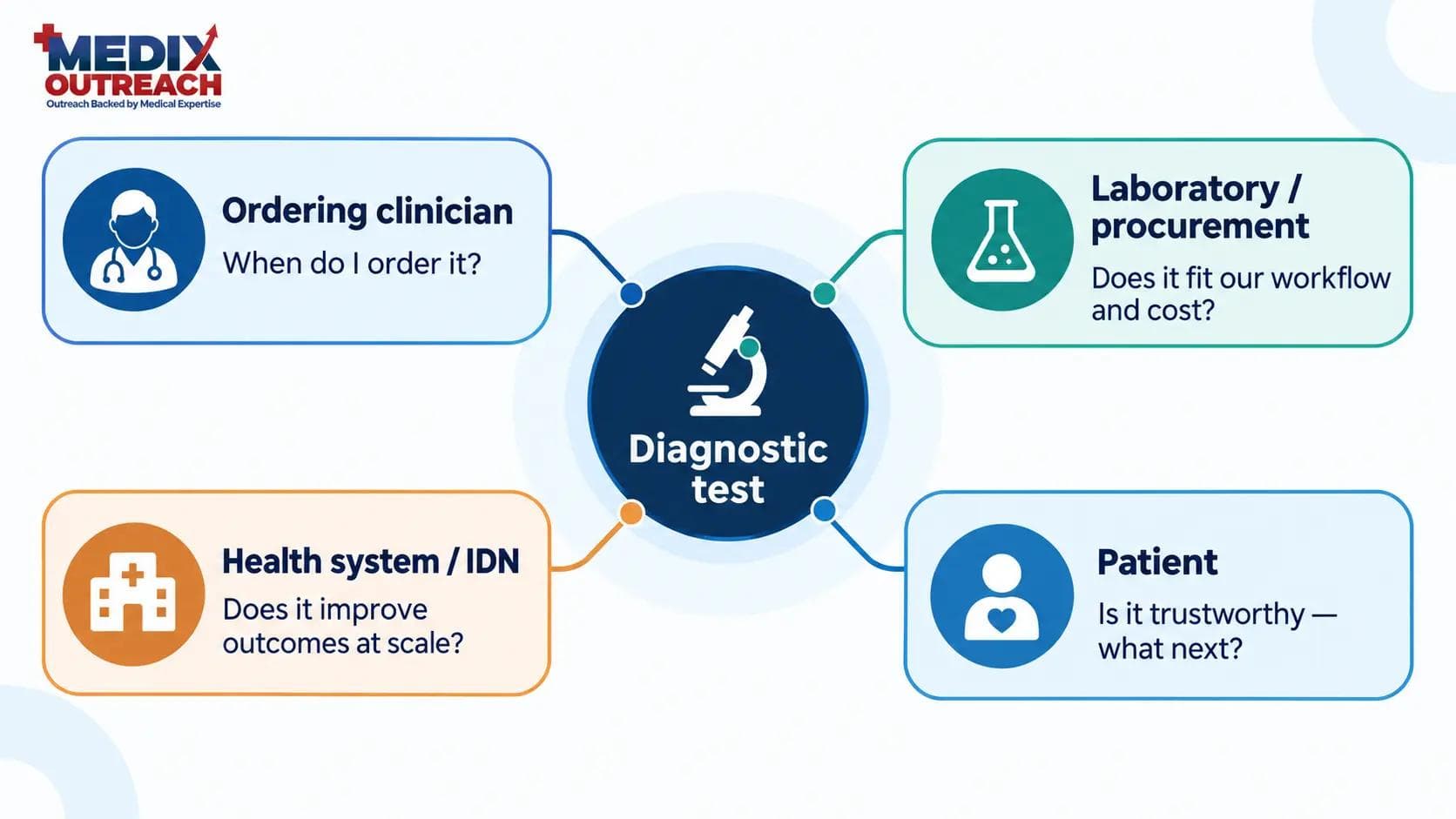
Map the three buyers before you write a word
Start by segmenting the audiences and giving each its own evidence and its own channel.
- The ordering clinician (PCP, specialist, or their care team) responds to peer-reviewed data, guideline alignment, clear ordering criteria, and a frictionless ordering experience. Their question: when should I order this, and will it change what I do next?
- The laboratory and procurement decide whether the test lives in-house or is sent out, and on what terms. Their question: does this fit our workflow, our accreditation, and our cost structure?
- The health system or IDN cares about population impact, cost avoidance, and quality measures. Their question: does this improve outcomes or total cost of care at scale?
- The patient (for consumer-initiated or elective testing) responds to clarity, credibility, and a simple next step. Their question: is this trustworthy, and what do I do with the result?
Building clinician demand is a provider-relationship problem as much as a marketing one — the same muscle behind provider network development. The strongest diagnostics programs treat physician engagement as a channel, not an afterthought.
Lead with evidence, not adjectives
The center of gravity in diagnostics marketing is the evidence narrative. Practical rules:
- Publish and repackage the validation data. Peer-reviewed analytical and clinical validation studies are your most valuable marketing assets. Turn each into a plain-language summary, a clinician one-pager, and a slide a sales team can actually use.
- State performance honestly and specifically. Sensitivity, specificity, positive and negative predictive value, limits of detection, and the population the study was run in. Vague superiority claims invite scrutiny and erode trust with exactly the audience you need.
- Show clinical utility, not just accuracy. A more accurate result matters only if it changes management. Document the decision the result informs and the downstream outcome or cost it affects.
- Respect the advertising rules. The FTC's Health Products Compliance Guidance applies to advertising for health-related products, including diagnostic tests: claims must be truthful and substantiated, and testimonials or expert endorsements do not substitute for competent, reliable scientific evidence. "Results not typical" disclaimers do not cure a claim you cannot support.
This is why clinical credibility is the real product in healthcare marketing. Evidence, sourced and specific, is what converts.
The reimbursement narrative is a marketing asset
Most diagnostics content skips reimbursement. That is a mistake, because a clinician's real objection is often "will my patient get a bill?" Make the coverage story part of your messaging.
- Labs must hold CLIA certification — high-complexity certification for most laboratory-developed tests — to legally report patient results. As of 2026, LDTs are overseen by CMS under CLIA after a federal court vacated the FDA's 2024 rule that would have regulated them as devices, and FDA rescinded that rule. Knowing which regime your test falls under shapes both claims and go-to-market.
- For molecular tests, Medicare coverage typically runs through the MolDX program: registering the test for a DEX Z-Code, passing a technical assessment of clinical utility, and billing with the correct CPT or proprietary laboratory analysis (PLA) code, per CMS's MolDX billing and coding guidance. Commercial payer policies often follow.
- Give your commercial team a coverage-and-billing toolkit: which payers cover the test, the codes to use, prior-authorization steps, and patient out-of-pocket expectations.
Fold this into a broader market access and reimbursement strategy so marketing, medical, and market-access teams tell one consistent story.
Mid-article CTA
Sitting on strong data but slow adoption?
Medix helps diagnostic and lab companies convert clinical evidence into ordered, reimbursed test volume.
Book a Diagnostics Growth CallBuild a demand engine, not a campaign
Test volume grows from a repeatable system, not a one-time launch push. The engine has four channels.
Search and answer engines. Clinicians and patients research tests online, and health queries now trigger AI-generated answers at high rates. Structure your evidence pages so they can be found and cited — clear headings, explicit performance data, and question-shaped sections. See the healthcare SEO strategy pillar for the framework.
Content and medical education. A content marketing engine — clinician guides, case discussions, CME-adjacent education, and comparison resources — nurtures the long research cycle. Diagnostics buyers read before they contact anyone.
Field and inside sales. Diagnostics still moves through relationships: territory reps for high-value tests, inside teams and digital outreach for volume tests. Equip them with the validation one-pagers and the coverage toolkit above.
KOLs, guidelines, and society engagement. Key opinion leaders and inclusion in specialty-society guidelines are among the highest-leverage moves in diagnostics. A guideline mention or a respected physician's advocacy does more than any ad. Build these relationships early and treat them as a program, not a favor. The commercial-vertical playbook here mirrors medical device lead generation, where the same hospital and specialist buyers apply.
Compliance guardrails
Three regimes govern almost everything you publish:
- FTC — truthful, substantiated claims; honest testimonials; no deceptive comparisons.
- CLIA/CMS — certification and result-reporting rules that also constrain how you describe the test's status.
- HIPAA — patient data used in case studies, testimonials, or targeting must be properly authorized and de-identified.
Bake review into the workflow. A single overstated claim in a diagnostics campaign can trigger regulatory attention and destroy the clinician trust the whole strategy depends on.
A 90-day starting plan
- Weeks 1–2: Segment the three-to-four buyer types; write the core question and one honest, evidence-backed value statement for each.
- Weeks 3–4: Build the evidence library — validation summaries, clinician one-pager, coverage-and-billing toolkit.
- Weeks 5–8: Stand up the demand engine's foundation: evidence-rich, search-optimized pages and three cornerstone education pieces.
- Weeks 9–10: Launch clinician outreach with the one-pagers; open two or three KOL conversations.
- Weeks 11–12: Instrument the funnel — track ordering clinicians, test volume by account, and coverage-related drop-off — and review what moved.
Frequently asked questions
How is diagnostics marketing different from medical device marketing?
Both sell into clinical and procurement committees, but diagnostics marketing centers on the evidence-and-reimbursement narrative for a result, while device marketing (see medical device lead generation) centers on a physical product's workflow, safety, and total cost of ownership.
Do we need FDA clearance to market a lab-developed test?
As of 2026, most LDTs operate under CMS/CLIA oversight rather than FDA device clearance, following the vacatur of the FDA's 2024 LDT rule. Your regulatory status shapes what you may claim, so confirm it before building messaging.
What is the single highest-leverage marketing move for a diagnostic?
Get the test into clinical practice guidelines and earn credible KOL advocacy. Nothing else converts ordering behavior as durably.
How long until diagnostics marketing shows results?
Adoption follows the clinical evidence and reimbursement timeline, not a quarterly campaign. Expect the demand engine to compound over 6–18 months; the accounts that pilot early become your reference base.