
Ketamine clinics sit in an unusual spot. Demand for interventional psychiatry is real and growing, the treatment is almost entirely cash-pay, and most patients make the decision privately after weeks of research. That combination rewards clinics that market well — and punishes clinics that market carelessly, because the advertising rules around a controlled substance used off-label are strict.
The clinics that grow predictably do not treat marketing as a stream of ads. They build a patient-acquisition system: a way to be found, a reason to be trusted, and a referral base that sends patients who are already a good clinical fit. This guide lays out that system, and where compliance has to shape every step.
Why ketamine clinic marketing is different
Before tactics, it helps to name what makes this vertical its own category.
- It is cash-pay and high-consideration. Most ketamine treatment is not covered by insurance, so the patient is spending their own money on a series of visits. The decision is emotional, researched, and slow.
- The clinical and regulatory context is sensitive. Ketamine is not FDA-approved for the treatment of any psychiatric disorder; the esketamine product Spravato was FDA-approved in 2019 for treatment-resistant depression and is dispensed only through a restricted REMS program with in-office monitoring. Compounded ketamine is not FDA-approved, and the FDA has flagged safety risks with it. Your marketing cannot promise outcomes the evidence and your scope do not support.
- Trust is the real conversion lever. A patient considering a dissociative treatment for depression, PTSD, or chronic pain is evaluating safety and credibility first, and price second.
That means the winning message is rarely "book now." It is "here is who treats you, how we keep you safe, and what the experience is actually like."
Start with compliant claims, not clever ads
Advertising for a clinic is governed by the FTC's health-products advertising standards (claims must be truthful and substantiated), by state medical-board rules on physician advertising, and by platform policies that restrict ads for ketamine and controlled substances. Get this layer right before spending a dollar on demand.
- Substantiate every health claim. Avoid cure language and specific success-rate statistics you cannot support with competent evidence. Describe the treatment, the conditions it is used for, and the realistic range of experiences.
- Disclose honestly. Note that individual results vary, that ketamine for psychiatric use is largely off-label, and that treatment is delivered under medical supervision.
- Protect patient privacy. Testimonials, before-and-after stories, and retargeting all touch sensitive health data; align them with HIPAA-compliant marketing practices and get consent in writing.
- Know the ad-platform limits. Paid search and social platforms restrict or ban ketamine-related ads; plan for organic, referral, and content channels to carry most of the load.
Compliance is not a tax on growth here. It is the moat. Clinics that look and sound credible win the patients who were scared off by the ones that did not.
The ketamine clinic patient-acquisition funnel
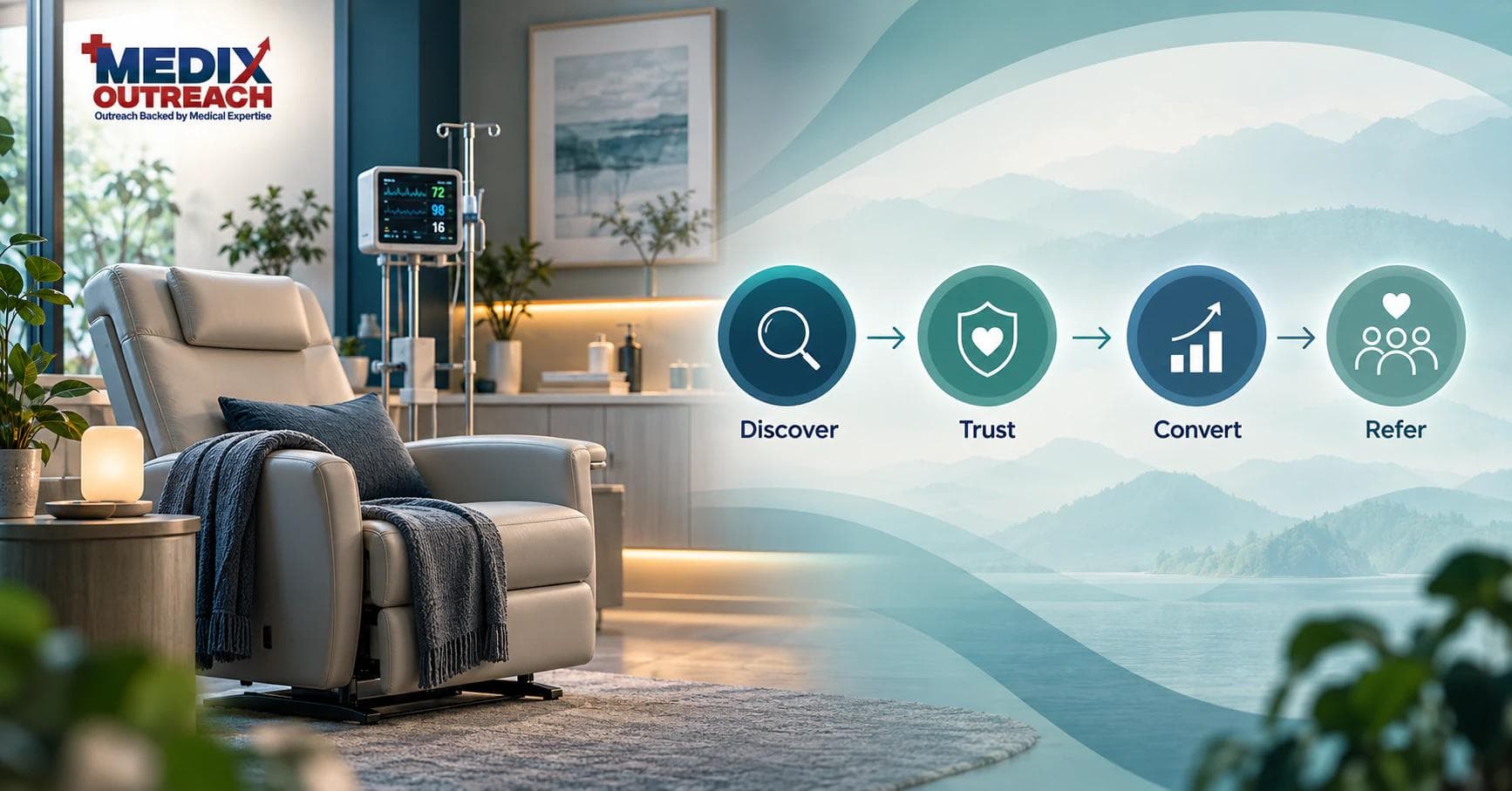
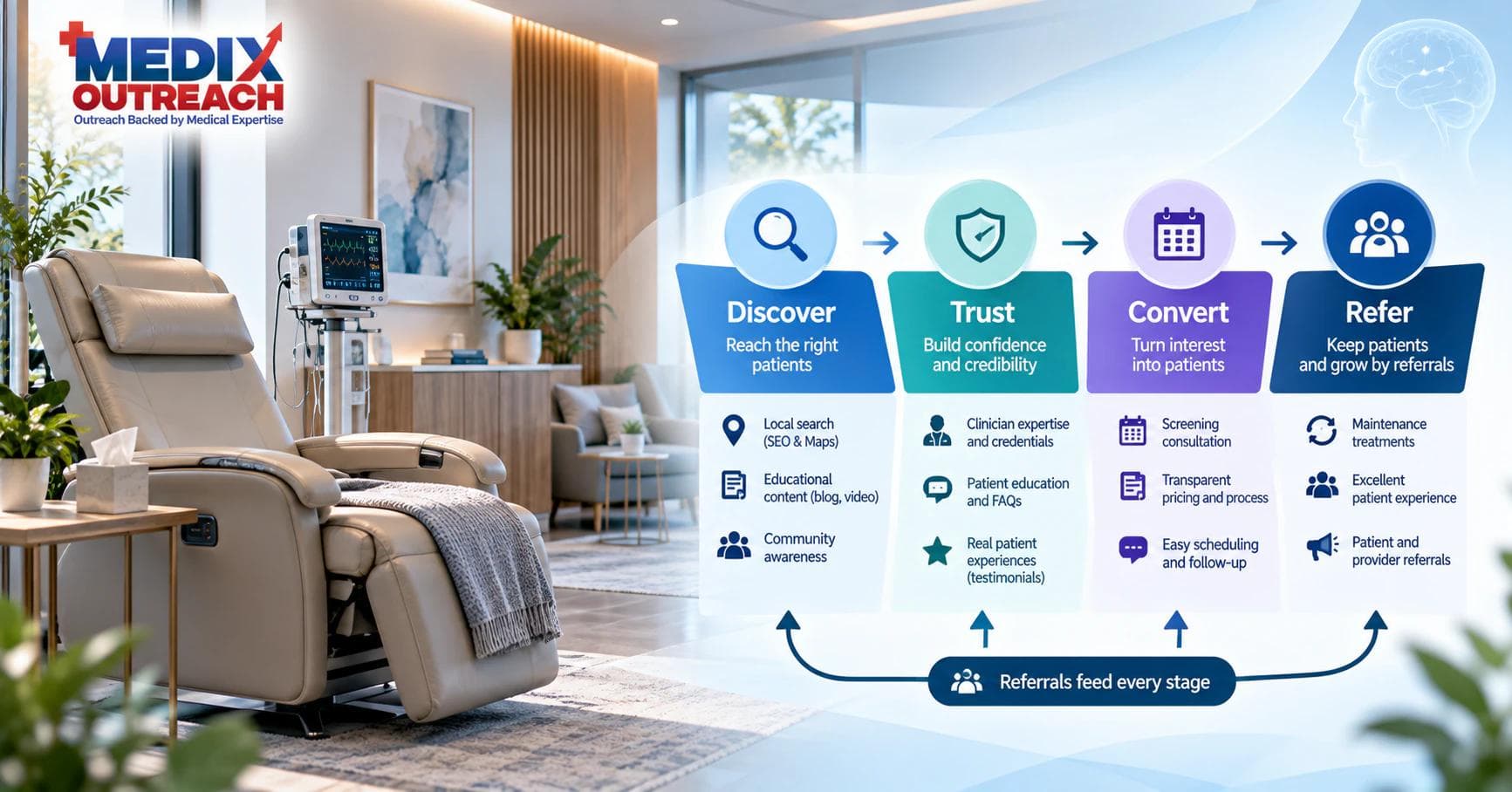
Think in stages, and match a channel and an asset to each. Most ketamine patients move through the same path.
1. Be findable (discovery)
- Local search. Most searches are geographic ("ketamine clinic near me," "ketamine for depression [city]"). A complete, accurate Google Business Profile, consistent listings, and location pages are the highest-ROI work for most clinics.
- Condition and education content. Pages and articles that answer real questions — what treatment-resistant depression is, how ketamine is used, what a session involves, safety and screening — capture the research phase and feed AI search answers. This is the same editorial-authority approach described in the Medix healthcare SEO strategy.
2. Build trust (consideration)
- Lead with the clinicians: credentials, supervising physician or psychiatric nurse practitioner, monitoring protocol, and screening process.
- Show the experience: what happens before, during, and after a session, and how you handle safety and aftercare.
- Make credibility concrete without overclaiming — accreditation, safety standards, and a clear description of candidacy and contraindications.
3. Convert (decision)
- Offer a low-friction first step: a screening consult, not an immediate infusion booking.
- Be transparent about cost and the typical treatment series so the cash-pay decision is informed.
- Respond fast. In high-consideration cash-pay care, speed-to-lead is a major differentiator, the same dynamic covered in the Medix guide to the digital patient-acquisition journey.
4. Retain and refer (loyalty)
Maintenance visits and word-of-mouth drive long-term economics. A recovered patient who refers a friend, and a referring therapist who trusts your clinic, are worth far more than any single ad click.
Mid-article CTA
Need help building your healthcare growth engine?
Medix helps healthcare startups, clinics, pharma companies, and provider-focused platforms build scalable commercial pipelines.
Book a Strategy CallReferral partnerships are the most durable channel
Because ad platforms are restrictive and patients want validation, professional referrals are often the strongest and most defensible acquisition channel for a ketamine clinic. The referral sources that matter:
- Therapists and psychologists with patients who have not responded to therapy alone.
- Primary care and psychiatry practices managing treatment-resistant depression or anxiety.
- Pain management and other specialists for chronic-pain indications.
Earning those referrals is a B2B motion, not a consumer one. It looks like the referral-development work Medix builds for behavioral-health and specialty practices: clear clinical positioning, an easy intake pathway, closed-loop communication back to the referrer, and a reason to trust that patients are safe in your hands. The same playbook Medix uses to build a psychiatry referral network and to run physician-liaison programs applies directly here. Make it effortless for a therapist to refer, and keep them informed, and you build a channel no competitor can buy.
Measure what actually grows the clinic
Vanity metrics (impressions, followers) do not pay for a clinic. Track the numbers that connect spend to booked, completed treatment:
- Cost per qualified consult by channel (not cost per click).
- Consult-to-treatment conversion rate.
- Referral volume and source — which partners actually send patients who complete care.
- Patient acquisition cost vs. treatment-series value and lifetime value including maintenance.
Attribution in cash-pay care is messy because the journey is long and private. Ask every patient how they found you, and reconcile that against your analytics, so you invest in what works rather than what is easiest to measure.
Frequently asked questions
Is it legal to advertise a ketamine clinic? Yes, within limits. Advertising must be truthful and substantiated under FTC standards, must follow your state medical board's rules on physician advertising, and must respect platform policies that restrict ketamine ads. The constraint is on overclaiming outcomes and on how you use patient health data, not on marketing itself.
What is the best marketing channel for a ketamine clinic? For most clinics, local SEO plus professional referral partnerships. Paid ads are restricted for ketamine, so organic discovery and trusted referrals from therapists and physicians typically produce the best cost per completed treatment.
How is ketamine clinic marketing different from med spa marketing? Both are cash-pay and high-trust, but ketamine involves a controlled substance used largely off-label for psychiatric conditions, so claims, screening, and privacy requirements are far stricter, and professional referrals carry more weight than lifestyle advertising.
Can I use patient testimonials? Carefully. Testimonials touch protected health information and can imply typical results. Get written consent, avoid implying guaranteed outcomes, and align the practice with HIPAA-compliant marketing standards.
Growing a ketamine clinic the right way
The ketamine clinics that scale are not the loudest advertisers. They are the most credible ones: easy to find, clearly safe, and backed by professionals who trust them enough to refer. Build the funnel, respect the rules, and treat referral relationships as your core channel, and growth becomes a system rather than a gamble.
Medix Outreach helps cash-pay and specialty clinics build compliant patient-acquisition engines and the professional referral networks that feed them. If you want a ketamine or interventional-psychiatry clinic to grow predictably, book a free strategy call or explore our Patient Acquisition & Practice Growth service.