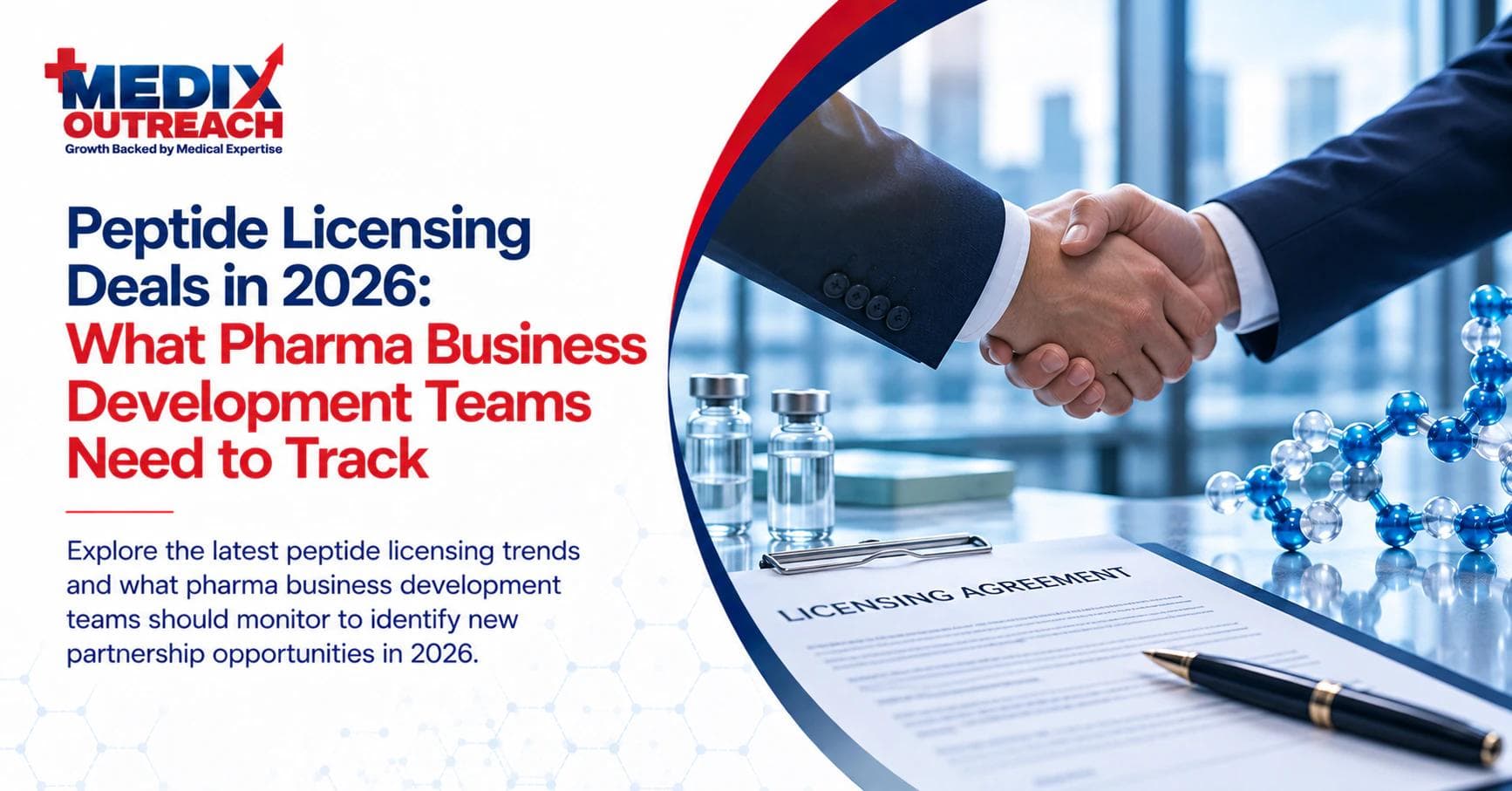
The peptide market is becoming increasingly partnership-driven.
As pharmaceutical companies compete across obesity, metabolic disease, rare disease, and other therapeutic areas, licensing and strategic collaborations can provide a way to access new molecules, technologies, development capabilities, or geographic rights.
For peptide companies, this creates an important business development opportunity.
The challenge is identifying which partnerships are commercially relevant before the opportunity becomes a formal transaction.
Why licensing matters in the peptide market
Pharmaceutical companies do not always need to develop every capability internally.
A company may have:
- A promising peptide candidate
- A delivery technology
- Manufacturing expertise
- A regional commercial opportunity
- A complementary development platform
but lack another capability needed to move the program forward.
Licensing can help connect those capabilities.
Recent pharmaceutical transactions illustrate the broader importance of licensing as a business-development mechanism. In July 2026, Spero Therapeutics entered a licensing agreement with Innovent Biologics for development and commercialization rights outside Greater China, with the transaction valued at up to approximately $1.1 billion.
The deal was not peptide-specific, but it demonstrates how pharmaceutical companies continue to use licensing to expand pipelines and commercial reach.
The peptide opportunity is broader than molecule licensing
When companies think about peptide partnerships, they may immediately think about licensing a drug candidate.
But commercial opportunities can also involve:
- Manufacturing partnerships
- Regional commercialization rights
- Drug-delivery technologies
- Formulation platforms
- Research collaborations
- Co-development
- Technology transfer
- Strategic investments
This creates a larger ecosystem for pharma business development.
What makes a peptide licensing opportunity commercially relevant?
Not every promising scientific asset represents a good commercial opportunity.
Business development teams should examine:
- Development stage
- Therapeutic application
- Intellectual-property position
- Manufacturing requirements
- Regulatory pathway
- Geographic rights
- Existing partnerships
- Commercial infrastructure
- Strategic fit
The objective is to understand the opportunity before initiating a serious partnership discussion.
Mid-article CTA
Evaluating a peptide licensing opportunity?
Medix helps healthcare and pharma companies build scalable commercial pipelines through targeted business development and provider outreach.
Book a Strategy CallWhy timing matters
Early identification can be particularly valuable.
A company entering clinical development may be approaching decisions about manufacturing, commercialization, regional rights, or additional funding.
A peptide company that identifies those signals early can begin building the relationship before the formal transaction process begins.
This is where peptide marketing outreach can support pharma business development.
Turning market intelligence into outreach
A modern process could look like:
Market monitoring ↓
Identify relevant peptide programs ↓
Analyze development stage ↓
Identify strategic requirements ↓
Map decision-makers ↓
Build targeted outreach ↓
Develop partnership discussion
The outreach should be based on the company's actual situation rather than a generic partnership pitch.
What buyers need from partnership conversations
A pharmaceutical company evaluating a peptide partnership may want to understand:
- What does the partner actually bring?
- Is the capability differentiated?
- Can it scale?
- What evidence supports the technology?
- What development stage is supported?
- What geographic markets are involved?
- What commercial infrastructure exists?
This means peptide B2B sales needs to communicate both scientific and commercial relevance.
The role of healthcare commercialization
A licensing deal does not automatically create commercial success.
After a partnership is established, companies still need to address:
- Market access
- Manufacturing
- Regulatory requirements
- Commercial strategy
- Distribution
- Stakeholder engagement
The strongest partnership strategy therefore considers commercialization from the beginning.
Final takeaway
Peptide licensing opportunities are part of a larger shift toward ecosystem-based pharmaceutical development.
For peptide companies, the opportunity is not simply to find companies interested in partnerships.
It is to identify organizations where a specific capability, asset, technology, or market opportunity creates a meaningful reason to collaborate.
That is where pharma business development and targeted peptide marketing outreach become closely connected.