

Medical device lead generation is the system a MedTech company uses to identify, engage, and qualify the clinicians and institutional buyers who can actually approve a purchase. It is a pipeline problem, not an advertising problem. The people who decide are rarely the people who search, the decision runs through a committee, and the sale can take 9 to 18 months. A lead engine that treats device buyers like consumer clicks will produce activity and no pipeline.
The good news: because the buying process is structured, it is predictable. Once you map the committee, respect the compliance rules, and build a multichannel engine around them, you can forecast pipeline instead of hoping for it. This guide shows how. For the positioning and launch decisions that sit upstream of demand, pair it with our medical device go-to-market strategy piece.
Why medical device lead generation is different
Three realities separate device lead gen from ordinary B2B.
Regulation constrains the message. What you can claim about a device depends on its FDA classification and clearance pathway — a Class II 510(k) device and a Class III PMA device are not marketed the same way, and off-label promotion carries real legal exposure. Your lead magnets, ads, and sales decks all have to survive regulatory review.
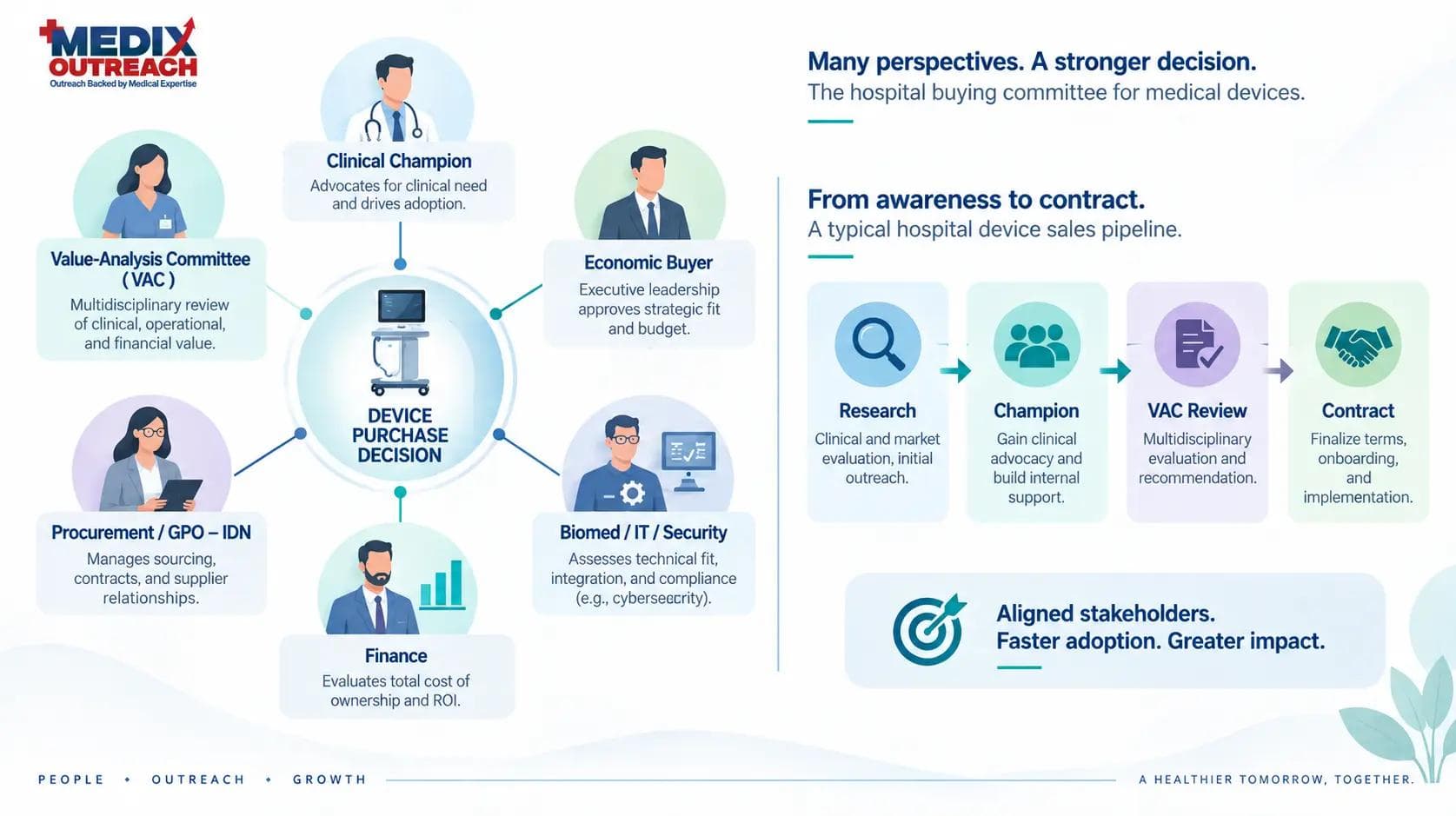
The buyer is a committee. According to Gartner, a complex B2B purchase typically involves six to ten decision-makers. In a hospital, that means a clinical champion, department leadership, procurement/supply chain, biomedical engineering or IT, finance, and — for most meaningful purchases — a value-analysis committee. The physician who loves your device cannot sign the contract alone.
The cycle is long and evidence-gated. Buyers research extensively before they ever talk to a rep. Your job is to be present, credible, and useful throughout that self-directed research, then convert interest into a qualified, committee-ready opportunity.
Map the buying committee before you generate a single lead
Generic "leads" are worthless if they are not attached to a mapped account. For each target hospital or system, identify the roles:
- Clinical champion — the physician or clinician who wants the device and will advocate internally. Your primary demand target.
- Economic buyer — service-line or department leadership who owns the budget and the ROI case.
- Procurement / supply chain — controls contracting, often through a group purchasing organization (GPO) or integrated delivery network (IDN). Understand these mechanics in our hospital procurement, GPOs, and IDNs guide.
- Biomedical engineering / IT / security — for connected devices, they assess integration and cybersecurity. A weak security story now stalls deals; see medical device cybersecurity.
- Value-analysis committee (VAC) — the cross-functional body that formally reviews new products for clinical value, safety, and total cost. Most hospitals route device purchases through a VAC.
The VAC is where device deals live or die, and it is what most lead-gen programs ignore. A VAC wants clinical evidence, a total-cost-of-ownership analysis, safety and reprocessing considerations, and a comparison to the current standard. If your content and sales enablement are not built to feed a value-analysis submission, your "qualified leads" will stall at the committee door. Build a VAC-ready evidence packet early and treat it as a core marketing asset.
Build a multichannel lead engine
No single channel reaches a device buying committee. Combine four.
Search and answer engines. Clinicians and biomed staff research specific problems and specifications. Rank for the clinical and technical queries that precede a purchase, and structure pages so they can be cited by AI answer engines — the framework is in our healthcare SEO strategy pillar.
Content and sales enablement. A content marketing engine — clinical evidence summaries, procedure or workflow guides, ROI and total-cost calculators, and the VAC evidence packet — nurtures the long research cycle and arms your champions to sell internally on your behalf.
Field and inside sales. High-value capital equipment needs territory reps and clinical specialists; consumables and lower-ACV devices scale through inside sales and targeted digital outreach. Both feed from the same mapped-account list.
Events, KOLs, and peer proof. Conferences, society engagement, and key-opinion-leader relationships create the peer validation clinicians trust. A respected surgeon's endorsement moves a VAC more than any ad.
Note the distinction between creating awareness and capturing contacts: demand generation builds the market's awareness and intent; lead generation captures and qualifies the specific people ready to engage. You need both, and they are covered as related disciplines in this batch. The same committee-and-compliance logic applies to adjacent verticals like diagnostics marketing.
Mid-article CTA
Leads stalling at the committee door?
Medix helps device companies produce committee-ready opportunities, not just contacts.
Book a MedTech Growth CallCompliance-safe outreach
Device commercial teams operate under rules general marketers do not.
- AdvaMed Code of Ethics. The industry's code governs interactions with health-care professionals — consulting arrangements, meals, education, and gifts. Your outreach and events must comply, and "we didn't know" is not a defense.
- FDA promotional rules. Claims must match the cleared or approved indication. Off-label promotion is a legal risk, and it also erodes clinician trust.
- HIPAA. Using patient data — in case studies, testimonials, or targeting — generally requires prior written authorization, per HHS marketing guidance.
Bake legal/regulatory review into the content workflow so speed never costs you compliance. Building clinician relationships the right way is the core of provider network development.
Qualify hard: an MQL-to-SQL framework for devices
Volume flatters vanity metrics. Qualify against the committee reality:
- Fit — right facility type, procedure volume, and current standard of care.
- Champion identified — a named clinician who will advocate internally.
- Access path — a known route to procurement and the VAC.
- Trigger — a reason to act now (a clinical gap, a competitor contract expiring, a new service line, a reimbursement change).
- Timeline and budget — a realistic decision window and funding source.
A "lead" missing a champion or an access path is a research contact, not a sales-qualified opportunity. Grading against this rubric is what makes device pipeline forecastable.
Metrics that matter
Track the pipeline, not the clicks: qualified opportunities by account, champion-identified rate, VAC-submission rate, average cycle time by stage, and win rate by trigger type. These tell you whether the engine is producing committee-ready deals or just traffic.
Frequently asked questions
How long is a typical medical device sales cycle?
For capital equipment and committee-reviewed purchases, commonly 9–18 months. Consumables and lower-cost devices move faster. Your lead engine has to sustain contact across the whole cycle.
What is a value-analysis committee and why does it matter for lead gen?
A VAC is the hospital body that formally evaluates new products for clinical value, safety, and total cost. Because most device purchases pass through it, your marketing must produce VAC-ready evidence, not just interest.
Do we need different content for clinicians and for procurement?
Yes. Clinicians want outcomes and workflow; procurement wants total cost of ownership and contracting fit. Same device, different proof, coordinated so the messages reinforce rather than contradict.
Is inbound or outbound better for medical devices?
Both. Inbound (search, content) captures self-directed research; outbound (field, inside sales, ABM) reaches mapped accounts and named committees. The strongest programs run them together.