Artificial Intelligence is transforming healthcare faster than ever before.
Healthcare SaaS platforms are automating documentation. AI-powered diagnostics are improving clinical decision support. Remote patient monitoring is becoming more intelligent. Pharmaceutical companies are accelerating research with machine learning. Hospitals are investing heavily in predictive analytics.
Innovation is everywhere.
Yet one question continues to determine whether these solutions succeed in the market:
Can healthcare providers trust them?
In 2026, healthcare organizations are no longer impressed by AI alone. They want evidence that it improves clinical outcomes, integrates into existing workflows, and supports better decision-making without creating additional risk.
For healthcare companies, that means clinical validation has become just as important as product innovation. This article focuses on validation and evidence as commercial assets; for the broader picture of why healthcare AI sales stall, see our companion piece on healthcare AI adoption and commercialization.
The Healthcare AI Market Has Changed
Just a few years ago, simply adding "AI-powered" to a product generated interest.
Today, nearly every healthcare technology company claims to use artificial intelligence.
As AI adoption grows, technology itself is no longer a competitive advantage.
Healthcare buyers have become far more selective.
Physicians, hospital executives, healthcare systems, and clinical leaders now evaluate AI solutions through a different lens.
Instead of asking, "What does your AI do?"
They're asking:
- Has it been clinically validated?
- Does it improve patient outcomes?
- Can providers trust the recommendations?
- Does it reduce administrative burden?
- Will it fit into our existing workflow?
- Is implementation practical?
These questions are reshaping healthcare commercialization across every sector.
Innovation Alone Doesn't Build Trust
Many healthcare startups invest heavily in product development but very little in commercialization.
The result is familiar.
A technically impressive platform receives positive feedback during demonstrations, yet sales cycles remain long and provider adoption stays low.
The issue isn't the technology.
It's credibility.
Healthcare buyers make decisions that directly affect patient care, compliance, and operational performance.
Every new technology introduces risk.
Before adopting AI, providers need confidence that the solution has been validated in real clinical environments.
Without that confidence, even the most advanced platform becomes difficult to sell.
Clinical Validation Is Becoming a Commercial Asset
Clinical validation is often viewed as a regulatory milestone. For AI-enabled products that meet the definition of a medical device, that milestone is shaped by FDA expectations for software as a medical device.
In reality, it's one of the strongest commercial assets a healthcare company can have.
Validated outcomes help organizations:
- Build provider confidence
- Differentiate from competitors
- Reduce sales objections
- Strengthen healthcare provider outreach
- Support procurement discussions
- Accelerate healthcare business development
When providers see clinical evidence supporting your solution, conversations shift from skepticism to implementation. Evidence also strengthens your position in market access and reimbursement discussions, where payers and procurement teams expect proof of value.
Providers Buy Outcomes, Not Algorithms
Healthcare professionals rarely care which AI model powers your platform.
They care about what it helps them accomplish.
Successful messaging focuses on questions like:
- Does this reduce physician burnout?
- Can staff save time?
- Will patients receive better care?
- Does it improve workflow efficiency?
- Can it support reimbursement opportunities?
- Does it reduce operational costs?
Healthcare commercialization succeeds when organizations connect technology to measurable clinical and operational outcomes.
Clinical Credibility Should Shape Your Go-to-Market Strategy
Many healthcare startups build their healthcare go-to-market strategy around product capabilities.
Healthcare buyers expect something different.
Your commercial strategy should demonstrate an understanding of:
- Clinical workflows
- Hospital operations
- Documentation challenges
- Healthcare regulations
- Provider priorities
- Administrative pressures
Organizations that combine healthcare expertise with commercial execution consistently generate stronger provider engagement than companies relying on generic B2B messaging.
Clinical credibility should be visible across every stage of your healthcare business development strategy, and it is closely tied to how clinical credibility works as a go-to-market asset.
Mid-article CTA
Need help building your healthcare growth engine?
Medix helps healthcare startups, clinics, pharma companies, and provider-focused platforms build scalable commercial pipelines.
Book a Strategy CallAI Adoption Depends on Workflow Integration
Even clinically validated technology can fail if it disrupts existing workflows.
Healthcare organizations evaluate AI based on practical implementation.
Questions include:
- Does it integrate with the EHR?
- Will staff require extensive training?
- Can providers use it without changing established processes?
- Does it improve efficiency rather than create additional work?
Healthcare providers don't want more technology.
They want technology that makes healthcare easier.
Solutions that fit naturally into existing workflows consistently outperform products requiring significant operational change. This is often where a strong evaluation turns into a signed deal, or stalls, which is why so many products get stuck moving from pilot to contract.
Why Commercialization Matters More Than Ever
Healthcare AI companies often invest in marketing before developing a commercialization strategy.
The result is awareness without adoption.
Healthcare commercialization aligns every part of commercial growth, including:
- Healthcare business development
- Provider outreach
- Healthcare demand generation
- Healthcare sales outsourcing
- Strategic partnerships
- Revenue pipeline development
Instead of generating more leads, commercialization focuses on converting qualified opportunities into long-term provider relationships.
That's where sustainable growth begins.
Healthcare Companies Need More Than Marketing
Traditional marketing creates visibility.
Healthcare commercialization creates trust.
Organizations that succeed in 2026 combine:
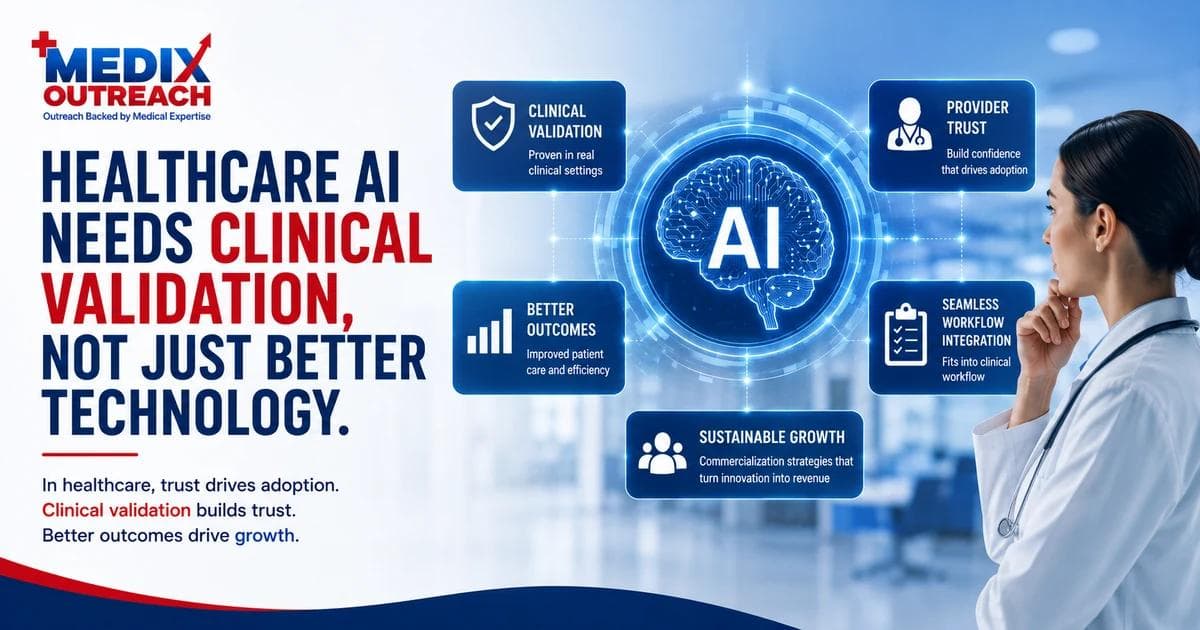
- Clinical validation
- Provider education
- Thought leadership
- Strategic partnerships
- Healthcare provider outreach
- Business development
- Healthcare content marketing
Together, these elements create confidence before the first sales conversation even begins.
Healthcare companies that educate providers consistently outperform those that simply promote products.
How Medix Outreach Helps Healthcare AI Companies Commercialize Faster
At Medix Outreach, we believe AI innovation deserves a commercialization strategy built specifically for healthcare.
Our team combines pharmacist-led expertise with healthcare go-to-market strategy and commercial growth, provider outreach, strategic partnerships, healthcare sales outsourcing, and end-to-end revenue pipeline development.
We help healthcare SaaS companies, AI startups, digital health innovators, pharmaceutical organizations, biotech companies, and medical device manufacturers communicate clinical value in a way that resonates with providers and healthcare decision-makers.
Rather than functioning as another healthcare lead generation agency, we help organizations build the trust required to accelerate adoption across the U.S. healthcare market.
Conclusion
Healthcare AI is no longer competing on technology alone.
It's competing on trust.
The companies that grow fastest won't necessarily have the most sophisticated algorithms.
They'll be the organizations that combine innovation with clinical validation, provider engagement, healthcare business development, and strategic commercialization.
As healthcare continues to adopt AI in 2026 and beyond, clinical credibility will become one of the most valuable competitive advantages any healthcare company can build.
Technology may start the conversation.
Clinical validation closes the deal.
Frequently Asked Questions
What is clinical validation for healthcare AI?
Clinical validation for healthcare AI is evidence that a solution performs as intended in real clinical environments and improves outcomes, efficiency, or decision-making without adding unacceptable risk. It can range from peer-reviewed studies and real-world evidence to regulatory clearance where the product meets the definition of a medical device. For buyers, validation answers the core question of whether providers can trust the technology with patient care.
Why is clinical validation a commercial asset, not just a regulatory step?
Validated outcomes build provider confidence, differentiate a product from competitors making similar AI claims, reduce sales objections, and strengthen procurement and reimbursement discussions. In a crowded market where nearly every vendor claims to use AI, evidence is often what moves a conversation from skepticism to implementation. That makes validation one of the strongest commercial assets a healthcare AI company can have.
Why do technically strong healthcare AI products still struggle to sell?
The obstacle is usually credibility, not capability. Healthcare buyers make decisions that affect patient care, compliance, and operations, so every new technology introduces risk. Without evidence that a solution has been validated and fits existing workflows, even an impressive platform faces long sales cycles and low adoption. Strong technology opens the door, but validation and commercialization win the deal.
How does workflow integration affect healthcare AI adoption?
Even validated AI can fail if it disrupts how clinicians already work. Providers evaluate whether a solution integrates with the EHR, requires heavy training, or forces process changes. Products that fit naturally into existing workflows and reduce work consistently outperform those that add operational burden. Integration is frequently the difference between a successful pilot and a stalled one.
How should a healthcare AI company use validation in its go-to-market strategy?
Lead with outcomes rather than algorithms, and make clinical evidence visible across positioning, provider outreach, and procurement conversations. Pair validation with clinical credibility and workflow proof so buyers can see both that the solution works and that it fits their environment. Treating validation as a commercial asset, not just a compliance checkbox, is what accelerates provider trust and adoption.
<!-- EXTERNAL REFERENCES -->
- U.S. Food and Drug Administration, Software as a Medical Device (SaMD) -> https://www.fda.gov/medical-devices/digital-health-center-excellence/software-medical-device-samd -> supports the claim that clinical validation of AI-enabled medical software is shaped by FDA expectations.