

Pricing is one of the most powerful growth levers a healthcare company has, and one of the least examined. Teams will spend months refining a product and weeks refining a pitch, then set the price in an afternoon by copying a competitor or guessing. In most markets that costs some margin. In healthcare, where buyers scrutinize cost intensely and budgets are rigidly structured, a weak pricing strategy quietly caps growth and loses deals that should have closed.
Healthcare pricing is genuinely harder than pricing in other industries. The person who uses the product is often not the person who pays. Reimbursement sits between your product and the money. Budgets are split into categories that determine what a buyer can even approve. And procurement teams are built to push your price down. Getting pricing right in this environment is a strategic exercise, not a number you pick.
This guide lays out how to build a healthcare pricing and packaging strategy. It covers how to choose a pricing metric, how to price to value, how to package into tiers, how to fit the buyer's budget, and how to hold your price through pilots and procurement.
Pricing Is a Strategy, Not a Number
Price does more than set revenue per deal. It signals value, shapes which customers you attract, determines whether a buyer can fit you into a budget, and frames every negotiation that follows. Set it carelessly and you create problems that no amount of selling can fix.
Healthcare adds specific complications that generic pricing advice ignores:
- The user is not always the payer. A clinician may love your product while a finance team controls whether it gets bought.
- Reimbursement intermediates value. For many products, what a provider or payer earns or saves from your product depends on how care is reimbursed.
- Budgets are categorized. Capital and operating budgets have different owners, cycles, and rules, and your price has to fit one of them.
- Procurement is professionalized. Health systems and payers negotiate through supply chain and contracting teams whose job is to lower your price.
A pricing strategy accounts for all of this before a number is ever quoted. That is what separates pricing that supports growth from pricing that fights it.
Pricing Is Not the Same as Reimbursement
The most important distinction in healthcare pricing is the one between your price and reimbursement. They are related, and they are not the same.
Your price is what you charge your customer for your product. Reimbursement is how your customer, or their patients, get paid by insurers when care is delivered. For a device or a clinical service, reimbursement often determines how much value the buyer captures from your product, which shapes what they are willing to pay you. But reimbursement strategy is a separate discipline, covered in depth in our guide to market access and reimbursement strategy.
The practical point is this. You need to understand reimbursement to price well, because it drives your buyer's economics, but you should not confuse securing reimbursement with setting your price. Companies that blur the two either underprice because they think reimbursement is the whole story, or overprice because they ignore how reimbursement limits what the buyer can afford.
Choose a Pricing Metric That Matches Value
The pricing metric is the unit you charge by, and it may be the single most consequential pricing decision you make. The right metric scales with the value the buyer receives. The wrong one either caps your revenue as you deliver more value or prices you out before the buyer sees any.
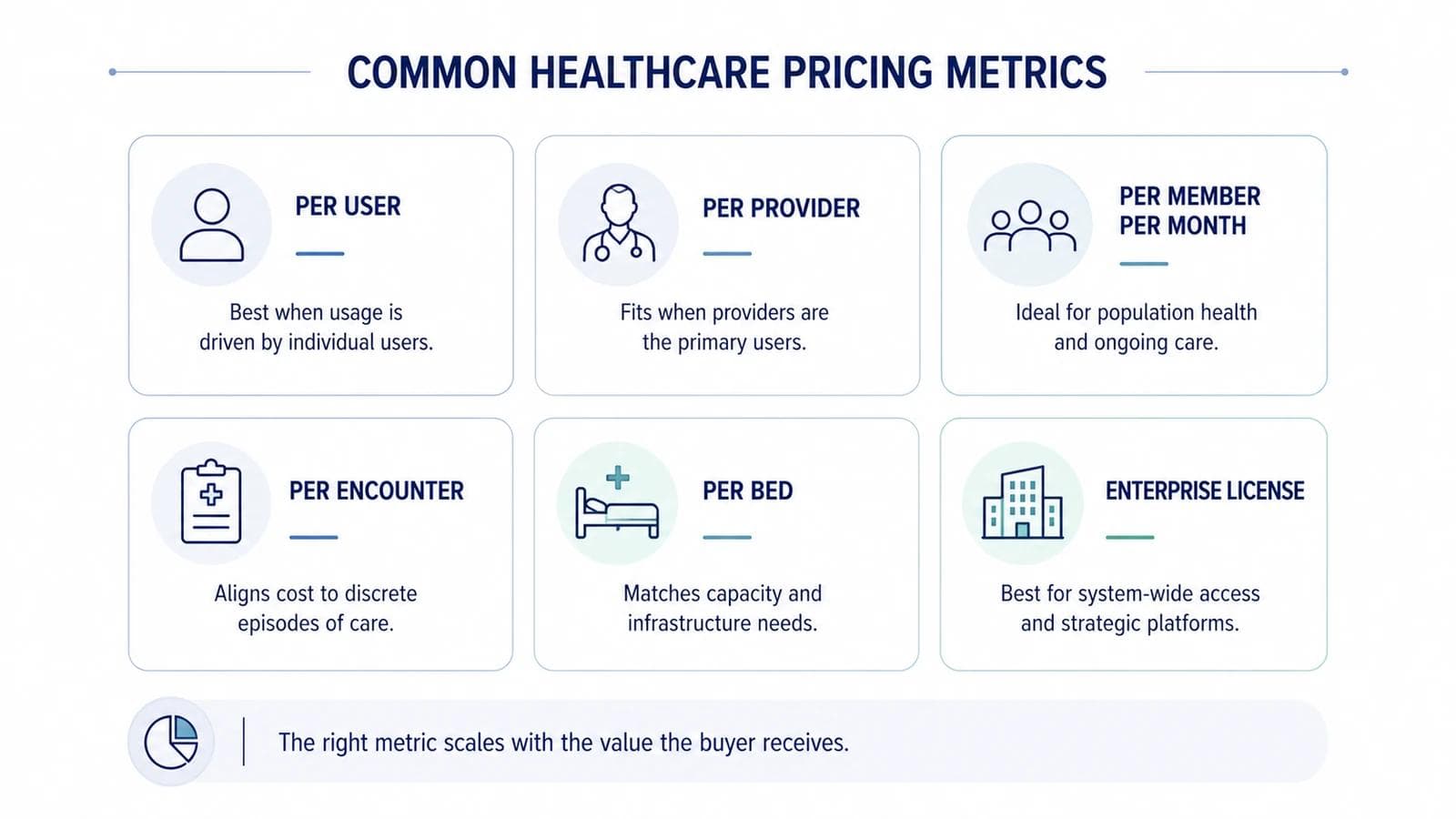
Common healthcare pricing metrics include:
- Per user or per seat. Simple and familiar, common for software used by a defined set of staff.
- Per provider. Useful when value scales with the number of clinicians using or prescribing.
- Per member per month. Standard in payer contexts, where value scales with the covered population.
- Per encounter or per procedure. Aligns price with usage, common where each use creates discrete value.
- Per bed or per facility. Used for some hospital products where the site is the natural unit.
- Enterprise or platform license. A flat fee for broad access, often used at scale to simplify buying.
Choose the metric that tracks the value your buyer gets, that the buyer finds intuitive, and that you can measure cleanly. A mismatch here is expensive. If your value scales with patient volume but you charge a flat fee, you leave money on the table with your largest customers. If you charge per encounter for something that delivers value through broad access, you make yourself hard to adopt.
Value-Based Pricing in Healthcare
The strongest healthcare pricing is anchored to the value you create, not to your costs or to a competitor's number. If your product saves a health system a meaningful amount per avoided complication, or earns a payer a better quality rating, that value is the real basis for your price.
Value based pricing requires two things. First, you need to understand and articulate the value in the buyer's terms, whether that is cost avoided, revenue enabled, or a rated measure improved. Second, you need credible evidence, because healthcare buyers do not accept value claims on faith.
Some companies go further and tie price directly to outcomes through performance guarantees or risk sharing. These structures can be powerful, especially with sophisticated payer and health system buyers, but they demand real proof and careful contracting. Do not promise outcomes you cannot measure. A defensible value story with honest evidence closes more deals than an aggressive guarantee you cannot stand behind. This connects closely to how you convert pilots, covered in our guide on moving from pilot to contract.
Packaging and Tiers
Packaging is how you group features and capabilities into offers. Done well, it lets different buyers find a fit, creates a natural path to expansion, and simplifies the buying decision. Done poorly, it confuses buyers and stalls deals.
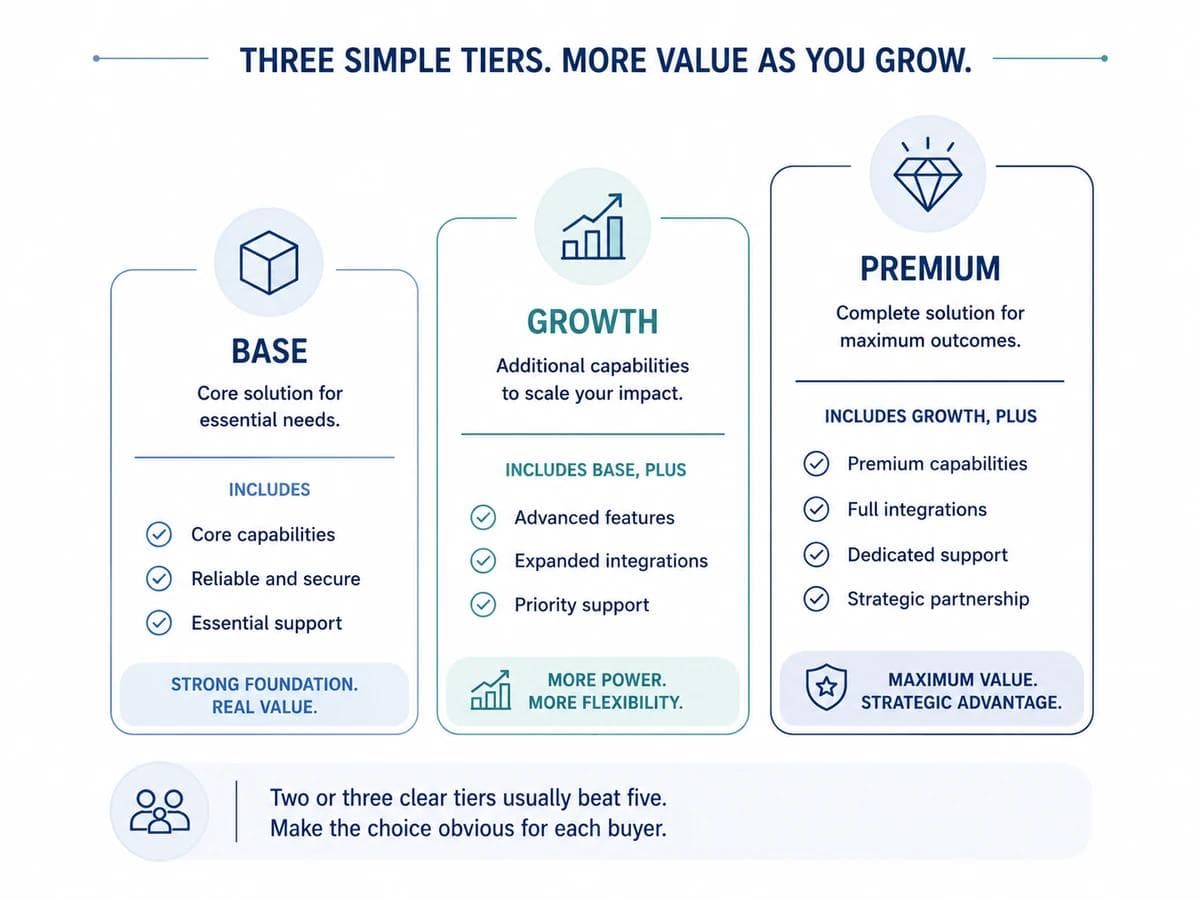
A common and effective approach is a small number of tiers, often a base, a middle, and a premium option. The base tier should deliver real value and be easy to say yes to. Higher tiers add capabilities that matter to larger or more sophisticated buyers. The goal is to make the choice obvious for each buyer segment, not to offer every possible combination.
A few principles keep packaging clean:
- Keep it simple. Two or three tiers usually beat five. Complexity slows decisions.
- Put real value in the base. A hollow base tier that forces an upgrade to be useful feels like a trap.
- Reserve high value features for higher tiers, so there is a genuine reason to move up.
- Make expansion natural. The path from base to premium should follow how a customer grows with you.
Good packaging supports the whole commercial motion. It gives reps a clear story, gives buyers an easy entry point, and gives you room to grow the account. The way a platform is packaged and positioned can be the difference between competing on price and competing on value, a dynamic explored in our healthcare SaaS go-to-market strategy guide.
Mid-article CTA
Need help building your healthcare growth engine?
Medix helps healthcare startups, clinics, pharma companies, and provider-focused platforms build scalable commercial pipelines.
Book a Strategy CallAlign Price to How Healthcare Buyers Budget
A price the buyer cannot fit into a budget will not get approved no matter how fair it is. Healthcare buyers operate inside rigid budget structures, and aligning to them removes a hidden source of lost deals.
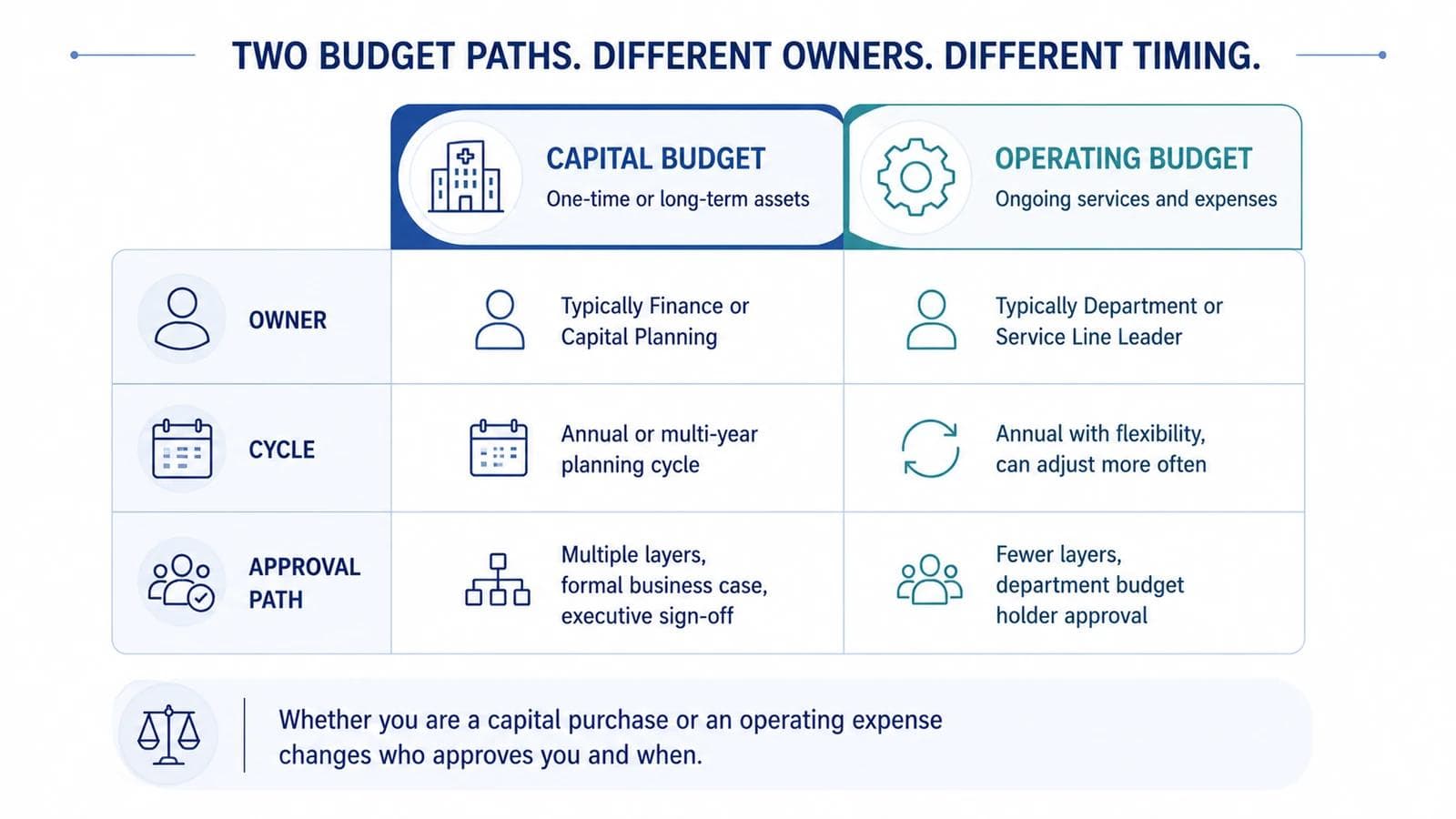
The central distinction is capital versus operating budgets. Capital budgets fund larger, longer lived purchases and often run on annual cycles with heavy approval. Operating budgets fund ongoing costs and can move faster but face scrutiny on recurring spend. Whether you present your product as a capital purchase or an operating expense changes who approves it and when.
This is where device and software economics diverge. A device sold as a one time purchase may land in a capital budget and compete against other capital projects. Software sold as a subscription typically lands in an operating budget with a different approval path. For device companies, this budget reality is part of the broader launch strategy covered in our medical device go-to-market strategy guide.
Ask which budget your buyer will use, who controls it, and what its cycle looks like. Then shape your pricing and packaging to fit that reality rather than forcing the buyer to fight their own budget rules on your behalf.
Pilot and Land-and-Expand Pricing
Many healthcare deals start with a pilot, and pilot pricing is a trap for the unprepared. Price a pilot too low or give it away, and you anchor the buyer to a number far below your real value, making expansion negotiations painful. Price it as a disconnected one off, and you lose the path to a larger contract.
Handle pilots as the first step of a larger relationship. Charge enough that the buyer has real commitment and does not treat the pilot as a free trial. Define success criteria up front, and discuss the expansion terms and pricing before the pilot begins, so a successful pilot flows into a contract instead of restarting the negotiation. A pilot without a pre agreed path to expansion tends to become a permanent discount.
Land-and-expand pricing works when your packaging and metric let a customer start small and grow. The initial deal should be easy to approve, and the natural growth of the account should increase what you earn, without a fresh procurement fight at every step.
Discounting, GPOs, and Negotiation
In healthcare, professional buyers will push your price down, and you should expect it. Discounting is not inherently bad, but undisciplined discounting destroys margin and trains buyers to always push harder.
A few disciplines protect your pricing:
- Discount for something, not for nothing. Trade price concessions for longer commitments, larger scope, references, or faster decisions.
- Understand contract pricing. Where hospitals buy through group purchasing organizations, negotiated rates set expectations, so build that reality into your pricing from the start. Our guide on how to sell to hospitals covers that procurement environment.
- Hold a credible floor. Know the price below which a deal is not worth doing, and be willing to walk.
- Keep pricing consistent. Wildly different pricing across similar customers creates problems when buyers compare notes, which in healthcare networks they do.
Pricing discipline also shows up in the pipeline. Deals that stall on price are often deals where value was never established, a pattern we cover in our guide to the healthcare sales pipeline. The fix is usually upstream, in how value was framed, not in a bigger discount.
Common Healthcare Pricing Mistakes
- Setting price by copying a competitor instead of anchoring to the value you create.
- Choosing a pricing metric that does not scale with the value the buyer receives.
- Confusing reimbursement with pricing, and either under or overpricing as a result.
- Building complicated packaging that slows the buying decision.
- Ignoring which budget the buyer will use and missing the approval path.
- Giving away pilots and anchoring buyers below your real value.
- Discounting reactively under procurement pressure without trading for anything in return.
Frequently Asked Questions
How should a healthcare startup set its initial price?
Anchor to the value you create for the buyer, expressed in their terms, rather than to your costs or a competitor's number. Understand how reimbursement and budgets shape what the buyer can pay, choose a pricing metric that scales with value, and start with simple packaging you can refine as you learn.
What is the difference between pricing and reimbursement?
Pricing is what you charge your customer for your product. Reimbursement is how your customer or their patients get paid by insurers when care is delivered. Reimbursement shapes what a buyer can afford and is essential to understand, but it is a separate discipline from setting your price.
What pricing model works best for healthcare SaaS?
It depends on where your value comes from. Per user pricing suits tools used by defined staff, per provider suits value that scales with clinicians, and per member per month suits payer contexts. Choose the metric that tracks the value the buyer receives and that they find intuitive.
How do you price a pilot without undervaluing the product?
Charge enough that the buyer has real commitment rather than treating the pilot as a free trial, define success criteria up front, and agree on expansion pricing before the pilot starts. That keeps the pilot from anchoring the buyer below your real value and creates a clean path to a full contract.
How should I respond when a payer or hospital pushes for a discount?
Expect it, and discount only in exchange for value such as longer commitment, larger scope, or references. Understand any group purchasing organization rates that set expectations, hold a credible floor, and keep pricing consistent across similar customers. Deals that stall purely on price often had a value problem upstream.
Price Like It Is Part of the Product
Pricing deserves the same rigor as the product itself, because it determines how much of the value you create you actually capture. In healthcare, where buyers scrutinize cost, reimbursement intermediates value, and budgets dictate what can be approved, careless pricing is a slow leak on growth.
The companies that price well do a few things consistently. They anchor price to value, not to a competitor. They choose a metric that scales with what the buyer gets. They package simply and leave room to expand. They fit the buyer's budget reality instead of fighting it. And they hold their pricing through pilots and procurement by trading concessions for commitment rather than giving them away.
Treat pricing as a strategy rather than a number, and it stops being the thing that caps your growth and becomes one of the levers that drives it.
Pressure Test Your Pricing With Medix
Healthcare pricing rewards teams that understand how their buyers value and budget, and that can hold a price through professional procurement. That commercial judgment is part of Medix Outreach's commercial growth and go-to-market work.
Our pharmacist-led team helps healthcare companies align pricing and packaging with how buyers actually decide, from metric selection to negotiation. If pricing is capping your growth, book a strategy call and we will pressure test your pricing and packaging together.