
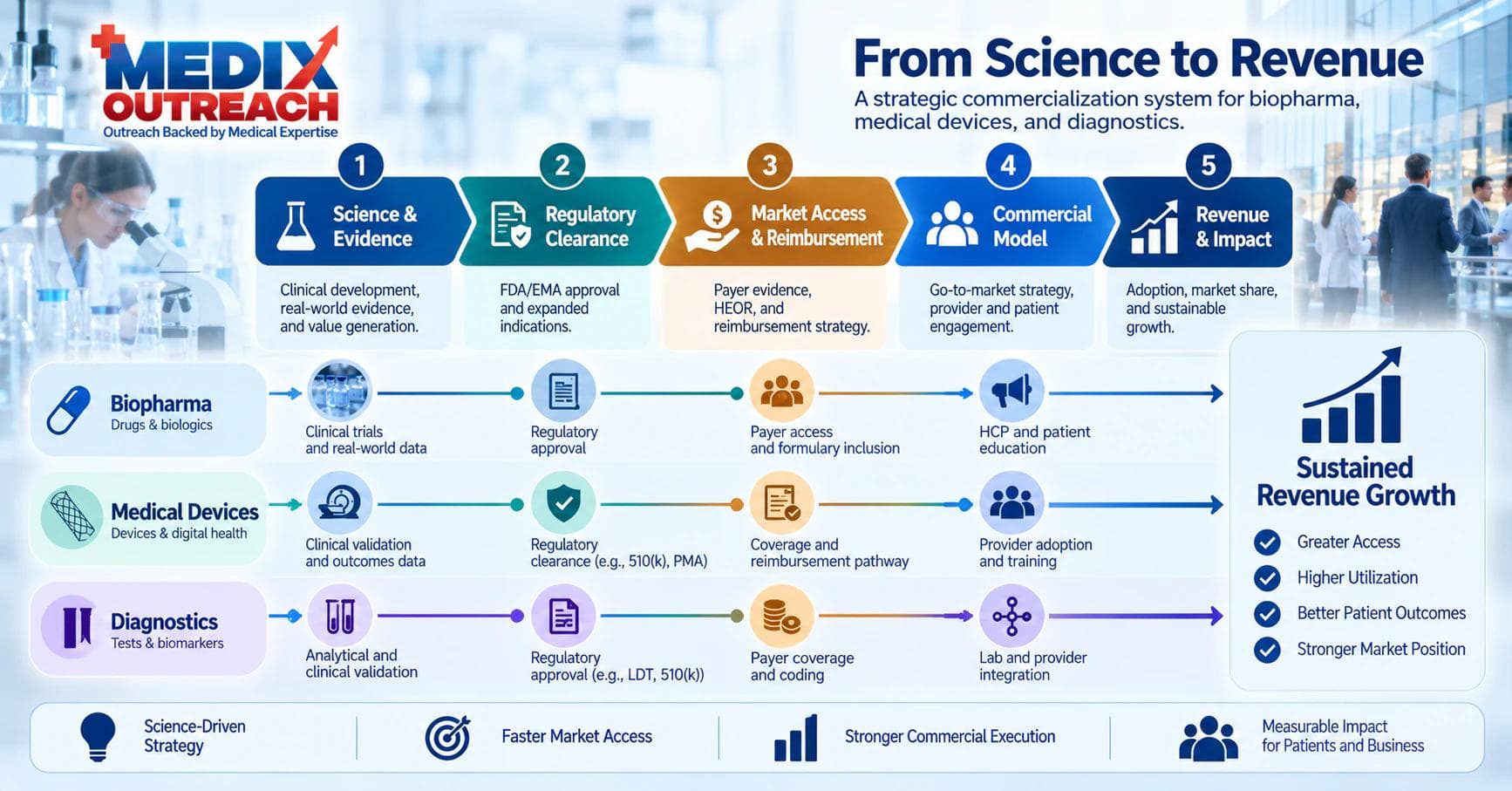
Life sciences companies spend years and fortunes proving that something works, and then discover that proving it works is not the same as getting it used, paid for, and sold. A drug, device, or diagnostic can clear the regulatory bar and still fail commercially — because no payer covers it, no clinician changes behavior for it, or no commercial model exists to sell it. Commercialization is the discipline of closing that gap, and in life sciences it is uniquely hard because the product is regulated, the buyers are clinical and institutional, and the money flows through reimbursement, not a checkout.
This guide lays out how biotech, pharma, medical device, and diagnostics companies turn validated science into a commercial business, and where emerging companies most often get it wrong. (For the broader, cross-industry view, see the Medix pillar on healthcare commercialization; this article is the life-sciences-specific lens.)
What "commercialization" actually means in life sciences
Commercialization is not marketing, and it is not a launch event. It is the end-to-end system that takes a regulated product from approval to sustained revenue. In life sciences it spans several interlocking workstreams:
- Regulatory clearance as the gate. Nothing commercial happens before the product is cleared or approved. The pathway differs sharply by modality — drugs through FDA approval, most devices through pathways like 510(k) or PMA (see FDA Device Advice), diagnostics through their own routes — and the pathway shapes the commercial timeline.
- Market access and reimbursement. For most life sciences products, there is no business without coverage and payment. Coding, coverage, and payment strategy often determine success more than the product itself — the subject of the Medix guide to market access and reimbursement strategy.
- Evidence beyond the regulatory minimum. Clinical and economic evidence that convinces payers and clinicians, not just regulators.
- The commercial model. How the product is sold, to whom, and by whom — direct sales, partnerships, or distribution.
Commercialization fails when a company treats these as sequential afterthoughts instead of a parallel system planned early.
Commercial readiness starts before approval
The most expensive mistake in life sciences commercialization is waiting until approval to think about it. By then, the evidence that payers need may not exist, the market may not be primed, and the commercial infrastructure is not built. Commercial readiness is a pre-approval discipline:
- Design evidence for the buyers, not just the regulator. Payers and clinicians ask different questions than the FDA. Build economic and comparative evidence into trials and real-world data plans early.
- Map the access pathway early. Understand coverage, coding, and payment well before launch, because these can take longer to secure than the clearance itself.
- Prime the market. Build clinical credibility and key-opinion-leader relationships ahead of launch, the approach in the Medix KOL and medical advisory board strategy.
- Decide the commercial model deliberately — which leads to the next section.
Build, buy, or partner the commercial function
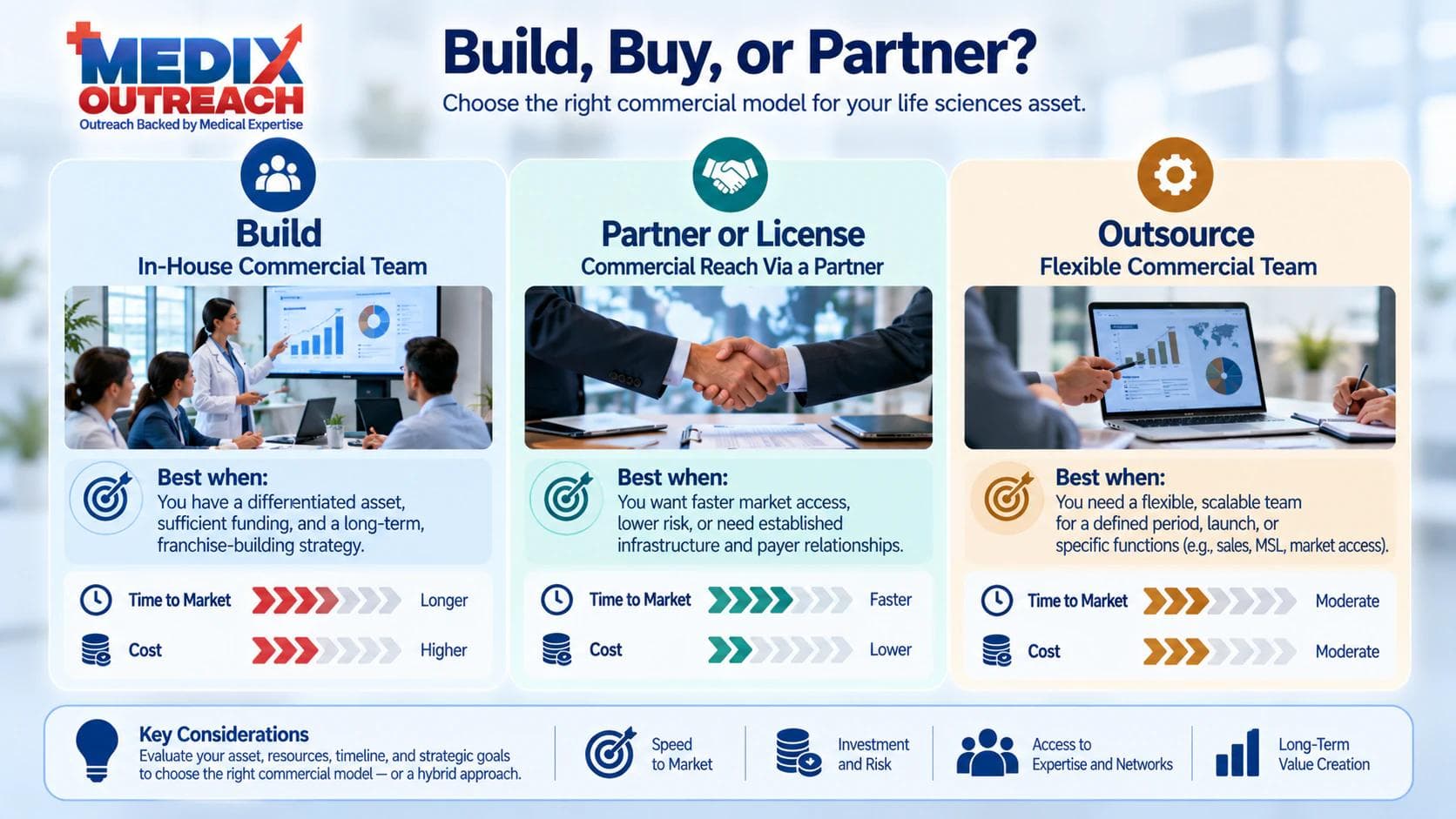
Emerging life sciences companies rarely have a full commercial organization, and building one prematurely burns capital. The strategic question is how to access commercial capability at the right scale and stage:
- Build an in-house commercial team when the product and market justify a permanent, scaled organization — expensive and slow, but fully owned.
- Partner or license with a company that already has commercial reach in the target market — faster access, shared economics, the model Medix supports through pharma business development and partnership and licensing strategy.
- Outsource the commercial function — a flexible way to launch without fixed headcount, covered in the Medix guide to outsourced healthcare commercial teams.
For most emerging biotech, device, and diagnostics companies, a staged approach — outsource or partner first, build later where it earns its cost — preserves capital and speeds time to revenue.
Mid-article CTA
Need help building your healthcare growth engine?
Medix helps healthcare startups, clinics, pharma companies, and provider-focused platforms build scalable commercial pipelines.
Book a Strategy CallCommercialization differs by modality
"Life sciences" spans very different commercial realities, and strategy has to reflect the modality:
- Biopharma — regulated promotion (see the FDA Office of Prescription Drug Promotion), payer-driven access, and KOL-led adoption.
- Medical devices — hospital buying committees, clinical adoption, and workflow integration.
- Diagnostics — coverage and coding are often the make-or-break factor; see diagnostics commercialization strategy.
A one-size commercialization plan fails because the buyer, the money, and the evidence requirements are different across these.
Measure commercial readiness and traction
- Access milestones — coverage, coding, and payment secured in target segments.
- Adoption — accounts, prescribers, or sites using the product, and depth of use.
- Commercial efficiency — cost to acquire and serve relative to revenue.
- Evidence coverage — whether the data answers payer and clinician questions, not just regulatory ones.
Frequently asked questions
What is life sciences commercialization? The end-to-end process of turning a regulated biotech, pharma, device, or diagnostic product into sustained revenue — spanning regulatory clearance, market access and reimbursement, evidence generation, and the commercial model for selling to clinical and institutional buyers.
When should a life sciences company start commercialization planning? Before approval. Payer evidence, access pathways, market priming, and the commercial model all take time to build, and waiting until clearance is the most common and expensive commercialization mistake.
Should an emerging biotech build its own commercial team? Usually not first. Partnering, licensing, or outsourcing the commercial function preserves capital and speeds time to revenue; building in-house makes sense once the product and market justify a permanent, scaled organization.
Why do life sciences products fail commercially after approval? Most commonly because of access and adoption, not the science: no reimbursement, evidence that does not convince payers and clinicians, or no commercial model to reach the buyers. Commercialization closes that gap.
From validated science to a commercial business
Life sciences commercialization is the discipline of making great science into a business that reaches patients and generates revenue. It is planned before approval, built around access and evidence as much as the product, and executed through a commercial model matched to the modality and the company's stage. The companies that treat it as a system — not a launch — turn clearance into commercial success.
Medix Outreach helps life sciences companies build commercial readiness and the partnerships, teams, and go-to-market to turn science into revenue. To plan your commercialization, book a free strategy call or explore our Healthcare Commercial Growth & Go-to-Market service.