

An outsourced healthcare commercial team is a single external group that runs your commercial function - commercial strategy, business development, provider outreach, sales, and partnerships - instead of you hiring each of those roles in-house. For most healthcare companies with a working product but a thin commercial bench, the build-versus-buy decision comes down to three things: how fast you need commercial motion, how much risk a wrong senior hire would create, and whether you can access healthcare-specific selling expertise quickly. As a rule, buy when you need a working commercial motion now and cannot absorb a bad first hire, and build when the motion is proven, repeatable, and central enough to own permanently.
What an outsourced healthcare commercial team actually is
An outsourced healthcare commercial team is the commercial function delivered as a service. Rather than recruiting a head of sales, a business development lead, a couple of reps, and a partnerships manager one hire at a time, you engage one team that already holds those capabilities and runs them together. The operative word is function. You are not buying a task; you are buying the whole arc from strategy to signed contract.
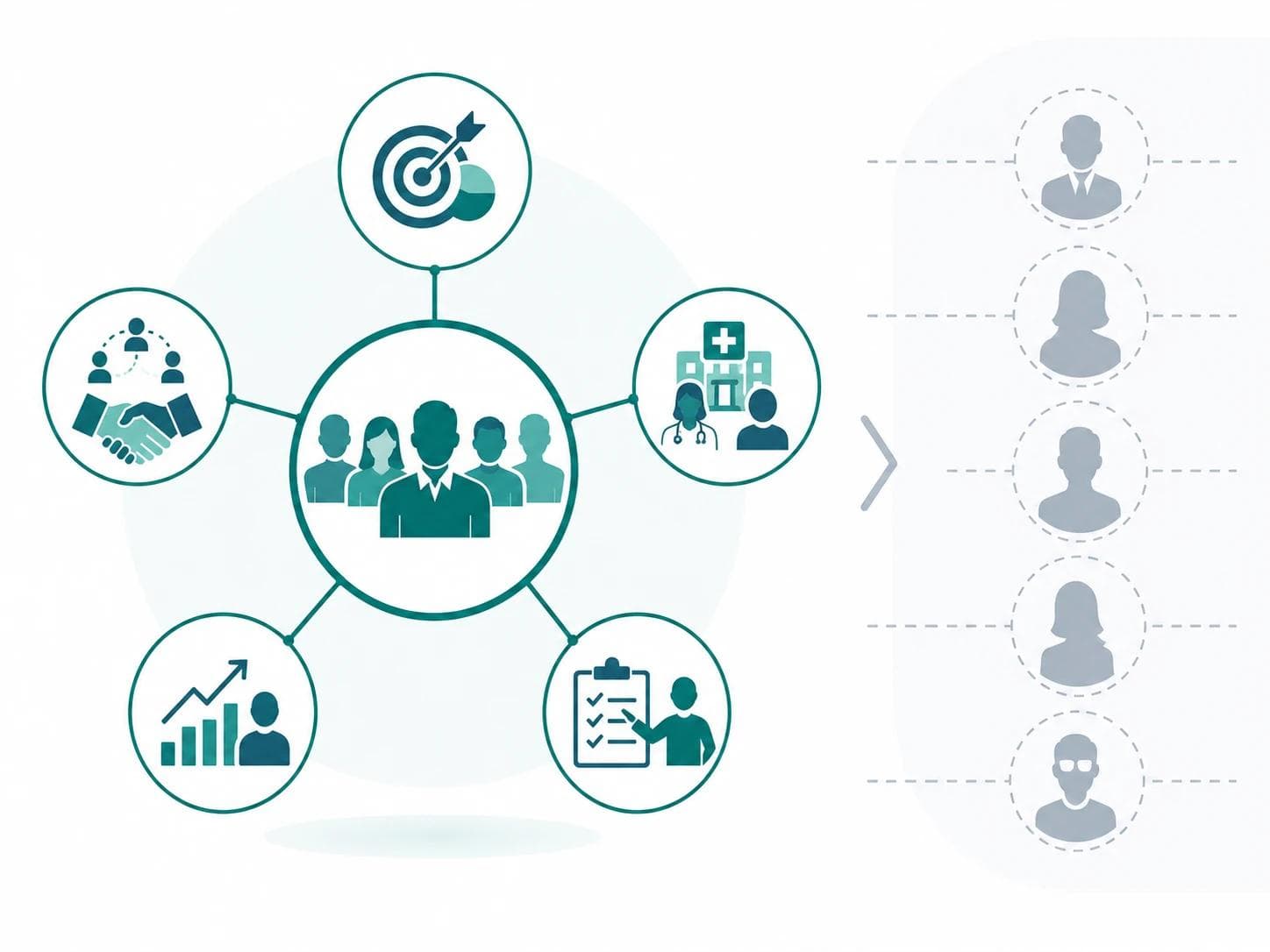
In practice, a full commercial function bundles capabilities that healthcare companies usually try to hire separately:
- Commercial strategy and go-to-market: who you sell to, in what order, with what offer and pricing logic
- Business development and partnerships: sourcing, structuring, and closing relationships that move revenue
- Provider outreach and referral development: reaching physicians, clinics, pharmacies, and health systems in a way clinical buyers respect
- Sales execution and pipeline management: qualifying, running the deal, and moving it to close
- Sales enablement and messaging: the positioning, materials, and process the whole motion runs on
This is deliberately broader than a single outsourced service. An outsourced SDR or appointment-setting engagement does one job well: it fills the top of the funnel with qualified meetings. That is valuable, but it is one function. An outsourced commercial team owns strategy, the meetings, the deal, the partnership, and the handoff to delivery. If you only need booked meetings, hire the narrower service. If you need someone accountable for revenue motion end to end, that is the commercial function, and it is a different purchase.
A healthcare commercial function also differs from a generic sales team in what it has to know. Clinical buyers, procurement committees, reimbursement realities, and compliance constraints shape every conversation. A team that understands how physician referrals actually form, or how a health system evaluates a vendor, sells differently than one running a horizontal SaaS playbook. That domain requirement is what makes the build decision harder than founders expect.
Why building an in-house healthcare commercial team is harder than it looks
Building in-house is the default assumption for many founders, and on paper it looks clean: hire great people, own the function, keep the knowledge. The problem is that each part of that plan is slower, more expensive, and riskier in healthcare than in most markets.
Start with hiring. Salespeople who can genuinely operate in healthcare are scarce, because the job requires both commercial ability and clinical or regulatory fluency, and those two skill sets rarely sit in the same person. We wrote a whole piece on why it is so hard for startups to find salespeople with healthcare backgrounds, and the short version is that the best candidates are employed, expensive, and evaluating you as much as you are evaluating them. A founder without a commercial track record is not an easy sell to a strong senior operator.
Then there is ramp time. Even a strong hire does not produce pipeline on day one. They have to learn the product, the buyer, the objections, and the compliance guardrails, then build a pipeline that takes months to mature because healthcare sales cycles are long by nature. Between search, notice periods, onboarding, and pipeline maturation, the realistic distance from decision to first closed revenue through a fresh in-house hire is often two to four quarters.
The sharpest risk is concentration. When you build early, you usually cannot afford a full team, so you make one senior hire and bet the commercial function on that individual. If they are wrong for the role, and first commercial hires frequently are, you lose the salary, the ramp time, the pipeline they did not build, and the market cycles you cannot get back. That is single-hire risk, and it is the single most expensive mistake early healthcare companies make on the commercial side. There is also a coaching gap: a first commercial hire needs a manager who has run the motion before, and most founders have not, so the person is left to invent the playbook alone. The power of a team that already operates as a unit, with clinical credibility built in, is that none of that has to be discovered from scratch.
None of this means building is wrong. It means building has a real cost, a real timeline, and a real failure mode, and those need to sit honestly on one side of the scale when you compare it to buying.
Build vs. buy: a framework for your commercial function
The build-versus-buy decision is not about which option is better in the abstract. It is about which option fits your stage, your risk tolerance, and how proven your commercial motion is right now. Run your situation through a short set of criteria before you decide.
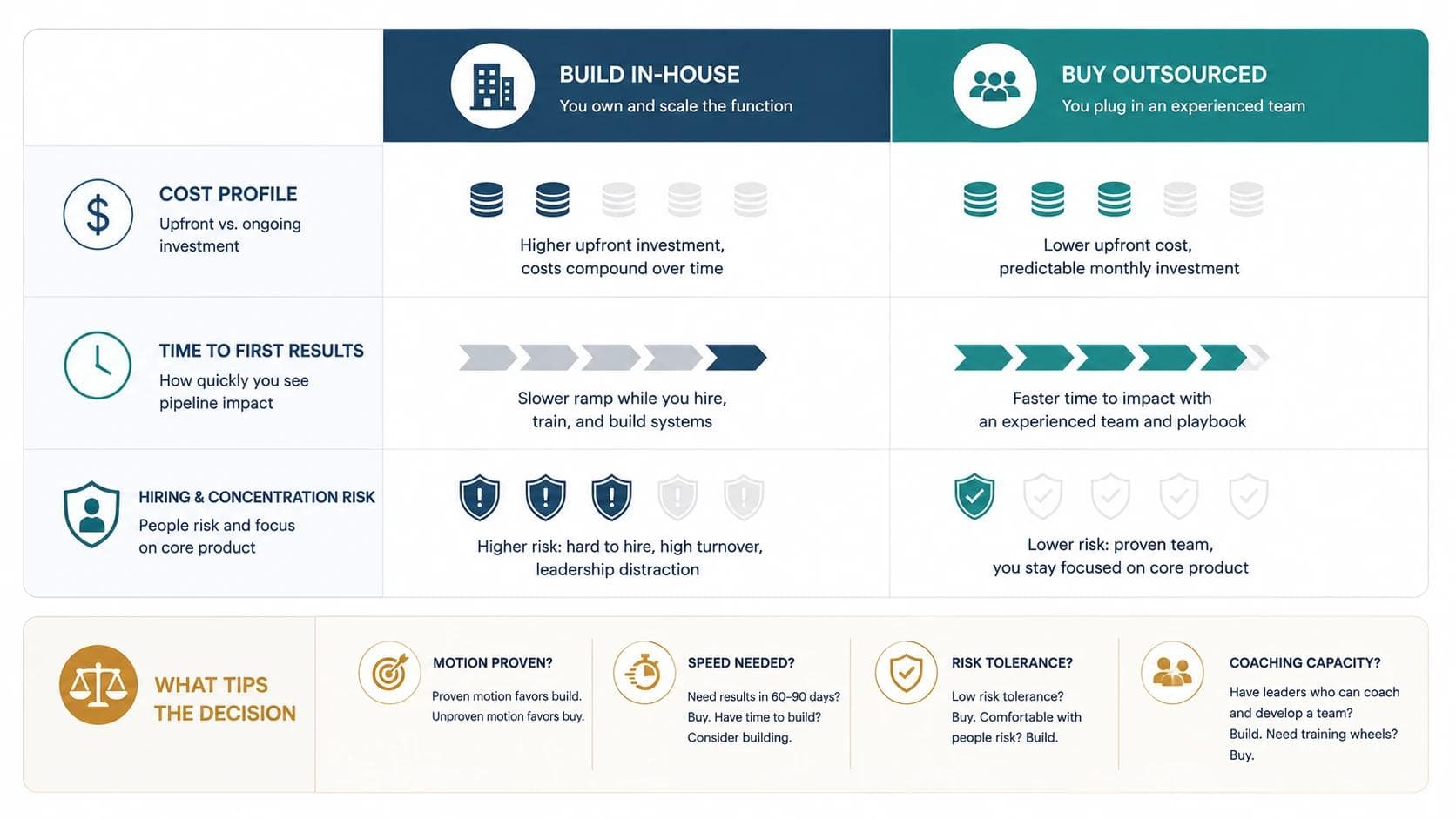
Ask these six questions:
- Is the motion proven or still being discovered? If you already know who buys, why, and how the deal closes, building to own a known motion makes sense. If the motion is still unknown, buying a team that can find it is far cheaper than paying an in-house hire to guess.
- How fast do you need commercial results? A team that already exists starts producing in weeks. A hire starts producing in quarters. If a board commitment, a runway clock, or a market window is driving you, speed favors buy.
- Can you absorb a wrong senior hire? If one bad hire would cost you two quarters and a meaningful slice of runway, that concentration risk favors buy. If you can carry the risk, building is more defensible.
- Is commercial the core of your business at this stage, or a supporting capability? A permanent, central, differentiating motion is worth owning. An early motion you are still validating is worth renting.
- Do you have someone in-house who can manage and coach commercial talent? If not, a hire will underperform regardless of quality, and an outsourced team that manages itself removes that gap.
- What is your runway and burn tolerance? Building carries fixed salary cost whether or not pipeline appears. Buying is typically a defined engagement you can scale or exit.
The pattern that emerges from those answers is usually clear. Build when the motion is proven and repeatable, commercial is core to own permanently, you can manage the talent, and you can carry the cost and the hiring risk. Buy when the motion is still being found, you need results this quarter, a wrong hire would hurt, or you have no one to coach a first commercial hire. Most companies are not permanently in one camp; they buy to find and prove the motion, then build to own it once it is repeatable. That is why the engagement models below matter as much as the decision itself.
The four engagement models, and when each one fits
Buy is not a single option. There is a spectrum of outsourced commercial models, and choosing the right point on that spectrum matters as much as the build-versus-buy call. The four common models differ in how much of the function you hand over and how permanent the arrangement is meant to be.
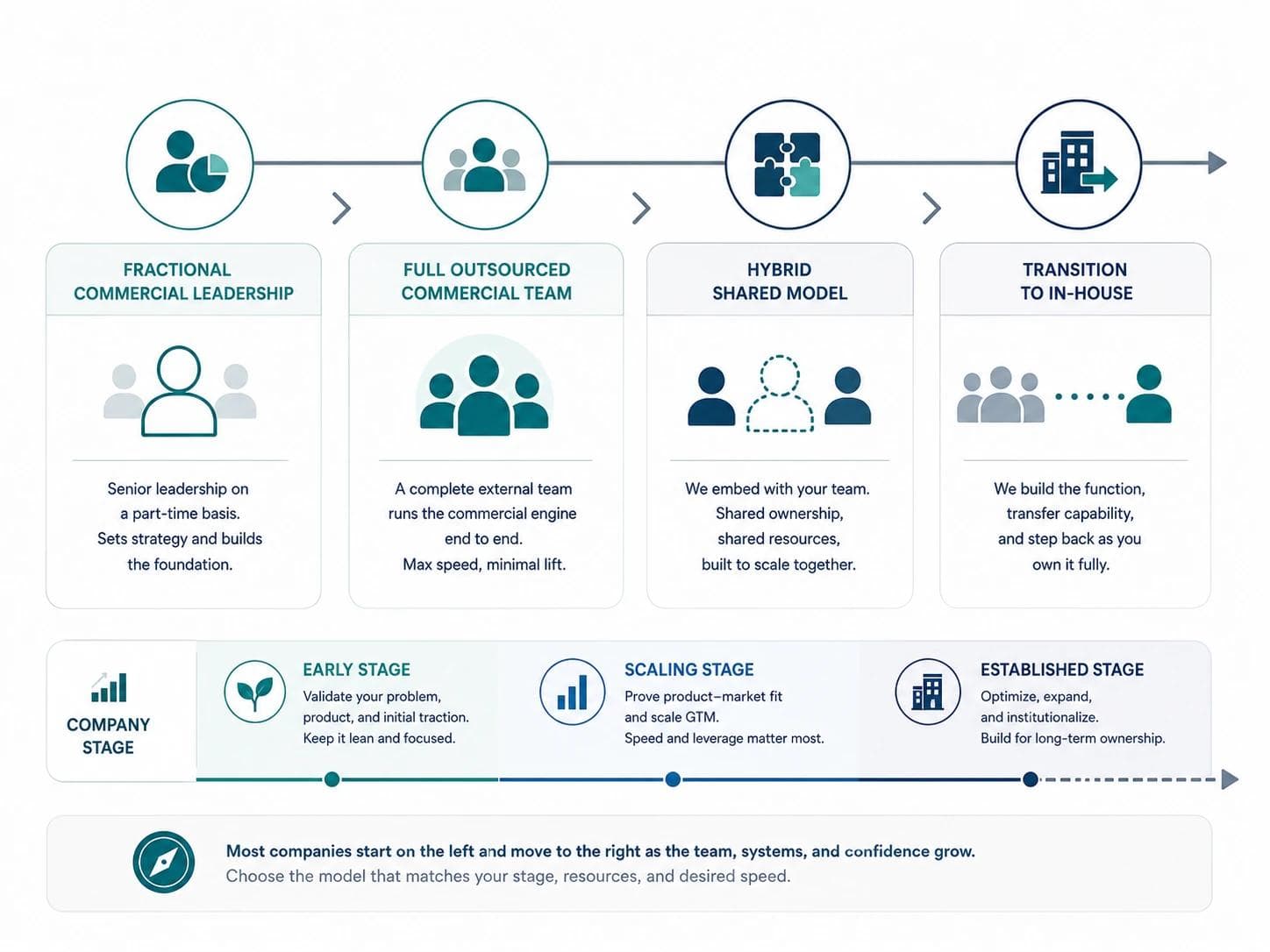
Fractional commercial leadership. A senior commercial operator works with you part-time to set strategy, define the buyer and the offer, and stand up the motion, without the cost of a full-time executive. This fits founders who have some commercial activity but no senior direction, and who mainly need someone who has built the motion before to architect it and steer it.
Full outsourced commercial team. The entire function - strategy, business development, provider outreach, and sales - is delivered by one external team accountable for the whole arc. This fits companies with a product and little or no commercial staff that need a working revenue motion without spending a year assembling it. It is the most complete version of buy, and closest to how a healthcare commercial growth and go-to-market engagement is structured.
Hybrid. An external team runs the function alongside one or two of your own hires, often carrying the parts that are hardest to staff (senior strategy, provider outreach, partnerships) while your people cover what you can hire for. This fits companies mid-build that have some in-house capacity but a gap they cannot fill fast enough.
Transition-to-in-house. You engage an outsourced team now with an explicit plan to hand the function back to your own hires later. The external team runs the motion, documents it, and helps you recruit and onboard the permanent team it will hand off to. This fits companies that know they want to own commercial eventually but cannot afford the ramp risk today.
Stage tends to point to a model. Pre-revenue and early-stage companies usually benefit from fractional leadership or a full outsourced team, because the motion is unproven and single-hire risk is highest. Companies scaling a motion that already works often fit hybrid, adding external capacity to in-house hires. Established companies with a proven, central motion usually build and own it, engaging outside help only for a specific expansion, a new segment, or a new-market entry where they lack local knowledge. The models are not a ladder you must climb in order; they are options you match to where the motion actually is.
Mid-article CTA
Need help building your healthcare growth engine?
Medix helps healthcare startups, clinics, pharma companies, and provider-focused platforms build scalable commercial pipelines.
Book a Strategy CallHow to structure and de-risk the engagement
Buying the commercial function only works if the engagement is structured well. A vague retainer against vague activity is how outsourced commercial arrangements go wrong. A well-built engagement looks more like a joint venture on your revenue than a service you switched on. Choosing the right partner is its own evaluation, and it deserves the same rigor you would apply to a senior hire, but once you have chosen, structure protects both sides.
Build these terms in from the start:
- Scope tied to outcomes, not hours. Define the motion the team is accountable for - segments, targets, pipeline stages, the kinds of deals or partnerships in scope - rather than a loose promise of activity.
- Phased milestones and gates. Structure the engagement in phases with checkpoints (for example, strategy and messaging first, then pipeline build, then closing motion), so both sides can course-correct or stop at a known point.
- Your data, CRM, and IP stay yours. Contacts, pipeline, messaging, and account knowledge live in systems you own from day one. This is non-negotiable, and it is what makes a future hand-back possible.
- A named senior owner. You should know exactly who is accountable for the motion, not a rotating pool. The whole point of buying the function is having one throat to choke.
- Compliance built in. In healthcare, outreach and marketing carry HIPAA and compliance obligations that a serious commercial partner handles by default, not as an afterthought.
- Clear exit and hand-back terms. Define upfront how the engagement ends and how the function transfers, so you are never locked in by knowledge that only the external team holds.
The enablement layer - positioning, materials, playbooks, and process - should be treated as a shared asset that accumulates in your systems throughout the engagement, not something the vendor keeps. If the team builds the motion but the knowledge walks out the door when they do, you have rented results without buying capability. Structured well, the opposite happens: every month of the engagement leaves you with more owned, documented, transferable commercial machinery.
How the hand-back to in-house works
The best outsourced commercial engagements are built to end, at least in their full form. If you plan to own commercial eventually, the hand-back is not an afterthought; it is designed from the first phase. Done properly, it is a transfer of a working, documented motion to a team the outsourced group helped you hire, not a cliff you fall off when a contract ends.
A clean hand-back usually runs in stages. First, the motion gets documented while it is being run: the buyer definitions, messaging, playbooks, objection handling, pipeline stages, and partnership templates all live in your systems as they are built. Second, hiring happens with the outsourced team's help, because the people who built the motion know exactly what profile can run it, which reduces the single-hire risk that made building alone so dangerous in the first place. Third, there is an overlap period where new in-house hires run the motion with the outsourced team beside them, inheriting live relationships and warm pipeline rather than starting cold. Finally, the external team steps back to an advisory role or exits entirely, and you own a function that is already producing.
Two case examples show how the motion and its knowledge can compound into something transferable. In a local provider referral engine we built for a psychiatry practice, the work was to construct a repeatable referral-generation motion the practice could continue to run. In a nationwide B2B peptides pipeline for clinics and wellness providers, the outcome was a functioning outbound and pipeline motion built from strategy through execution. In both, the point was not just activity during the engagement, but a motion and a body of knowledge the client keeps. A hand-back is simply the deliberate transfer of that motion to your own team when you are ready to own it.
How Medix approaches the outsourced commercial function
Medix Outreach runs the commercial function as one pharmacist-led team rather than a stack of disconnected services. Strategy, business development, provider outreach, and sales sit together, which is what lets a single team be accountable for the arc from positioning to signed contract instead of handing you a lead list and wishing you luck. The clinical grounding matters here: in healthcare, credibility with providers and buyers is part of the sale, and a team that speaks the buyer's language earns meetings and trust that generic outreach does not.
The model flexes to your stage. That can look like fractional leadership to architect the motion, a full outsourced team to run it, a hybrid alongside your hires, or a transition-to-in-house engagement built to hand back a working function. You can see how this fits into the broader picture in our healthcare business development strategy guide, read more about the team and how it operates, or look at the commercial growth and go-to-market service directly. The common thread across all of it is ownership: whatever we build, it accumulates in your systems as capability you keep.
The bottom line
Build-versus-buy for the commercial function is a staging decision, not a permanent identity. Build when the motion is proven, repeatable, and central enough to own, and when you can carry both the cost and the risk of getting the hire right. Buy when the motion is still being found, when you need results this quarter, or when a single wrong senior hire would cost you more than you can afford to lose. Many healthcare companies do both in sequence: they buy the function to find and prove the motion, then build to own it once it works, using a structured hand-back to move between them without losing momentum. The mistake is rarely the direction you choose; it is treating a reversible staging decision as if it were permanent and paying the price of single-hire risk when a lower-risk path was available.
Medix Outreach can help you decide whether to build or buy, and run the commercial function as one team while you do. If you want a straight read on where your motion actually is and the model that fits it, we are happy to have that conversation without a pitch attached.
Frequently Asked Questions
What is an outsourced healthcare commercial team?
An outsourced healthcare commercial team is a single external group that runs your entire commercial function - commercial strategy, business development, provider outreach, sales, and partnerships - as one accountable unit, instead of you hiring each of those roles in-house. It is broader than a single outsourced service such as appointment setting or lead generation, because it owns the whole arc from strategy through to a signed contract rather than one task within it. Companies use the model when they have a working product but limited commercial staff and need a functioning revenue motion without spending a year assembling one hire at a time.
Is it cheaper to outsource or build an in-house healthcare commercial team?
It depends on how you count cost and risk, not just salary. Building in-house carries fixed compensation whether or not pipeline appears, plus recruiting cost, months of ramp before revenue, and the concentration risk that a single wrong senior hire can cost two quarters and a large slice of runway. An outsourced team is usually a defined engagement that starts producing in weeks and can be scaled or exited. For an early company still proving its motion, buying is often cheaper on a risk-adjusted basis; for an established company with a proven, central motion, owning it in-house is usually more efficient.
How is an outsourced commercial team different from hiring an outsourced SDR agency?
An outsourced SDR or appointment-setting agency handles one function at the top of the funnel: generating qualified meetings. An outsourced commercial team owns the full function, including strategy, provider outreach, running and closing the deal, and building partnerships. If your only gap is booked meetings and you already have people to work them, the narrower SDR service is the right, lower-cost choice. If you need someone accountable for the whole revenue motion from positioning to signed contract, that is the commercial function, and it is a different and broader engagement.
When should a healthcare startup bring the commercial function in-house?
Bring it in-house once the motion is proven and repeatable, commercial is central enough to own permanently, you have someone who can manage and coach commercial talent, and you can carry both the compensation cost and the hiring risk. A common, lower-risk path is to buy the function first to find and prove the motion, then transition it in-house through a structured hand-back, where the outsourced team documents the motion, helps you hire the people to run it, and overlaps with your new hires before stepping back. That sequence removes most of the single-hire risk that makes building from scratch so expensive.
How do you de-risk an outsourced commercial engagement?
Structure the engagement around outcomes and ownership rather than loose activity. Tie scope to the specific motion the team is accountable for, break the work into phases with checkpoints where either side can course-correct or stop, and keep your data, CRM, contacts, and messaging in systems you own from day one. Insist on a named senior owner, compliance handling built in by default, and clear exit and hand-back terms so you are never locked in by knowledge only the external team holds. Done this way, every month of the engagement leaves you with more owned, documented commercial capability, which is also what makes a future move in-house possible.