
Most pharma launch advice is written for companies that do not need it. The big-launch playbook assumes a thousand-person commercial organization, a nine-figure budget, and years of pre-launch runway. Emerging biotech and lean pharma teams — often launching their first product, sometimes their only one — need something different: a launch strategy that sequences the few things that actually determine success and refuses to spend on the rest.
This playbook is for those teams. It covers what to do, in what order, and how to access commercial capability without building a commercial giant you cannot afford.
Launch success is decided long before launch day
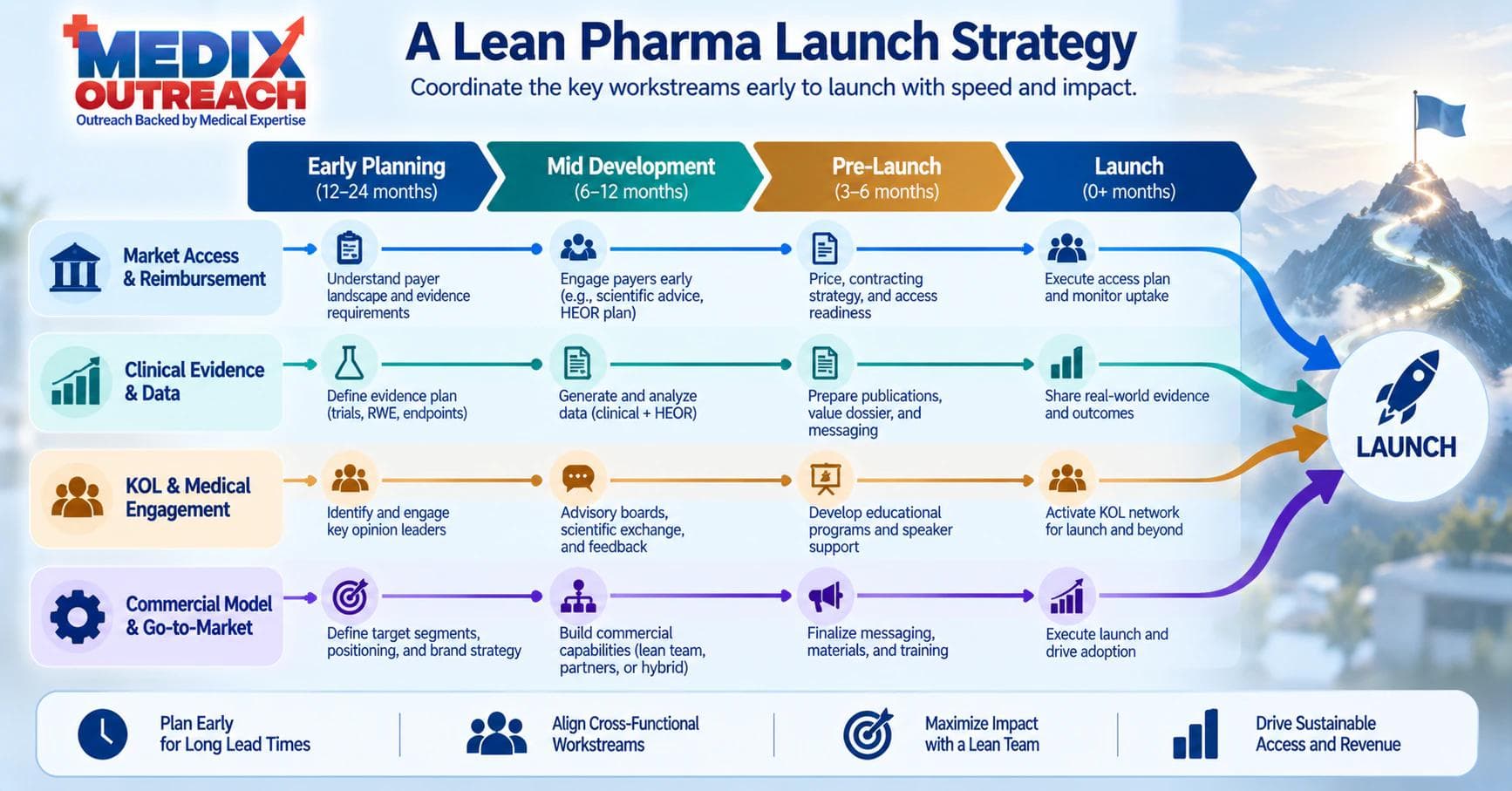
The single biggest misconception is that a launch is an event. It is the visible end of a long planning process, and the decisions that determine commercial success are made well before approval. For a lean team, the implication is clear: start the commercial workstreams early, in parallel with development, because the ones that matter most take the longest.
The common failure mode is a strong clinical program and a commercial plan that starts too late — the broader pattern catalogued in the Medix guide to healthcare go-to-market strategy mistakes.
The four workstreams that decide a launch
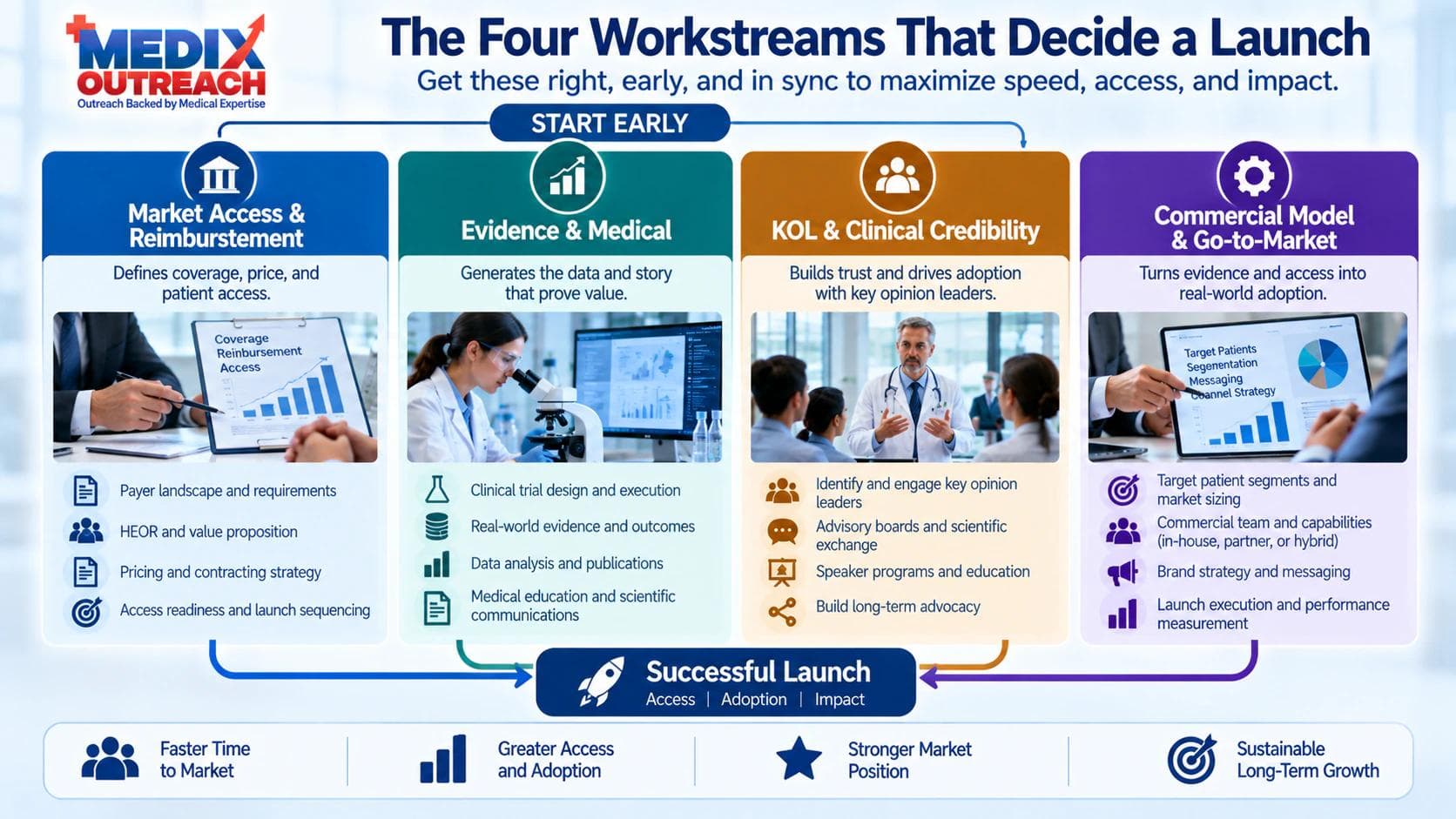
For an emerging pharma company, launch readiness comes down to four workstreams. Resource these first; treat almost everything else as optional.
1. Market access and reimbursement
For most drugs, there is no commercial launch without coverage and payment. Payer strategy, pricing, coding, and the evidence payers require are the foundation, and they take longer to secure than teams expect. Start here, not with branding. See the Medix guides to market access and reimbursement strategy and how to sell to payers.
2. Evidence and medical strategy
Beyond the data that won approval, launch needs evidence that convinces payers and prescribers — comparative effectiveness, real-world evidence, and health-economics. For a lean team, a focused evidence plan aimed at the two or three questions buyers will ask beats a sprawling one.
3. KOL and clinical credibility
Prescribers adopt what credible peers endorse. Building key-opinion-leader relationships and clinical credibility before launch primes the market and is high-leverage for a small team — the approach in the Medix KOL and medical advisory board strategy.
4. The commercial model
How you sell — and whether you build, partner, or outsource the commercial function — is the decision that most defines a lean launch. More on this below.
The lean launch decision: build, partner, or outsource
An emerging company cannot afford to be wrong about commercial infrastructure. Building a full sales and marketing organization for a first launch is slow and capital-intensive; getting it wrong can sink the company. The realistic options:
- Partner or out-license commercialization to a company with established reach in the target market — the fastest access to a commercial footprint, in exchange for shared economics. This is the core of pharma business development and finding the right licensing partner.
- Outsource the commercial function — field teams, access, and operations — to launch without permanent headcount, the model in the Medix guide to outsourced healthcare commercial teams.
- Build selectively — hire only the few in-house roles that must be owned (often medical and market access), and source the rest flexibly.
For most emerging pharma, a hybrid — own the strategic core, partner or outsource the scaled execution — delivers a credible launch without a big-pharma cost base.
Mid-article CTA
Need help building your healthcare growth engine?
Medix helps healthcare startups, clinics, pharma companies, and provider-focused platforms build scalable commercial pipelines.
Book a Strategy CallLaunch promotion within the rules
Pharma promotion is tightly regulated, and a lean team has less margin for a compliance misstep.
- Keep promotion consistent with the approved labeling. The FDA's Office of Prescription Drug Promotion oversees prescription drug promotion; off-label promotion is a serious risk.
- Understand the rules for drug advertising before building launch campaigns — see the FDA's basics of drug ads.
- Build a promotional review process early so launch materials move quickly without creating liability.
Sequence the launch like a lean team
Put the workstreams in the order their lead times demand:
- Early (well before approval): market access strategy, evidence/HEOR plan, and KOL development — the long-lead items.
- Mid: commercial model decision (build/partner/outsource) and payer engagement.
- Pre-launch: field and medical readiness, compliant launch materials, and distribution.
- Launch and beyond: disciplined execution, close measurement, and rapid iteration.
Measure launch readiness and traction
- Access secured — coverage and payment in priority segments.
- Evidence coverage — the payer and prescriber questions answered.
- Prescriber adoption and depth in target segments.
- Commercial efficiency — launch cost relative to uptake, the number a lean team lives or dies by.
Frequently asked questions
What is a pharma launch strategy? The plan to bring a new drug to market successfully — spanning market access and reimbursement, evidence and medical strategy, KOL and clinical credibility, the commercial model, and compliant promotion. Most of it is executed before launch day.
How is launch different for emerging vs. big pharma? Emerging and lean teams lack the budget and infrastructure of big pharma, so they must sequence ruthlessly — prioritizing access, evidence, and KOLs — and usually partner or outsource the scaled commercial execution rather than building a large organization.
When should pharma launch planning start? Well before approval. The highest-leverage workstreams — market access, evidence generation, and KOL development — have long lead times, so they must run in parallel with late-stage development.
Should an emerging pharma company build its own sales force to launch? Often not for a first launch. Partnering, out-licensing, or outsourcing commercial execution provides reach without the cost and risk of building a full organization; many lean teams own only the strategic core and source scaled execution flexibly.
Launching without a big-pharma budget
A successful emerging-pharma launch is not a smaller version of a big-pharma launch. It is a sharper one: start early, resource the four workstreams that decide success, choose a commercial model you can actually afford, and stay compliant. Lean teams that sequence the launch this way reach patients and generate revenue without betting the company on infrastructure they do not need.
Medix Outreach helps emerging and lean pharma teams plan launches and access commercial capability through partnerships, licensing, and outsourced commercial teams. To plan a launch your team can execute, book a free strategy call or explore our Strategic Partnerships, Licensing & Market Expansion service.