Most medical device marketing underperforms for the same reason: it is built to generate leads when the real job is to drive adoption. A device can have a 510(k) clearance, a strong sales team, and a full pipeline and still stall, because clinical buyers do not adopt on a demo and a datasheet. They adopt when the clinical evidence, the economics, the workflow fit, and the peer validation all line up — and marketing's job is to build all four, long before and long after the sales conversation.
This guide lays out a medical device marketing strategy for the whole adoption journey: how to position for clinical buyers, build demand, earn credibility, and do it inside the rules that govern device promotion. (For the full commercialization motion, see the Medix guide to medical device go-to-market strategy; for tactical pipeline, see medical device lead generation. This article is about the marketing engine that makes both work.)
Marketing to a clinical buyer is not marketing to a consumer
Device marketing fails when it borrows consumer or generic-B2B playbooks. The MedTech buyer is different in ways that reshape the whole strategy.
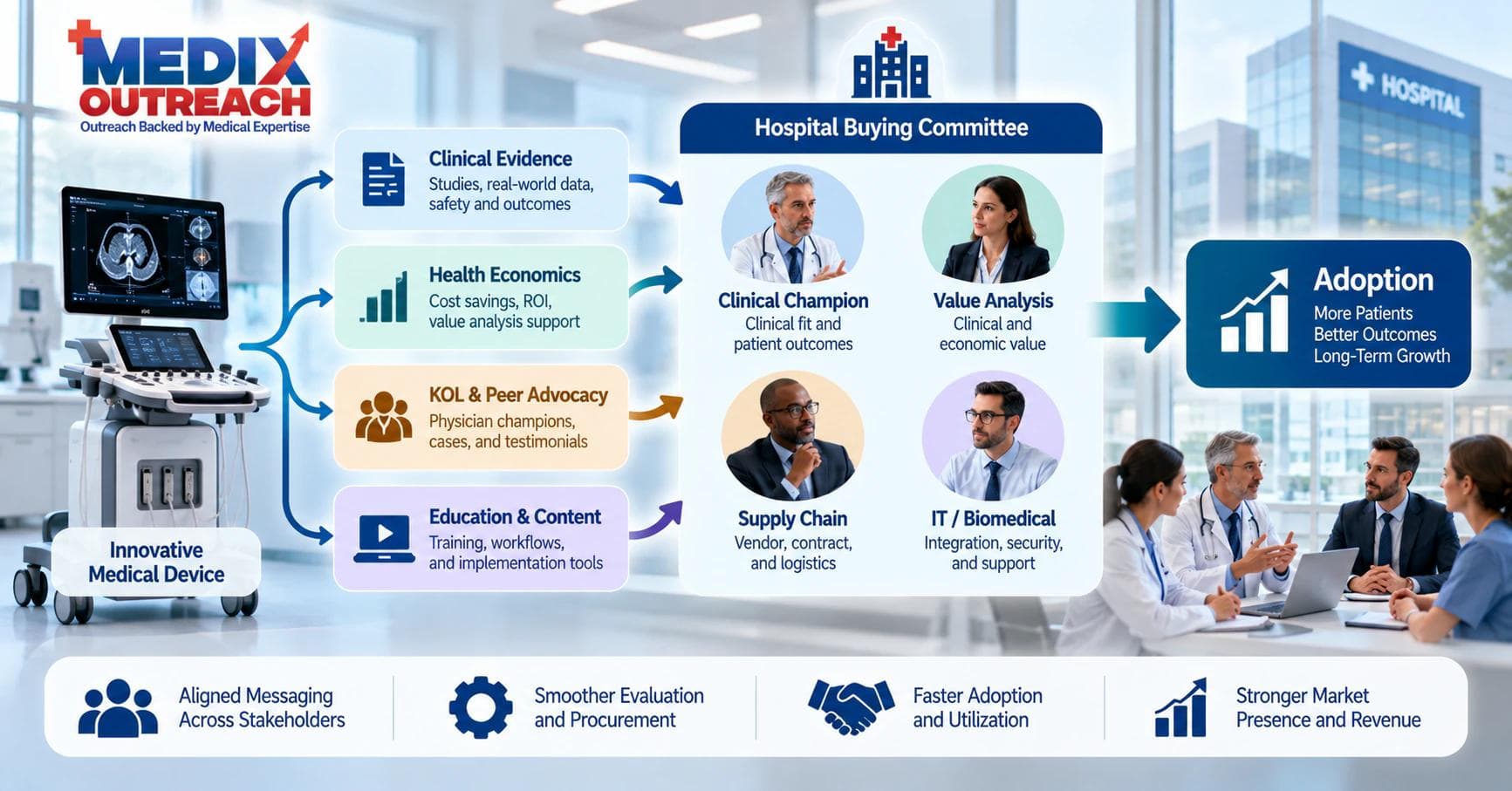
- The buyer is a committee, not a person. A clinician champion, a department head, value analysis, supply chain, and often IT and security all weigh in. Marketing has to speak to each, the dynamic Medix details in the guide to how hospitals buy.
- Evidence is the product. Clinical data, outcomes, and economic proof matter more than features. "Faster, better, cheaper" without evidence is noise to this audience.
- Peer validation drives decisions. Clinicians trust other clinicians. Key opinion leaders, references, and real-world experience move adoption more than advertising.
- Promotion is regulated. Device claims must be consistent with the cleared or approved labeling; off-label promotion is a serious compliance risk.
Start with positioning built on evidence and economics
Before any campaign, marketing has to answer three questions crisply, for each buyer in the committee:
- What clinical problem does this device solve, and what is the evidence? Outcomes, safety, and the strength of the data behind the claim.
- What is the economic case? Reimbursement pathway, total cost, and the budget it protects or the revenue it supports — the value-analysis committee's core question.
- What does adoption actually require? Training, workflow change, and implementation effort, framed honestly.
Positioning that answers all three is the foundation. Everything downstream — content, sales enablement, campaigns — is just distributing that message to the right buyer at the right stage. This is where clinical credibility becomes a go-to-market asset, not a nice-to-have.
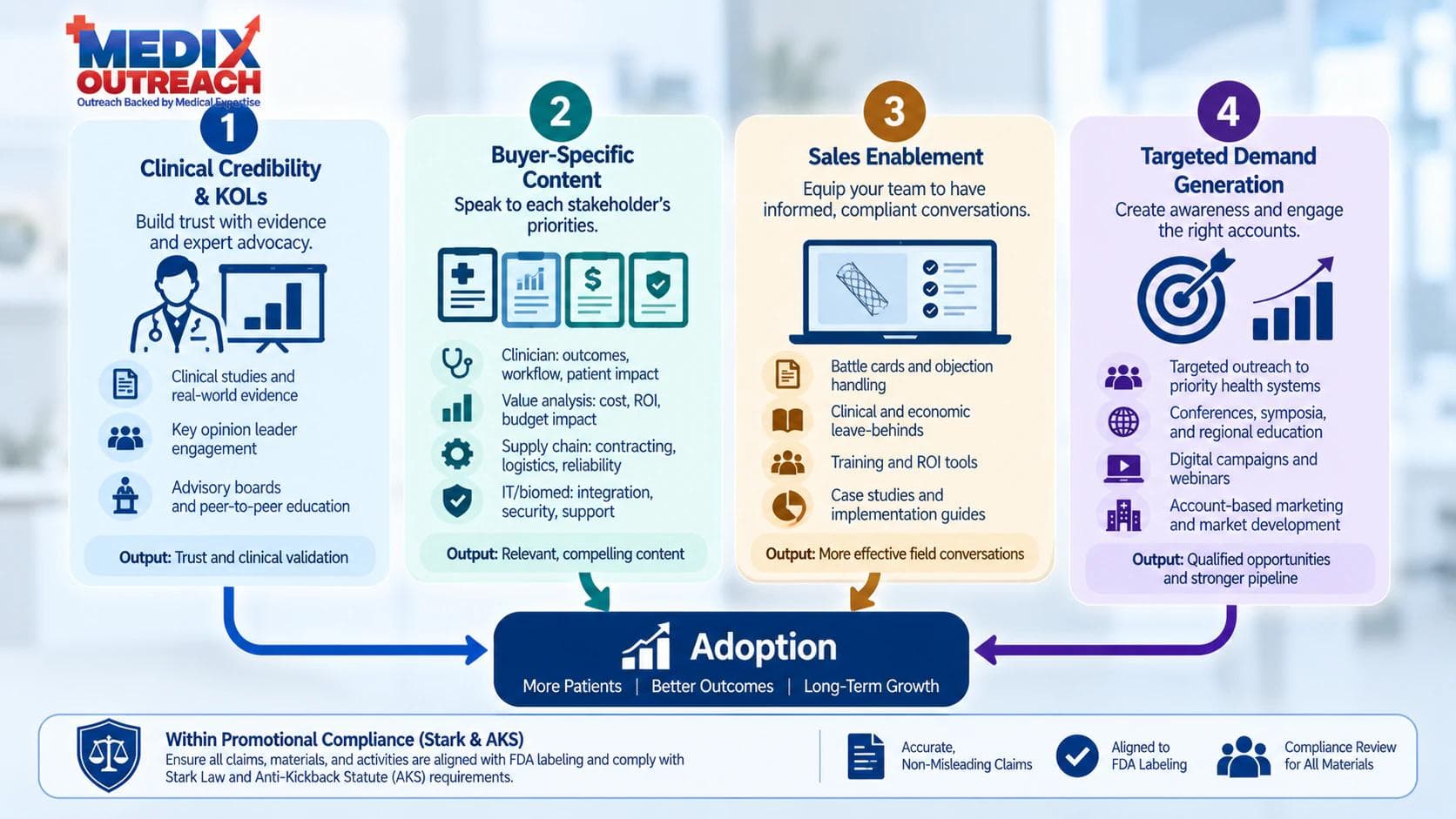
The device marketing engine, buyer by buyer
Build clinical credibility and KOLs
Evidence generation, publications, podium presence at the right congresses, and structured KOL and advisory relationships are the highest-trust marketing a device company can do. They create the peer validation that committees look for. This is a deliberate program, covered in the Medix KOL and medical advisory board strategy.
Create content that each buyer needs
Different buyers need different proof: clinical evidence summaries for the champion, economic and reimbursement models for value analysis, security documentation for IT, and implementation guides for operations. Device content marketing is about equipping the committee, not generating clicks — the approach in healthcare content marketing. Note that for connected devices, cybersecurity documentation is now a routine buying requirement, as covered in medical device cybersecurity as a sales requirement.
Enable the sales team to sell to a committee
Marketing's output is only as good as the sales team's ability to use it. Give reps the evidence, economic models, objection handling, and champion-enablement tools to carry the message into rooms marketing will never enter.
Generate demand against a defined account list
Device demand generation works best as targeted, account-based outreach to the specific hospitals, systems, and specialists that fit — not broad advertising. See how it connects to pipeline in healthcare demand generation.
Mid-article CTA
Need help building your healthcare growth engine?
Medix helps healthcare startups, clinics, pharma companies, and provider-focused platforms build scalable commercial pipelines.
Book a Strategy CallMarket within the rules
Device promotion is regulated, and compliance is part of strategy, not an afterthought.
- Keep claims consistent with the labeling. Promotion must align with the device's cleared or approved indications; review FDA guidance via Device Advice and device labeling requirements.
- Substantiate every claim. Comparative and performance claims need evidence; the FTC's standards apply alongside FDA rules.
- Route promotional materials through review. A disciplined marketing/regulatory review process keeps campaigns moving without creating liability.
Measure adoption, not just MQLs
- Evaluations and pilots initiated at target accounts — the real top of the device funnel.
- Committee progression — value-analysis submissions, approvals, and time-to-decision.
- New accounts adopting and utilization per account — adoption and depth, not just logos.
- Influence of KOL and evidence assets on won deals.
Lead counts flatter a report; adoption and utilization pay for the company.
Frequently asked questions
What is a medical device marketing strategy? A plan to build the clinical evidence, economic case, peer validation, and buyer-specific content that drive a device's adoption — aimed at the hospital or specialty buying committee, and executed within FDA and FTC promotional rules. It is broader than lead generation and distinct from the overall go-to-market motion.
How is medical device marketing different from other B2B marketing? The buyer is a clinical committee, evidence matters more than features, peer and KOL validation drive decisions, and promotion is regulated and must stay consistent with the device's labeling.
What is the biggest mistake in MedTech marketing? Optimizing for leads instead of adoption. A full pipeline that never clears value analysis is a marketing failure. Strategy should target evaluations, committee progression, and utilization.
Do medical device marketing claims need FDA review? Promotional claims must be consistent with the device's cleared or approved labeling, and companies should route promotional materials through a marketing/regulatory review process. Off-label promotion is a significant compliance risk.
Marketing that drives adoption, not just leads
A strong medical device marketing strategy is an adoption engine: evidence-based positioning, clinical credibility and KOLs, buyer-specific content, enabled sales, and targeted demand — all compliant and all measured against adoption. MedTech companies that build that engine convert clearance into clinical uptake, while competitors keep filling a pipeline that stalls at the committee.
Medix Outreach helps MedTech and healthcare companies build commercial engines that drive clinical adoption. To build a device marketing strategy that moves committees, book a free strategy call or explore our Healthcare Commercial Growth & Go-to-Market service.